Justice (Sandel) Ep 11, Claims of Community — notes and timestamps
Watch the video (55 min)
Watch the original video on YouTube
Episode 11 of Michael Sandel’s Justice course presents the communitarian challenge to Kantian and Rawlsian liberalism. Part One sets out Alasdair MacIntyre’s narrative conception of the self and asks whether there is a third kind of obligation, one of solidarity or membership, that we never consented to. Part Two stages a debate between critics and defenders of patriotism, tests loyalty against justice with three hard cases, and ends with the danger of making justice relative to tradition. It follows directly from the “is the right prior to the good?” question at the end of Episode 10, and uses Kant’s idea of autonomy from Episode 6. The course index lists every episode.
Key takeaways
- Two ideas of freedom are in play: Aristotle’s, realising your potential in roles that fit you, and Kant’s, autonomy as acting on a law you give yourself (2:25).
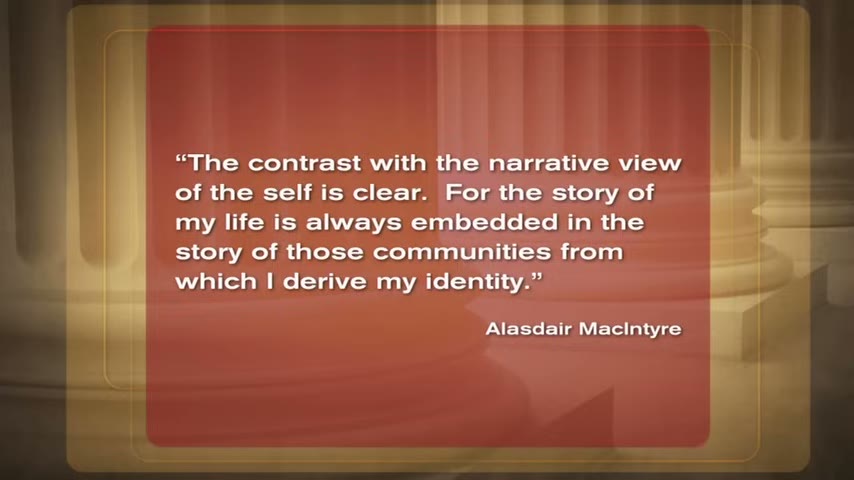
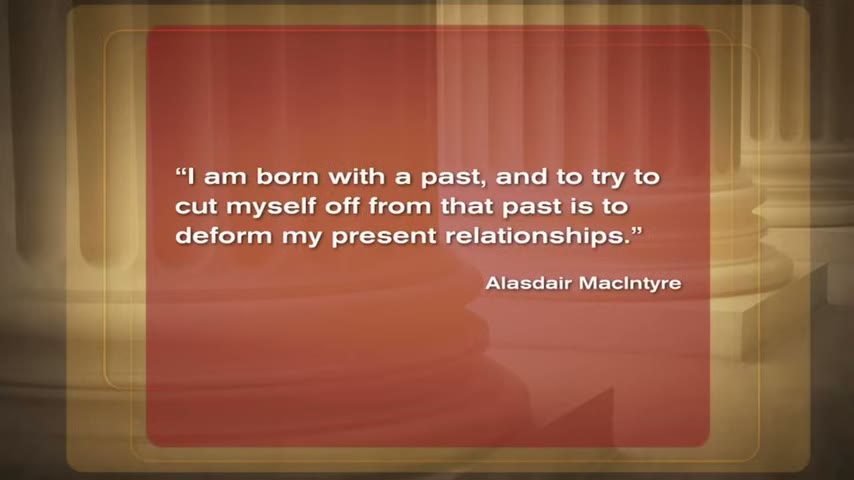
- MacIntyre says we are storytelling creatures whose obligations come partly from the family, city and nation whose stories we inherit (5:35).
- Liberals recognise two kinds of obligation, natural duties and voluntary obligations; communitarians add a third, obligations of solidarity or membership (11:04).
- The real test of loyalty is a case where it competes with universal justice, not one where it merely expresses it (37:40).
- Bulger and Lee chose family and home over a wider cause. The communitarian claim is that we can see these as moral dilemmas only if loyalty has moral weight (41:33).
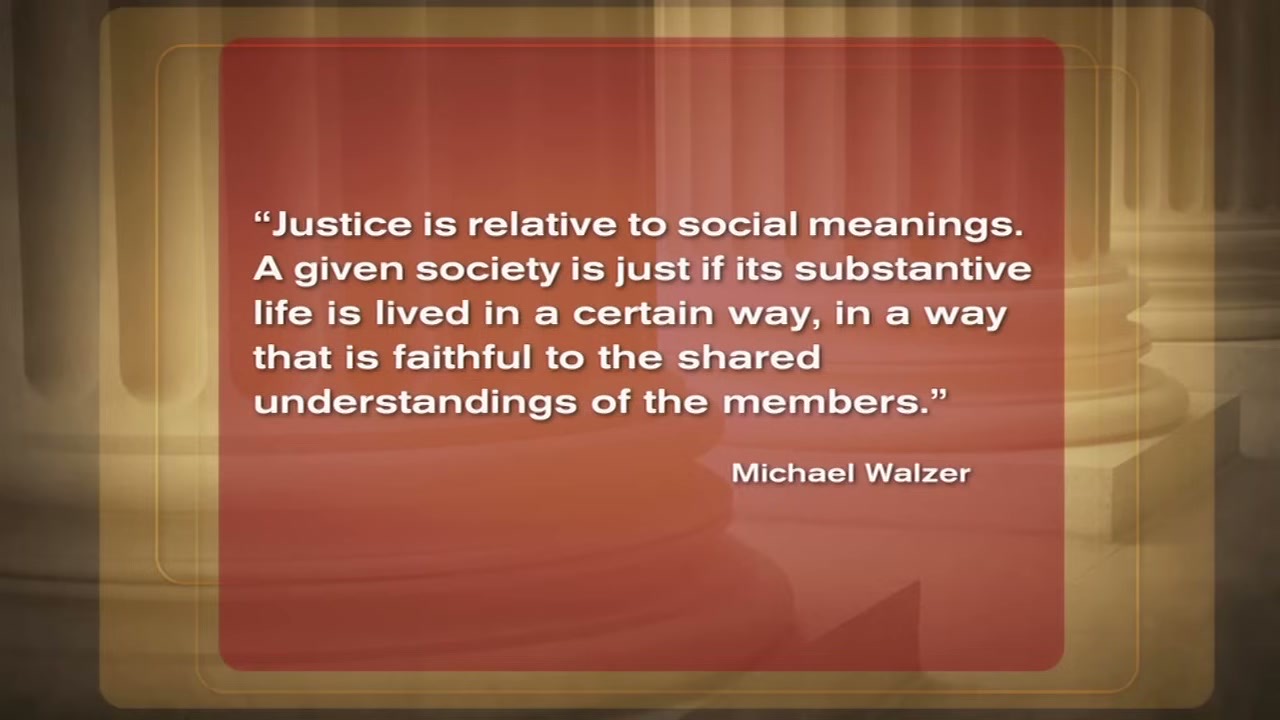
- The risk is relativism: if justice is fidelity to shared understandings, segregationists can appeal to tradition too (50:04).
Chapter notes
Part One
0:30 – 4:44 Aristotle, Kant and the unencumbered self
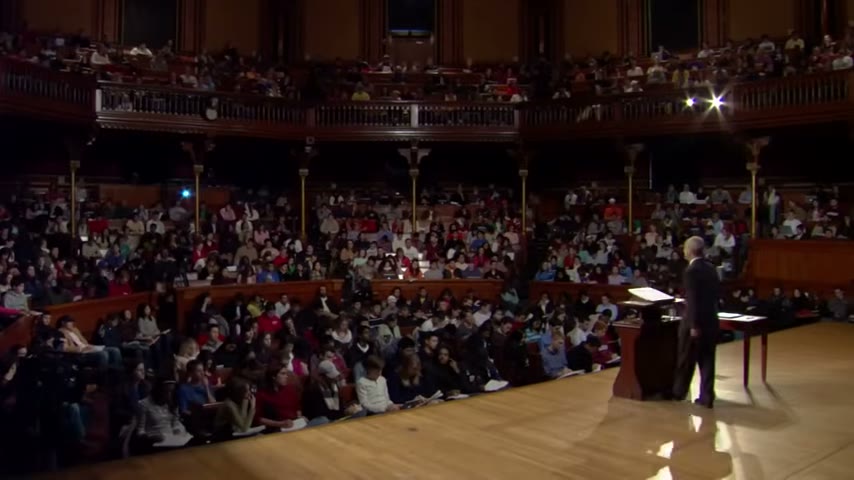
Sandel lines up the two traditions. For Aristotle, law exists to shape character and make a good life possible. For Kant, a constitution should set up a fair framework of rights within which people pursue their own conceptions of the good, because basing law on one way of life risks coercion. Underneath that lies a disagreement about freedom. Aristotle’s freedom is realising your potential in a role that fits you; Kant’s is autonomy.
The Kantian picture of a free, independent self that chooses its own ends is liberating. It says we are bound by no ties of history, tradition or inherited status that we did not choose. The communitarian critics grant its appeal but say it misses part of moral experience: the obligations of membership, loyalty and solidarity that we commonly recognise and even admire.
4:44 – 10:18 MacIntyre’s narrative self
MacIntyre’s alternative starts from the idea that people live their lives as stories.

We approach life as bearers of particular identities: someone’s son or daughter, a citizen of this city, a member of this nation. From those roles we inherit debts, expectations and obligations that form the moral starting point of a life. The self is to some extent “encumbered” by its history.
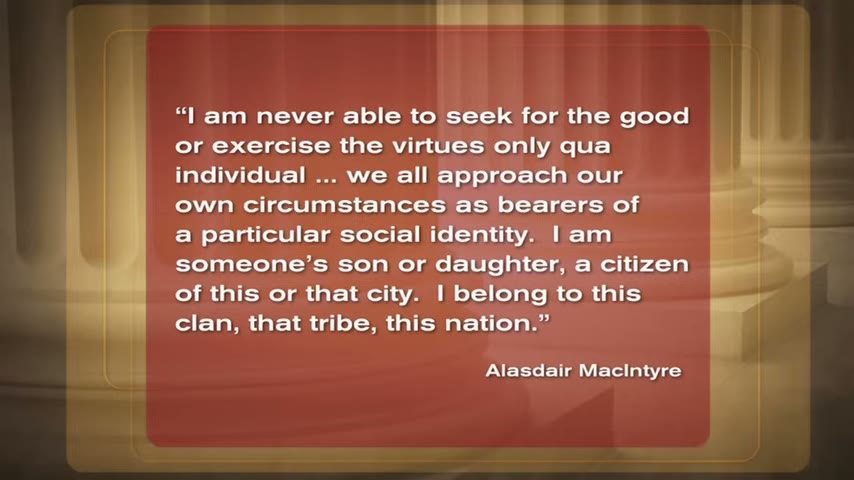
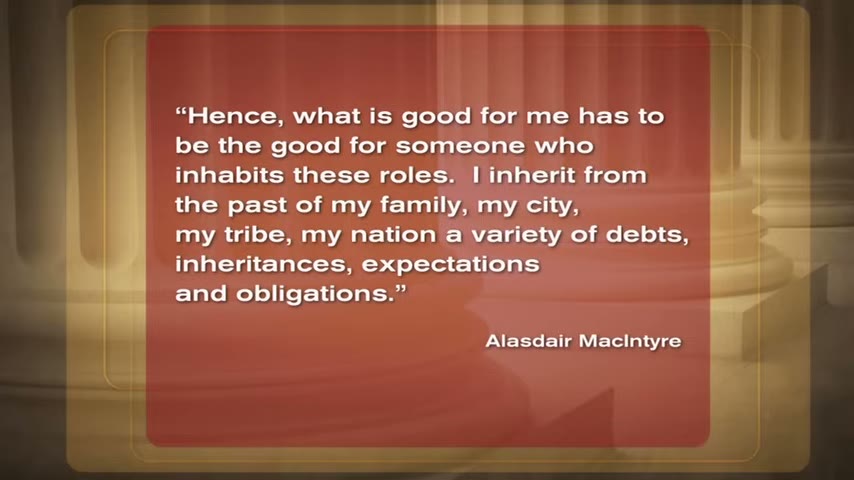
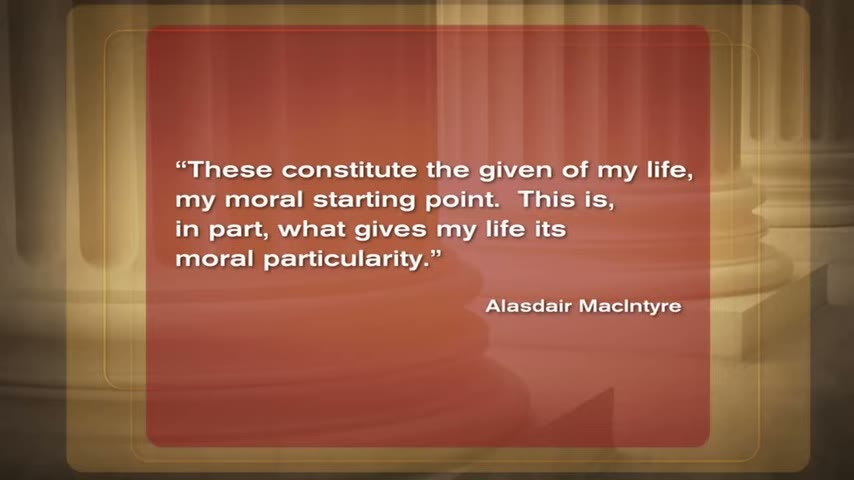
MacIntyre says individualism produces a kind of moral blindness. His examples are the American who denies any responsibility for the effects of slavery on the grounds that he never owned slaves, and the young German who thinks being born after 1945 makes the Nazi past irrelevant to his relationships with Jewish contemporaries. MacIntyre calls such historical amnesia a moral abdication. This is the collective-responsibility question that Sandel set aside in the affirmative-action debate in Episode 9.
10:18 – 12:43 Three kinds of obligation
On the liberal view, obligations come in two kinds:
| Kind | Who is owed | Source |
|---|---|---|
| Natural duties | Every human being as such | Respect for persons; universal |
| Voluntary obligations | Particular others | Consent: a promise, deal or contract |
| Obligations of solidarity or membership (communitarian addition) | Particular others: family, community, nation | Membership and shared history; not consent |
The communitarian claim is that the third row exists. These obligations carry moral force because living by them is part of understanding ourselves as the particular people we are.

12:43 – 17:23 Test cases: family, resistance pilots, airlifts and borders
Sandel offers a sequence of cases, starting easy and getting harder:
- Two drowning children, one yours. Flipping a coin would seem morally obtuse.
- Two aging parents, one yours. Children never chose their parents, so consent cannot explain the stronger duty.
- A French Resistance pilot in the Second World War refuses to bomb his own home village, though he supports the cause and does not dispute the target.
- The Israeli airlift of Ethiopian Jews during a famine: a special obligation of solidarity, or troubling partiality?
- Franklin, Texas and Franklin, Mexico, on either side of the Rio Grande: do Americans owe more to needy people on their own side of the border?
If we admire the pilot, the communitarian says, it is because we do recognise obligations of solidarity. Patriotism, on this view, can be a virtue because it expresses the obligations of citizenship.
17:23 – 23:56 First reactions: conflict, the human community, and sentiment
A show of hands finds sympathy on both sides. The critics raise three lines:
- Patrick: if obligations flow from membership, they will often conflict, and the theory gives no way to choose. Nikola answers that humanity, the widest community, should take precedence. Patrick replies that one could just as well start from the smallest, the family.
- Elizabeth: family ties may be natural, but citizenship is a constructed and false narrative. Which side of the river you were born on is an accident.
- Rina: patriotism is like the instant pride students feel in their Harvard houses: sentiment, not moral obligation. Pressed on parents, she grounds the duty in reciprocity, noting that people usually feel more obligation to the adoptive parent who raised them.

Rina’s adoption point is a good example of the liberal strategy the next lecture examines: translating an apparent obligation of membership into reciprocity, which liberals can accept.

Part Two
24:28 – 29:58 The strongest objections, organised
Sandel groups the criticisms. Obligations of membership may conflict (Patrick). They may be sentiment rather than obligation (Rina). Or they may be real but fully explained by liberal ideas, consent or reciprocity (Julia). He notes that Julia’s view matches Rawls, who says that apart from people who volunteer, for example by running for office or enlisting, citizens generally have no political obligation, because it is unclear what binding act they performed. A related view allows loyalty to family or country as long as it never requires violating universal duties. A last objection is that membership obligations are just collective selfishness.

He then forms the critics into a team at the front of the hall to face the defenders.
29:58 – 37:40 The patriotism debate
- Ajay: loving his country more than humanity is no more prejudice than loving his parents more than other people’s. His country is part of his identity, and patriotism includes the right to object.
- A German student: had he been born 80 years earlier he would have been a citizen of Nazi Germany, and he does not think he would have owed it loyalty.
- A critic citing Locke: a moral obligation to a society you never chose would be a “blank moral check” to an unknown body. Obligation should rest on reciprocity: we owe what we receive in protection and security.
- Rahul: patriotism is not a blank cheque; you can love your country and oppose its government, and abandoning patriotism hands the field to fundamentalists.
Sandel presses the defenders: if patriotism is only loyalty to principles of justice your country happens to embody, and you may reject it when it fails them, what is left of loyalty? Julia agrees that this thin patriotism undercuts its value as a virtue.
37:40 – 41:33 The real test: Dan’s roommate
Sandel states the test the communitarians must pass. They need a case where loyalty competes with, and may outweigh, a universal principle of justice. Dan offers one: if he saw his roommate cheating on a problem set, he would not turn him in, and he thinks that would be right. Sandel calls it a harder but truer test. One student says loyalty would win but it would still be the wrong choice. Another argues that a roommate has inside information that would be unfair to use. Many in the room side with Dan.
41:33 – 45:24 Billy Bulger and Robert E. Lee
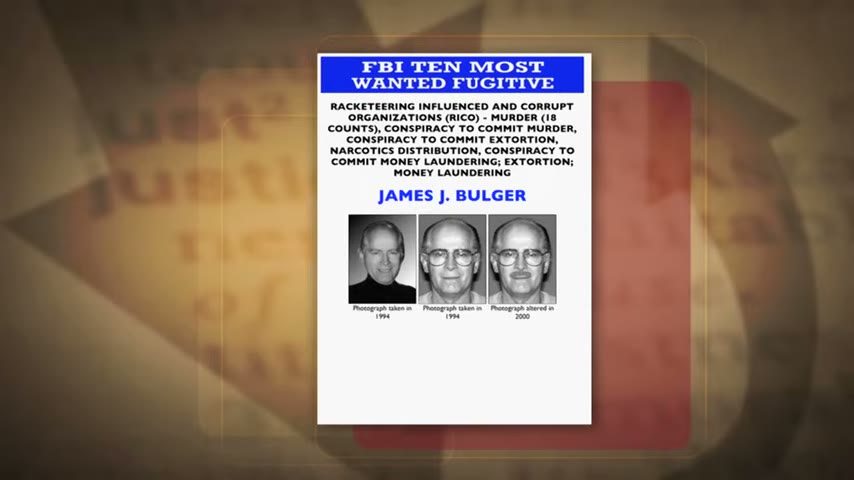
Sandel raises the stakes with two public cases. Billy Bulger, once president of the Massachusetts State Senate and then of the University of Massachusetts, was called before a grand jury and asked about his brother Whitey, an alleged gang leader on the FBI’s most wanted list. He refused to help, saying he had a loyalty to his brother.

Then Robert E. Lee. On the eve of the Civil War he was a Union officer who opposed secession, and Lincoln offered him command of the Union army. He refused and returned to Virginia.

45:24 – 49:15 How should loyalties be ranked?
Julia says these cases show why choice must matter: when communities conflict, you need grounds other than the accident of membership. Sandel replies that everyone agrees a choice is made; the question is on what principle. Andre spots a pattern: in all three cases the person picked the more local community, family over the Commonwealth, state over nation. Samantha answers that in the Civil War brothers chose both ways, so communitarians have no single standard. Sandel notes the class now has three rival ranking rules: Nikola’s (most universal first), Andre’s (most local first) and Samantha’s (scale cannot decide), so some further moral judgment is needed.

49:15 – 53:59 Does justice become relative?
The deepest worry behind these objections is about justice itself. If the priority of the right over the good fails and justice depends on conceptions of the good, does it reduce to whatever a community happens to value?
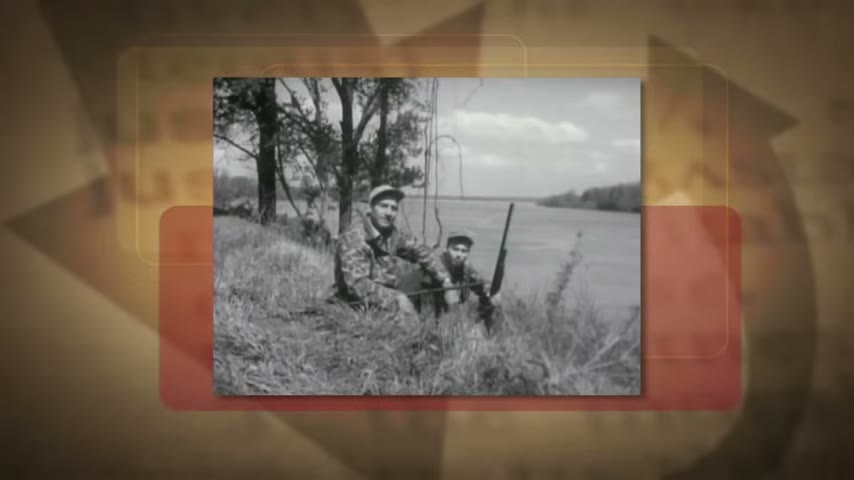
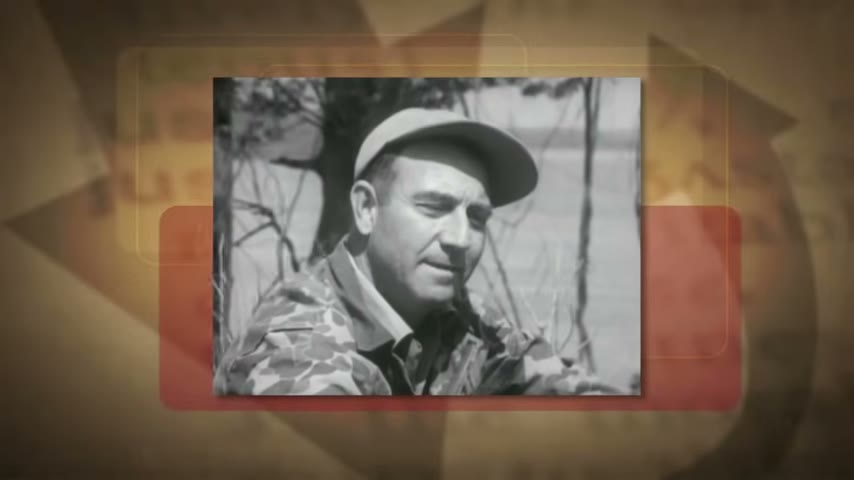
Sandel then shows a short clip from the documentary Eyes on the Prize: white Southerners in the 1950s defending segregation as their tradition and way of life. They are situated, narrative selves appealing to history. Does that show justice cannot be tied to a community’s shared understanding of the good, or can the claim be rescued? He leaves the question for Episode 12.
Skip list
- 0:00 – 0:30 Funding credits.
- 23:56 – 24:28 Trailer for Part Two (Dan’s roommate example, which appears in full at 38:29).
- 29:58 – 30:45 Sandel walks down and the critics gather as a team; logistics only.
- 53:59 – 55:10 Website promo and closing credits.
Glossary
- Communitarianism — the view that the self and its obligations are partly constituted by the communities it belongs to.
- Unencumbered self — the Kantian and Rawlsian picture of a person free of any moral ties they did not choose.
- Narrative conception of the self — MacIntyre’s view that we understand what to do by understanding the stories we are part of.
- Natural duties — universal obligations owed to all persons as such.
- Voluntary obligations — obligations to particular others that arise from consent.
- Obligations of solidarity / membership — particular obligations arising from belonging, not from consent.
- Reciprocity — owing something in return for benefits received; a liberal way to explain apparent loyalties.
FAQ
What is the narrative conception of the self?
It is Alasdair MacIntyre's view that people are storytelling creatures who can only decide what to do by first knowing which stories they are part of: their family, city, nation and history. On this view some obligations come with those stories rather than from consent.
What are obligations of solidarity?
They are a third kind of moral obligation, alongside universal natural duties and voluntary obligations we agree to. They arise from membership in a family, community or nation and are not traceable to consent.
Why does Sandel discuss Billy Bulger and Robert E. Lee?
Both chose loyalty to family or home over a wider claim of justice. Bulger refused to help find his fugitive brother, and Lee declined to lead the Union army against Virginia. Sandel uses them to test whether loyalty can carry moral weight against universal principles.
What is the main problem with tying justice to community?
If justice simply means faithfulness to a community's shared understandings, as Michael Walzer suggests, then segregationists defending their way of life could claim justice too. Sandel leaves that challenge open for Episode 12.
Studying another course? Paste its YouTube or Bilibili link on the home page to request a handout — or make your own with the desktop app (coming soon).