Justice (Sandel) Ep 3, Free to Choose — notes and timestamps
Watch the video (55 min)
Watch the original video on YouTube
Episode 3 of Michael Sandel’s Harvard course turns from utilitarianism to its strongest opponent on rights: libertarianism. Part One sets out Robert Nozick’s view and follows his argument from “taxation takes my earnings” to “I own myself”. Part Two is a live debate: three student volunteers defend libertarianism against the class. Watch Episode 2 first, because this lecture starts from the problems Mill could not solve. For the full course map, see the course index.
Key takeaways
- Mill’s defence of rights may protect people for the wrong reason (2:43). If rights only matter because they pay off in the long run, they can be dropped whenever they don’t.
- Libertarianism rules out three kinds of law: paternalism, morals legislation and redistribution (7:43).
- For Nozick, justice depends on history, not on the final pattern (11:41). Fair acquisition plus free transfer means the result is just, however unequal.
- The core chain: taxation → taking my labor → forced labor → slavery (22:17). To reject the conclusion you must break a link.
- Everything rests on self-ownership (24:57), the idea that each of us is the proprietor of our own person.
- The class debate keeps returning to that premise (48:41). Sandel ends by sending the question to John Locke, where the idea comes from.
Chapter notes
0:29 – 5:31 Why Mill is not enough
Sandel sums up the two weak points left by Episode 2. The Simpsons/Shakespeare experiment showed a gap between what people enjoy and what they rank as higher. And Mill’s case for rights depends on the long run.
He presses the second point with the organ-transplant case. A doctor who takes a healthy patient’s organs to save five would, in the long run, scare people away from checkups. But is that the only reason the doctor shouldn’t do it? Most people feel the real reason is respect for the person, not a forecast of bad effects. If so, we need a theory where individuals are “separate beings with separate lives” (5:59), not inputs to be added up.
5:31 – 11:14 Libertarianism and the minimal state
Libertarianism takes rights seriously by making liberty the basic right (5:31): we may live as we choose, provided we respect others’ right to do the same. Nozick puts it bluntly: individual rights are so strong that they raise the question of what the state may do at all.
Three common kinds of law fail that test:
- Paternalist legislation — seat-belt and helmet laws. Wearing a seat belt may be wise, but forcing it is coercion.
- Morals legislation — laws that promote virtue, such as old bans on gay and lesbian intimacy. No third party is harmed, so the state has no business here.
- Redistribution — taxing the rich to help the poor. Libertarians call it theft by the state, or by the majority.
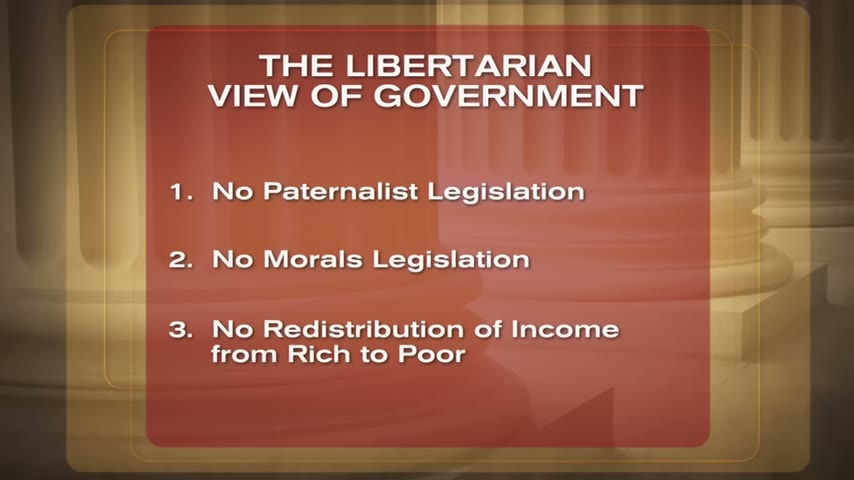
What remains is a minimal state: national defence, police, and courts to enforce contracts and property rights.
11:14 – 13:27 Nozick’s two principles
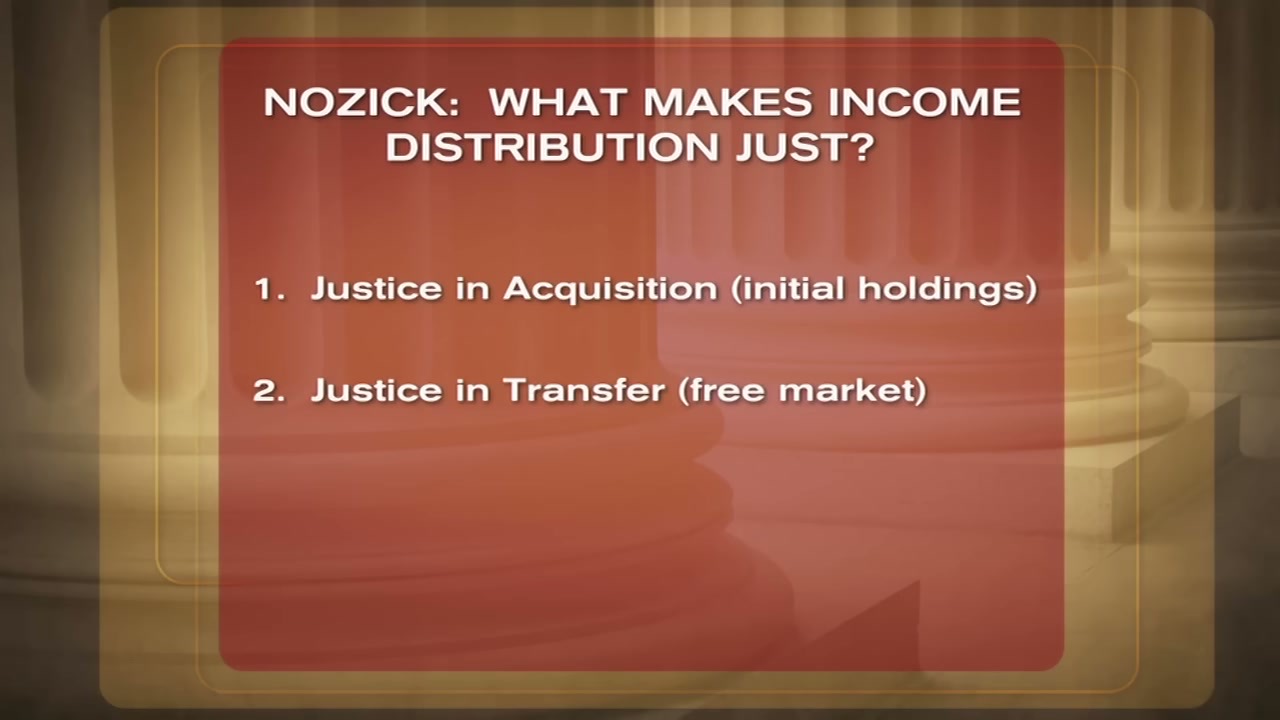
Our note: this is the most important structural idea in the episode. Utilitarians and most egalitarians judge end states (who has what). Nozick judges histories (how they got it). Many later debates come down to which kind of test you think justice should use.
13:27 – 17:49 Bill Gates and Michael Jordan
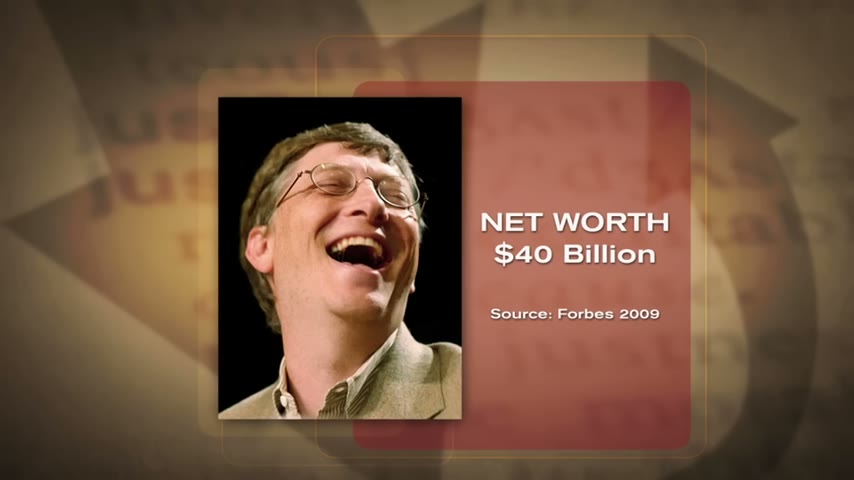
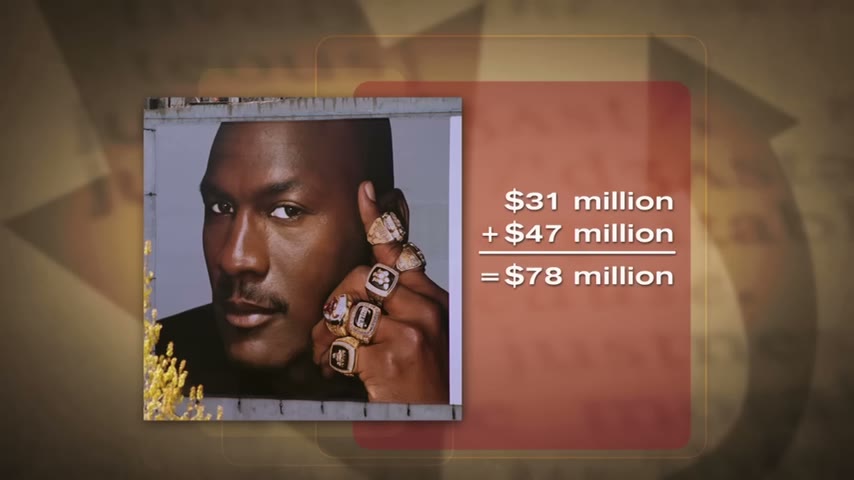
Sandel makes the stakes concrete. On one estimate Bill Gates earned more than $150 a second, so stopping to pick up a $100 bill would not be worth his time (15:10). A utilitarian would redistribute at once: he would barely notice, and the poor would gain a great deal. Michael Jordan’s slide shows $31 million in salary plus $47 million in endorsements in one year. On the libertarian view, if this was earned fairly, taxing a third of it for good causes is coercion and violates his rights.
17:49 – 21:47 First reactions: skateboards and fair starts
- A critic argues Jordan received “a larger gift from the society” and owes more in return; a laundry worker may work as hard (17:49).
- Joe, a self-described collector of skateboards, defends libertarianism. If 99 people take 99 of his 100 skateboards, that is theft. He allows that in an emergency such as the lifeboat, injustice might have to be tolerated, but it is still theft.
- A reply: the government is not taking 99 out of 100; it is taking some of what you could never use. Without some redistribution, people who start at the bottom never get a fair chance. Sandel names this the equality-of-opportunity worry.
21:47 – 27:08 Taxation, forced labor and self-ownership
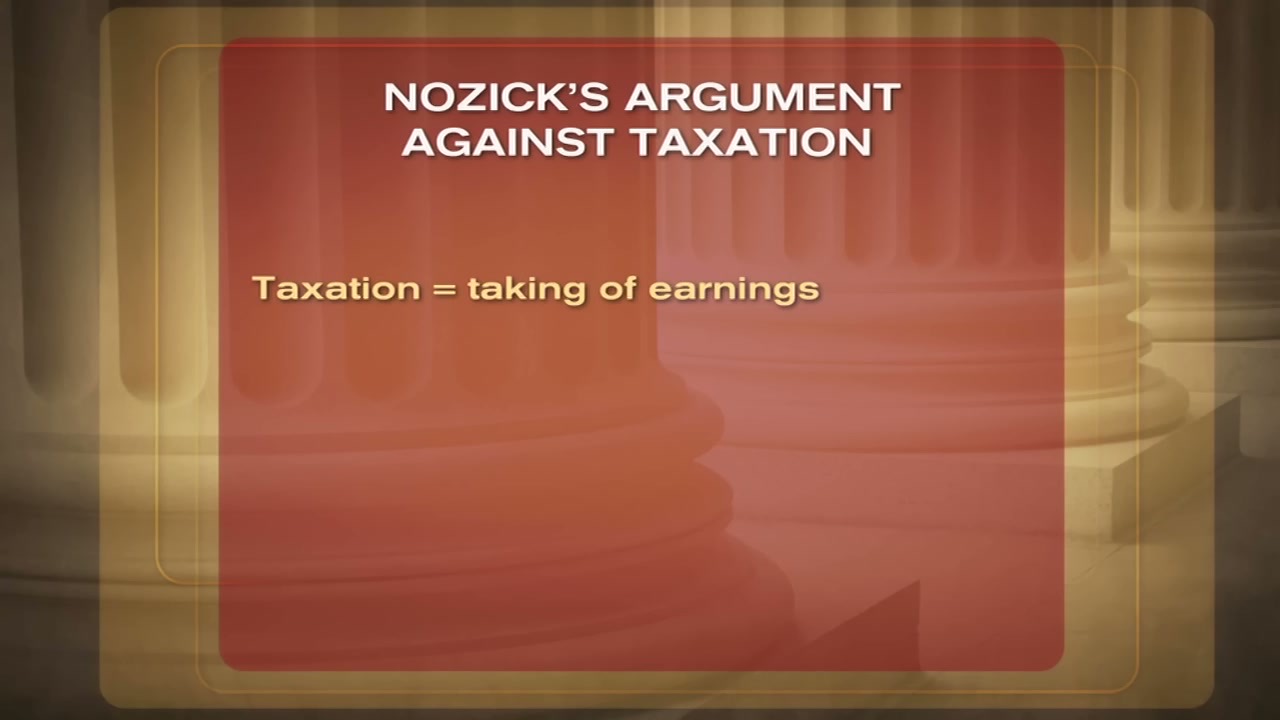
Nozick goes further than Joe. Taxation takes the fruits of my labor. If the state may claim the fruits, it effectively claims some of my hours, which makes taxation morally equivalent to forced labor. Forced labor means someone else partly owns me, which is slavery. The principle underneath is self-ownership: “we are the owners or the proprietors of our own person” (25:25).
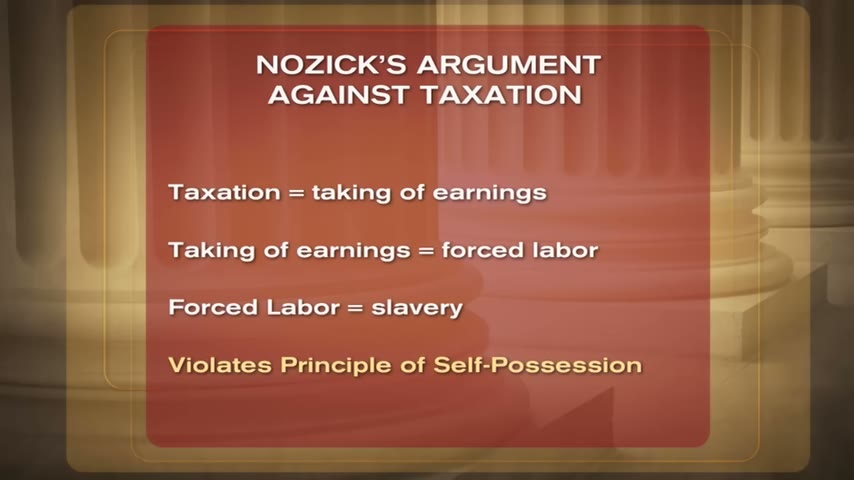
Sandel shows how far the principle reaches. It explains why taking the healthy patient’s organs is wrong, why paternalism is wrong, and why redistribution is wrong, even to help victims of Hurricane Katrina. Taxing Jordan is, morally, like ordering him to skip next week’s games to help with flood relief. If you reject the conclusion, you must break the chain somewhere.
27:53 – 31:47 Part Two: Friedman and the private fire company
Part Two opens with two illustrations of how far the minimal state goes. Milton Friedman counts Social Security as paternalism: people should be free to save for retirement or not. And collective goods can sometimes be made private. Sandel tells of the Salem Fire Corporation in Arkansas, a subscription service whose crew watched a non-subscriber’s house burn, only making sure the fire didn’t spread to members (30:23).
31:47 – 38:53 Team libertarian answers objection 1
Three volunteers, Alex Harris, John Sheffield and Julia Roto, form “team libertarian” to answer the class’s objections.
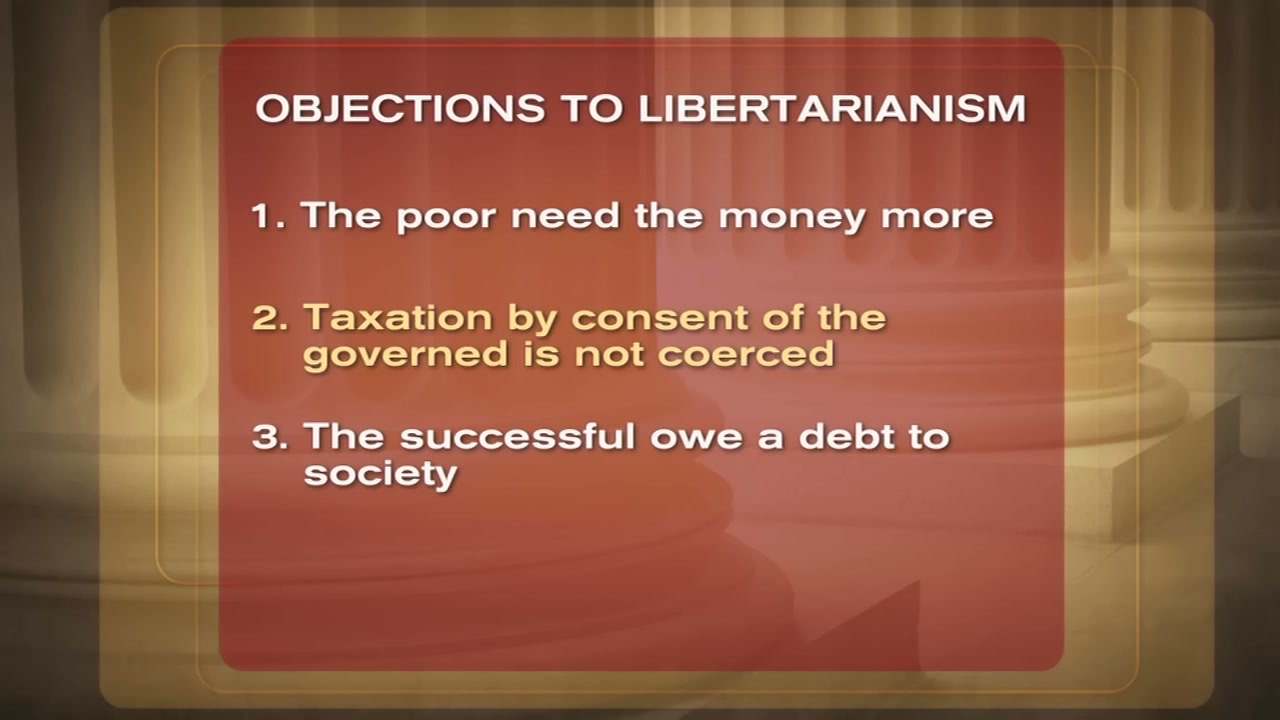
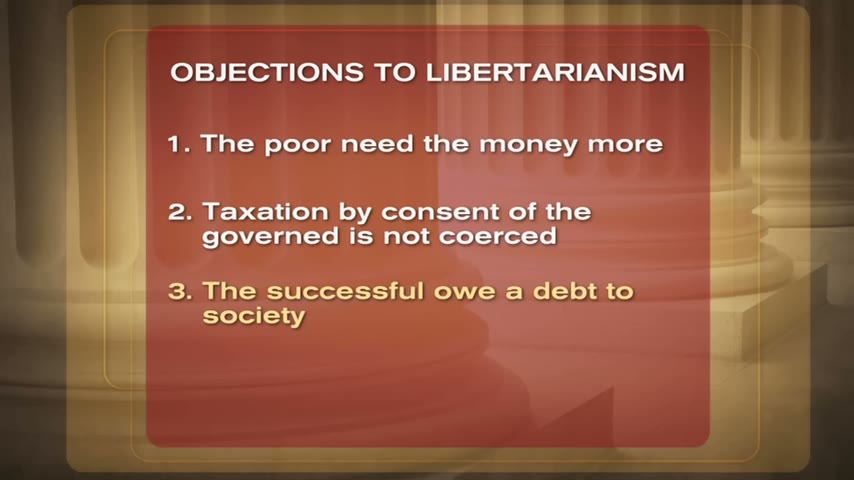
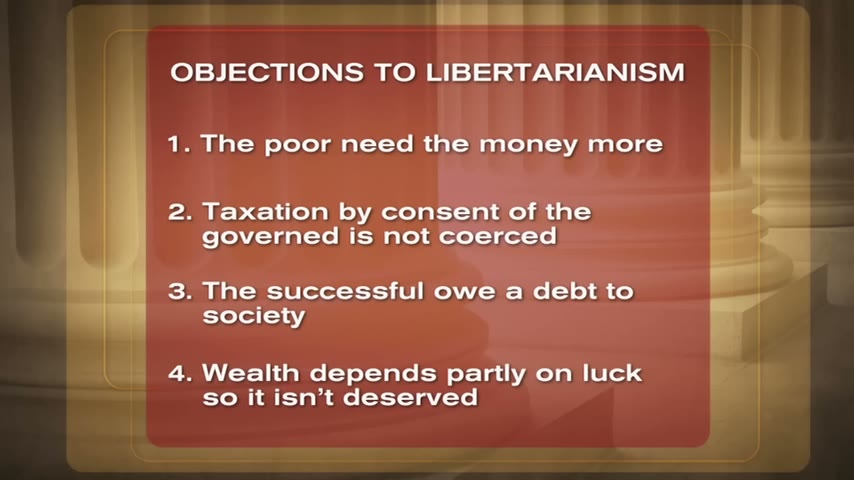
Objection 1: the poor need the money more. John answers that a good outcome does not justify violating a right derived from self-ownership; Bill Gates is free to give to charity. Julia adds a distinction between need and desert: the poor may need help without deserving the proceeds of a tax on Jordan. Pressed on Katrina victims, she holds to it, while admitting there is a need for help.
38:53 – 46:53 Objection 2: democracy and consent
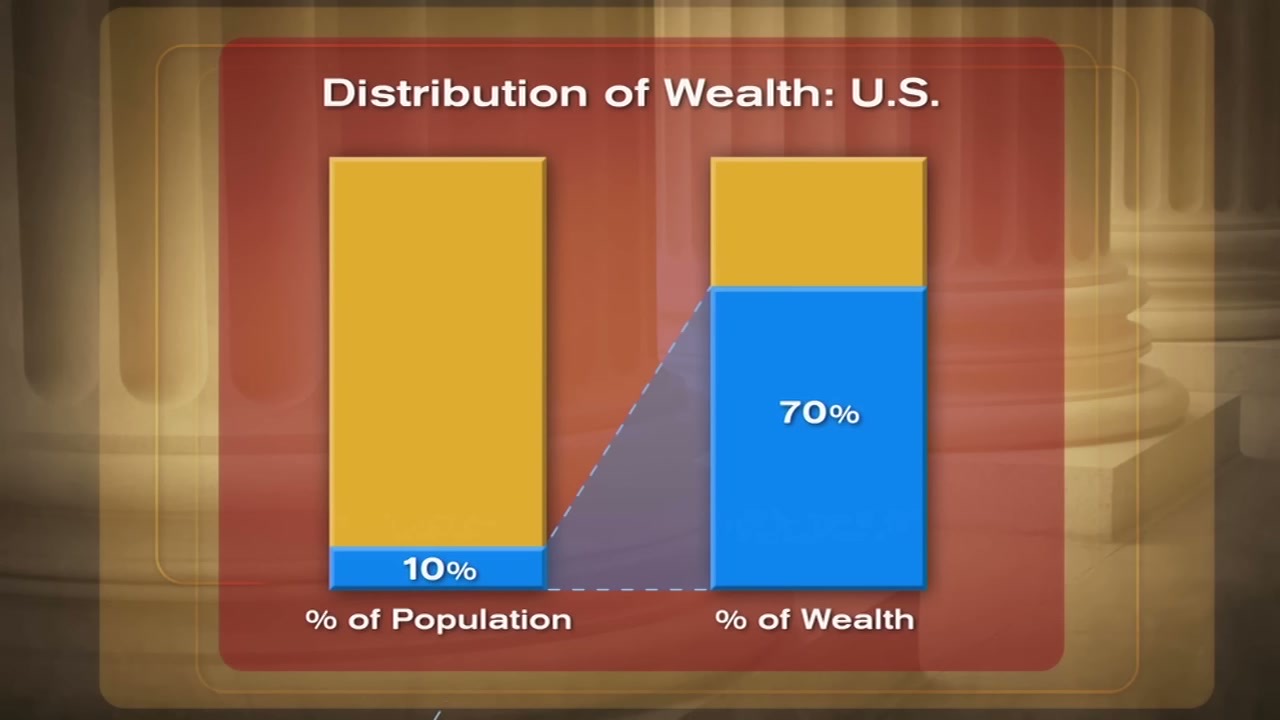
Raul argues that property rights are defined and enforced by a democratic government, so taxation passed by elected representatives has the consent of the governed (38:53). John replies that democracy is not “mob rule”: the middle 80% should not decide what the top 10% owes the bottom 10%.
Alex makes the strongest libertarian move. His tiny share of a vote is not the same as his right to decide for himself. He favors a constitution that takes basic rights off the table, and he puts the right to keep one’s earnings on a par with freedom of speech and religion, both grounded in self-ownership. Anna disputes the analogy: practising religion affects no one else, but wealth depends on a stable society, and desperate poverty spills over onto others.
Sandel then asks whether it is wrong to steal a loaf of bread to feed a starving family. John says yes, it is still a violation of property. Julia says no: self-ownership includes the right to keep oneself alive. Our note: Julia’s answer shows that self-ownership can point in more than one direction.
46:53 – 49:55 Objection 3: a debt to society, and luck
Julia argues that the wealthy have already paid their debt: they did something society valued, and their teammates and coaches were paid. Victoria then questions the premise itself: living in a society means you cannot simply disregard the people around you, so you don’t fully own yourself (48:15). Alex answers the luck version of the objection: whether wealth is deserved is irrelevant; what matters is that it came through free exchange.

50:02 – 53:34 Summary: can we do without self-ownership?
Sandel’s wrap-up shows the dilemma (50:02). Most critics attack the modest link (is taxation really forced labor?). Victoria attacks the foundation. But if we give up self-ownership, do we lose our defence against using people, and end up back with utilitarianism and pushing the fat man off the bridge? Nozick took the idea from John Locke, who explained property as mixing our labor with unowned things. So Locke is next, in Episode 4.
Skip list
- 0:00 – 0:29 Funding credits.
- 13:27 – 15:37 The Bill Gates arithmetic (the Lincoln bedroom, pay per second). It only says “very rich”.
- 27:08 – 27:53 A preview of Victoria’s comment, which plays in full at 47:49.
- 33:56 – 35:18 Team libertarian assembling.
- 53:52 – end Website promo and credits.
Glossary
- Libertarianism — the view that the basic right is liberty, so the state may only protect rights and enforce contracts.
- Minimal state — a government limited to defence, police and courts, funded only for those purposes.
- Paternalism — laws that restrict people for their own good, such as seat-belt or helmet laws.
- Morals legislation — laws meant to promote virtue or express the community’s moral views.
- Justice in acquisition / transfer — Nozick’s two tests: were holdings first acquired fairly, and did they change hands by free exchange?
- Self-ownership (self-possession) — the premise that each person is the owner of their own person, labor and talents.
- End-state vs. historical principle — judging a distribution by its pattern versus by the process that produced it.
FAQ
What three kinds of law does libertarianism reject?
Paternalist laws that protect people from themselves, such as seat-belt laws; morals legislation that enforces a view of virtue; and taxation that redistributes income from rich to poor. A minimal state funding defence, police and courts is allowed.
What is Nozick's argument that taxation is like slavery?
Taxing my earnings takes the fruits of my labor, which is morally the same as claiming some of my labor itself. Claiming my labor without consent is forced labor, and forced labor means the community partly owns me. The argument rests on the premise that I own myself.
How does Nozick decide whether a distribution of wealth is just?
He looks at how it came about rather than at the pattern. If people acquired their initial holdings fairly (justice in acquisition) and all later changes came from free exchange (justice in transfer), the result is just however unequal it is.
What objections to libertarianism does Sandel's class raise?
Three main ones: the poor need the money more; taxation by an elected legislature has the consent of the governed and so is not coercion; and the successful owe a debt to the society that made their success possible. A fourth student, Victoria, questions whether we really own ourselves at all.
Studying another course? Paste its YouTube or Bilibili link on the home page to request a handout — or make your own with the desktop app (coming soon).