Sapolsky's Human Behavioral Biology (Stanford): lecture guide and study notes
Body and brain run in a loop (6:00). What happens in the body can change behavior, and a thought can change heart rate. The course is about that two-way traffic.

Behavior obeys the same optimization logic as anatomy (6:19). A giraffe's heart is exactly as big as the equations predict because a giraffe with a smaller one could not exist. Sapolsky's claim is that social behavior can be predicted the same way.
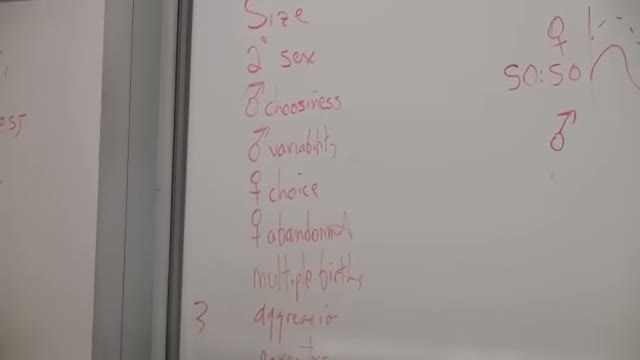
Infanticide follows a predictable rule (15:44). It shows up in species where a female's interval between births is longer than a dominant male's typical tenure, which makes killing a rival's infants pay.
Classical mutations change how well one protein does its job (23:20). Point mutations, insertions and deletions alter a protein's shape, and with it how well its key fits its lock.
Micro vs. macro is the organizing contrast (19:02). Microevolution tunes how an existing protein works; macroevolution changes which proteins are made, when, and in which networks, the lecture's "if-then clauses".
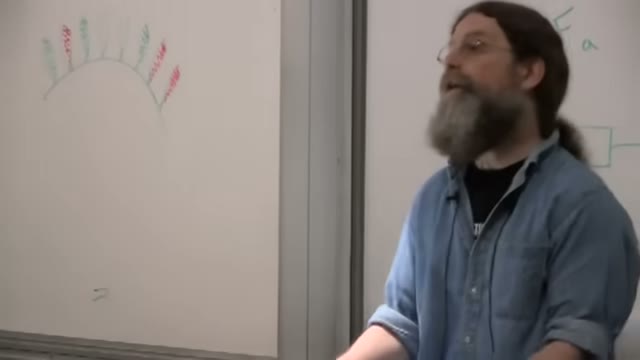
Every classic method depends on an "equal environments" assumption, and each one breaks (7:29). Identical twins are treated more alike than fraternal twins, and boys and girls are handled differently within minutes of birth.
Watch the video
Watch the original video on YouTube
Human Behavioral Biology is Robert Sapolsky’s undergraduate course at Stanford (Bio 150), published by Stanford on YouTube as 25 lectures. Its question is how to explain a human behavior, such as an act of aggression or a choice of partner, when evolution, genes, hormones, brain circuits and upbringing all have a claim on the answer. Sapolsky’s method is to teach each of those explanations in turn, and then show why none of them works alone.
It suits anyone who has read popular neuroscience and wants the full argument, delivered with Sapolsky’s anecdotes and asides. No background is needed. Our handouts give each lecture’s argument in our own words, with chapter timestamps back to the video, a list of what you can skip, and a glossary.
Lectures
| # | Video | Length | What you learn | Our handout |
|---|---|---|---|---|
| 01 | Introduction to Human Behavioral Biology | 57 min | Why body and brain shape behavior together, the three costs of thinking in categories, and why the course refuses single explanations. | Lecture 1 notes |
| 02 | Behavioral Evolution | 97 min | Why “for the good of the species” fails: individual selection, kin selection and reciprocal altruism, with the prisoner’s dilemma and tit for tat, then tournament versus pair-bonded species. | Lecture 2 notes |
| 03 | Behavioral Evolution II | 97 min | Infanticide, sex-ratio bets, genomic imprinting and group selection, then the main scientific and political critiques of sociobiology. | Lecture 3 notes |
| 04 | Molecular Genetics I | 94 min | How evolution works at the level of DNA: point mutations and gradualism, punctuated equilibrium, split genes, promoters, transcription factors and epigenetics. | Lecture 4 notes |
| 05 | Molecular Genetics II | 74 min | How changes in splicing, promoters, transcription factors and jumping genes can produce big evolutionary leaps, and the case for punctuated equilibrium. | Lecture 5 notes |
| 06 | Behavioral Genetics I | 99 min | Why twin, adoption and sex-difference studies tend to overstate genes, plus prenatal effects, the Dutch Hunger Winter and epigenetics. | Lecture 6 notes |
| 07 | Behavioral Genetics II | 93 min | The second half of the behavioral genetics unit. | Handout coming soon |
| 08 | Recognizing Relatives | 79 min | How animals and people tell kin from non-kin. | Handout coming soon |
| 09 | Ethology | 101 min | Studying behavior in its natural setting. | Handout coming soon |
| 10 | Introduction to Neuroscience I | 61 min | Neuroscience basics for the rest of the course. | Handout coming soon |
| 11 | Introduction to Neuroscience II | 73 min | Neuroscience basics, continued. | Handout coming soon |
| 12 | Endocrinology | 49 min | How hormones work. | Handout coming soon |
| 13 | Advanced Neurology and Endocrinology | 73 min | Brain and hormones together. | Handout coming soon |
| 14 | Limbic System | 89 min | The brain’s emotional circuitry. | Handout coming soon |
| 15 | Human Sexual Behavior I | 102 min | First of three lectures on sexual behavior. | Handout coming soon |
| 16 | Human Sexual Behavior II | 101 min | Sexual behavior, continued. | Handout coming soon |
| 17 | Human Sexual Behavior III & Aggression I | 97 min | The end of the sexual behavior unit and the start of aggression. | Handout coming soon |
| 18 | Aggression II | 105 min | Aggression, continued. | Handout coming soon |
| 19 | Aggression III | 101 min | Aggression, continued. | Handout coming soon |
| 20 | Aggression IV | 103 min | The last aggression lecture. | Handout coming soon |
| 21 | Chaos and Reductionism | 98 min | The limits of explaining a system by its parts. | Handout coming soon |
| 22 | Emergence and Complexity | 102 min | How complex behavior can arise from simple rules. | Handout coming soon |
| 23 | Language | 103 min | The biology of language. | Handout coming soon |
| 24 | Schizophrenia | 100 min | Schizophrenia through the course’s lenses. | Handout coming soon |
| 25 | Individual Differences | 54 min | Why individuals differ. | Handout coming soon |
How the course is built
| Block | Lectures | What it does |
|---|---|---|
| The argument | 01 | Sets out the problem: behavior has many causes, and thinking in categories hides that. |
| Evolution and genetics | 02–09 | How natural selection, genes and gene–environment interaction shape behavior, and how animals behave in the wild. |
| Brain and hormones | 10–14 | Catch-up neuroscience and endocrinology, ending with the limbic system. |
| Whole behaviors | 15–20 | Sex and aggression, explained through every lens taught so far. |
| Complexity | 21–22 | Chaos, reductionism and emergence: why the parts don’t add up to the whole. |
| Applications | 23–25 | Language, schizophrenia and individual differences. |
Suggested watching order
- Watch in order if you can. Each block depends on the last, and Sapolsky keeps returning to earlier examples.
- Short on time? Watch Lecture 1, which states the whole argument in under an hour, then the block you care about most.
- Coming from popular genetics? Read Lecture 5 and Lecture 6 together. They are the course’s case against “a gene for” a behavior.
FAQ
How many lectures are in Sapolsky's Human Behavioral Biology course?
Stanford's official playlist has 25 lectures. Most run between 75 and 105 minutes; the shortest, Endocrinology, is under 50 minutes. Together they come to roughly 36 hours of video.
Do I need a biology background to follow the course?
No. Sapolsky builds the background as he goes. Lectures 4 and 5 teach the molecular genetics the course needs, and Lectures 10 to 13 are catch-up lectures on neuroscience and hormones for students without that grounding. Watching in order helps, because the later behavior lectures lean on both.
What is the structure of the course?
It moves through a series of explanatory 'buckets': evolution, genetics and ethology first, then neuroscience and endocrinology, then whole behaviors (sex and aggression) seen through all of those lenses at once, then chaos and complexity, and finally language, schizophrenia and individual differences. The point of the order is to stop any single bucket from claiming to explain behavior on its own.
Where should I start if I only have time for a few lectures?
Start with Lecture 1, which sets out the argument of the whole course in under an hour. Then pick the block you care about: Lectures 2 and 3 for evolution, Lectures 5 and 6 for how genes and environment interact, or the Aggression lectures (17 to 20) for the course's best-known material.
Studying another course? Paste its YouTube or Bilibili link on the home page to request a handout — or make your own with the desktop app (coming soon).