Sapolsky Human Behavioral Biology, Lecture 3: Behavioral Evolution II — notes and timestamps
Watch the video (97 min)
Watch the original video on YouTube
Lecture 3 of Robert Sapolsky’s Stanford course Human Behavioral Biology (Bio 150, recorded in 2010) finishes the evolution unit that began in Lecture 2. That lecture set up three tools: individual selection, kin selection and reciprocal altruism. This one puts them to work on behaviors that once looked like pathology or nonsense, such as males killing infants, baboons holding babies as shields, mothers betting on the sex of their offspring, parental genes fighting over the placenta, and chimpanzee border wars. Sapolsky then lets group selection back in under strict conditions and spends the last half hour on the case against the whole sociobiological approach. That critique leads into the molecular genetics that begins in Lecture 4. For the full course map, see the course index.
Key takeaways
- Infanticide follows a predictable rule (15:44). It shows up in species where a female’s interval between births is longer than a dominant male’s typical tenure, which makes killing a rival’s infants pay.
- Females are not passive (22:57). Miscarriage triggered by a new male’s smell, defense that scales with a mother’s age, and fake estrus all make sense as counter-strategies.
- Which sex leaves home at puberty predicts where the violence is (57:37). Baboon males are unrelated and fight each other; chimp males are kin and fight neighboring groups together.
- Imprinted genes are a tug-of-war between parents (45:33). Father-derived genes push fetal growth, mother-derived ones push back, which Sapolsky ties to tournament-style mating.
- Group selection is back, in narrow form (1:11:17). Selection can act on a single gene, an individual or a group, depending on the circumstances.
- The framework stands on three assumptions, all contested (1:17:32): behavior is heritable, traits are adaptive, and change is gradual.
- Not every trait is an adaptation (1:23:18). Gould and Lewontin’s spandrels, and the idea of evolution as a tinkerer, undercut “just-so” explanations.
Chapter notes
2:47 – 11:36 Recap: three building blocks and two mating systems
After the logistics, Sapolsky restates where Lecture 2 left off. The same cold logic that sets the size of a heart can be applied to behavior, with the caveat that no animal is consciously strategizing; the “what would you do as this dandelion” framing is a teaching shortcut (4:19).
- Individual selection: behavior as a means of getting copies of your own genes into the next generation.
- Kin selection: helping relatives in proportion to shared genes, the reason social animals care so much about who is related to whom.
- Reciprocal altruism: cooperation between non-relatives, formalized by game theory and the prisoner’s dilemma. The open question, how cooperation gets started at all, is flagged for later.
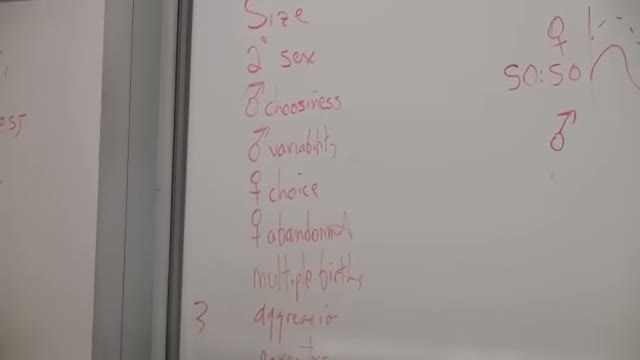
He then replays the tournament vs. pair-bonded contrast (8:29). In tournament species, males are much bigger, more aggressive, unchoosy about mates and wildly unequal in reproductive success (he cites 5% of males getting 95% of matings); females want good genes because that is all they will get; males die younger. In pair-bonded species, all of those differences shrink, males provide care, and females choose for good fathering. The point: from two skulls alone you can predict a great deal about a species’ private life.
11:36 – 18:20 Competitive infanticide
The old documentary line was that only humans kill for no reason, and that baby features exist to calm aggression. In the 1970s field workers started reporting otherwise. Sarah Hrdy described infant killing among langur monkeys in India (13:40), and similar reports followed for lions and other species. The first reaction was to call the populations abnormal; that didn’t survive more data.
The patterns that emerged:
- It is usually adult males doing the killing.
- The victims are infants likely fathered by other males.
- It only appears where a female’s interbirth interval is longer than a top male’s average tenure (15:44).
The third point is the key. A newly dominant male may hold his position for a year and a half while every female is nursing and won’t ovulate for years. Killing the infants does two things at once: it cuts a rival’s reproductive success, and it ends nursing so the mothers ovulate again (16:45). Sapolsky lists langurs, vervets, patas monkeys, lions and mountain gorillas.
His strongest anti-“good of the species” example is the mountain gorilla, which he describes as near extinction yet still showing infanticide (17:49). Our note: his figure of 600–700 animals reflects the time; later censuses have counted over 1,000.
18:20 – 26:35 Exceptions and female counter-strategies
The kin exception (18:51): when the incoming male is a brother of the outgoing one, infanticide largely disappears.
Inducing miscarriage instead. In wild horses, new males harass pregnant females until they miscarry. In many rodents it happens through smell alone: the odor of an unfamiliar male triggers a stress-hormone cascade that ends the pregnancy (19:51). From the female’s side this is the lesser loss: abort early and ovulate again rather than pay for a pregnancy whose young will be killed. And again, the effect weakens if the newcomer is a relative of the previous male.
Graded defense (21:55). Langur mothers defend infants, but not to the point of serious injury. Older mothers, with fewer chances left to breed, defend harder, and grandmothers hardest of all.
Pseudoestrus (22:57). A pregnant langur facing a new male can show the swellings and signals of estrus without ovulating. The male mates with her, she gives birth weeks later, and he treats the infant as his own. A student asks why selection hasn’t produced males who can count (24:30). Sapolsky’s answer, under the jokes: there has been little selection for linking mating to birth months later, and many species simply lack that kind of cognitive rule.
26:35 – 30:16 Kidnapping as blackmail
The classic 1950s–60s reading of a cornered baboon grabbing an infant was that babies calm everyone down. Watching known individuals shows something colder (27:39): the subordinate grabs an infant likely to be the attacker’s own offspring. The qualifiers confirm it. A dominant male who joined the troop two weeks earlier has no infants yet, so threatened males rarely bother kidnapping against him.
Sapolsky’s own field story (29:12): an aging, formerly high-ranking male under attack grabbed an infant that was probably his own, then dropped it as if he had realized the mistake. Sapolsky takes that as a hint that at least some primates are tracking these relationships, not just running a blind rule.
30:16 – 36:35 Inherited rank and sex-ratio bets
Nepotistic hierarchies (30:48). In many female primate hierarchies, a daughter ranks just below her mother, and each new daughter slots in above her older sisters. Rank is inherited, a pure kin-selection outcome.
Sons as a gamble, daughters as a safe bet (31:52). In a tournament species, a son might father dozens of offspring or none; a daughter will almost certainly have a few. That gives two predictions, which Sapolsky says the data bear out in several primates:
- High-ranking females should lean toward sons, low-ranking ones toward daughters.
- In hard times, births should tilt toward daughters, because male fetuses cost more.
He cites human figures for the higher cost and fragility of male fetuses, a male excess at conception that shrinks by birth, female-skewed births in famines, and lower weight in a baby born after a brother (33:59). Our note: the claimed male excess at conception is disputed; large recent studies put the sex ratio at conception close to even.
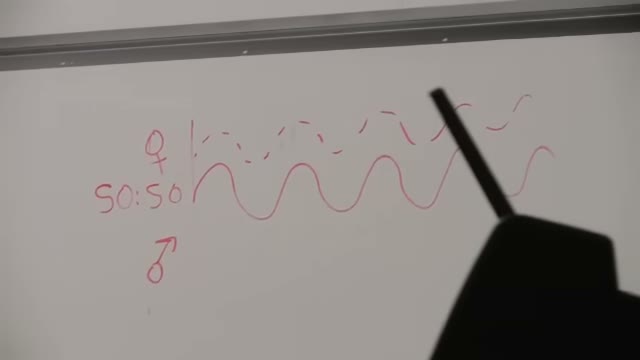
He credits the framework to Robert Trivers in the 1970s (35:33). There is a built-in brake: if everyone has daughters, sons become valuable, and vice versa, so the ratio oscillates around 50:50, with whichever sex is rarer worth more. Our note: the formal name is the Trivers–Willard hypothesis (1973), and the balancing effect is usually called frequency-dependent selection, an idea going back to R. A. Fisher.
36:35 – 40:16 Kin recognition and brothers sharing a mate
A quick reminder of the vervet experiment from Lecture 2: play an infant’s alarm call and the others look at its mother. Then adelphic polyandry (37:38), the rare arrangement of one breeding female with several males, who almost always turn out to be brothers. When two male lions share a pride instead of fighting over it, they are very likely brothers.
Humans have a version. In traditional rural Tibet, a woman could marry a man together with all his brothers, down to an infant brother (39:13). Sapolsky’s explanation is economic: in poor farming areas, splitting land among several sons would leave each below subsistence, so the brothers stay one reproductive unit and the farm stays whole.
40:16 – 45:00 Conflict between the sexes, and genes that remember their parent
Males compete with males and females with females, but the partners in a mating can also have different interests (40:48). In a tournament species where the male leaves after mating, he has no stake in the female’s future breeding; she does.
That conflict shows up in genetics. Ordinary Mendelian rules don’t care which parent contributed an allele. Imprinted genes do (42:56): the same allele works differently depending on whether it came from mother or father. The field took off in the early 1990s when researchers found that one mutation could produce two different diseases depending on the parent it came from. The mechanism is methylation, which silences one parent’s copy (43:59). Sapolsky warns that “imprinting” will reappear in the ethology lectures with an unrelated meaning.
45:00 – 51:18 Haig’s tug-of-war over the fetus
David Haig, an evolutionary biologist at Harvard, supplied the explanation (45:00). Imprinted genes active from the father tend to promote fetal growth, metabolism and a richer uterine lining; those active from the mother tend to slow growth. The examples:
- Growth factor vs. receptor (46:36). The paternal copy of a gene for insulin-like growth factor pushes growth; a maternal gene affecting its receptor blunts the response. Each side escalates in a coevolutionary arms race.
- Placental invasion (47:38). Knock out the paternal side and embryos fail to implant; knock out the maternal side and the result is choriocarcinoma, an aggressive cancer. Our note: choriocarcinoma arises from placental tissue, often after a molar pregnancy that carries only the father’s chromosomes, which fits Haig’s logic closely.
- After birth (49:12). Some imprinted genes act in the infant brain: the paternal one boosts suckling, the maternal one damps it.
- Placental lactogen (49:45). A father-driven fetal hormone pulls sugar from the mother’s blood; if her counter-response misfires, the result can be gestational diabetes.
Sapolsky’s claim is that this conflict belongs to tournament species and would not be expected in pair-bonded ones, where both parents share a long-term stake (50:15). Humans have imprinted genes, so once again we sit somewhere in between. Our note: imprinting is found widely across placental mammals; the conflict theory is better read as predicting how strong the tug-of-war should be than whether it exists at all.
51:50 – 55:32 Sperm that poison the competition
After the break (and a note that homosexuality will be covered in the sexual behavior lectures), Sapolsky describes William Rice’s work at UC Santa Cruz (52:21). Female flies mate with many males, so sperm from several males compete inside her. Males have evolved substances that kill rivals’ sperm, which also harm the female.
Rice held female evolution fixed while letting males evolve. Over about 30 generations, male toxicity rose until it shortened female lifespan (53:57). When he reversed the setup, females evolved ways to detoxify. To a male with no future stake in that female, her health is someone else’s problem. Our note: Rice’s experiments used fruit flies, and the harmful substances are proteins in the seminal fluid rather than the sperm themselves.
55:32 – 59:45 Who leaves home decides who fights
To avoid inbreeding, one sex disperses at puberty, and no one has found a general rule for which (56:33). In chimps and gorillas females leave; in baboons and macaques males do. The consequence:
| Baboons | Chimpanzees | |
|---|---|---|
| Who leaves at puberty | Males | Females |
| Adult males are… | Unrelated immigrants | Lifelong relatives |
| Main male aggression | Within the troop | Between groups |
Chimp males from one group patrol their border and kill outsiders (58:09). Jane Goodall documented one community wiping out another. Since victims are killed for their group membership, Sapolsky says this meets the UN definition of genocide. He looks ahead to human armies, which try to turn unrelated recruits into a “band of brothers”; chimps manage it through real kinship.
59:45 – 1:07:37 Group selection returns, version one: founder populations
Group selection is back, Sapolsky says, but not the version where elderly wildebeest sacrifice themselves for the herd, which he calls Marlin Perkins group selection after the host of Mutual of Omaha’s Wild Kingdom (1:01:50).
The first respectable version (1:02:24):
- A geographic event cuts off a small subpopulation.
- Being small, it becomes inbred, so relatedness is high and kin selection favors cooperation.
- Cooperation spreads until it covers distant relatives too, and becomes fixed.
- The barrier disappears and the groups merge. Now the cooperators outcompete everyone else, and cooperation “crystallizes” outward, sustained by reciprocity rather than kinship.
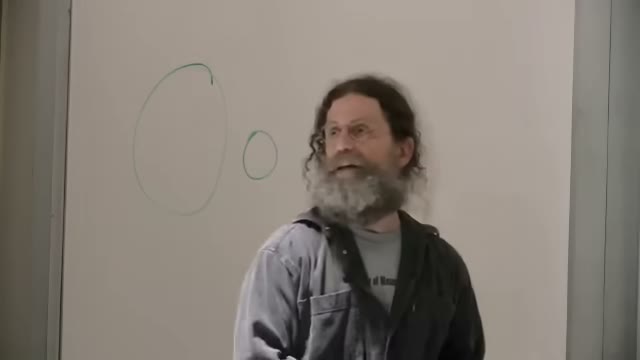
This is a founder effect, and it answers the question left open in the recap: how to get cooperation started when the first cooperator in a population of defectors is simply exploited (1:07:06). His human analogy is a trade dominated by a family network that lends to each other at low interest, prospers, and pulls everyone else into the same habits of trust.
1:07:37 – 1:13:52 Version two, and multilevel selection
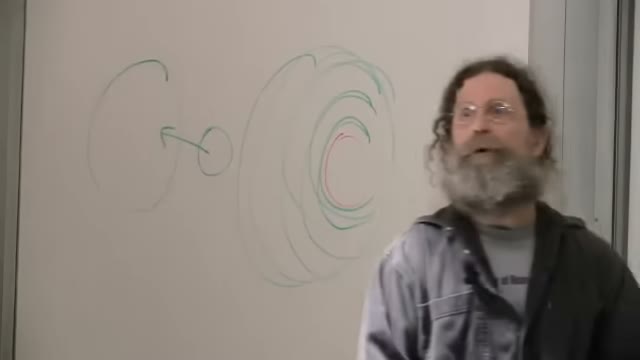
The second version is more general (1:08:09). Picture aggressive, high-laying hens and calmer, lower-laying ones. One-on-one, the aggressive hen wins. But a flock of aggressive hens injures and stresses itself into low fertility, while a flock of calm hens does fine. A beats B, but groups of B beat groups of A. The calm hens aren’t sacrificing for the group; their traits just pay off only collectively.
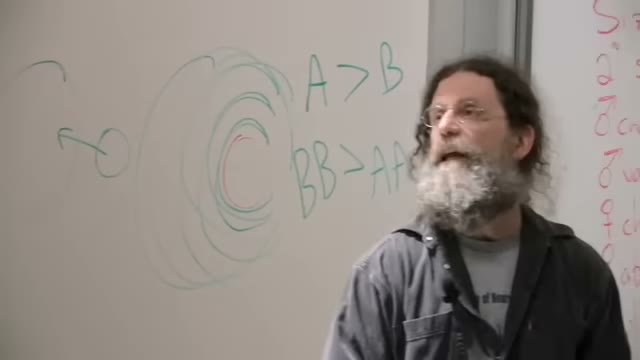
David Sloan Wilson, the main champion of this idea, applied it to religion in Darwin’s Cathedral, treating the rise of Calvinism as a founder effect in which a cooperative community outcompeted neighboring city-states (1:10:13). Our note: Sapolsky places Calvinism in Zurich in the 17th century but hedges; Wilson’s analysis concerns Calvin’s Geneva in the 16th century.
The broader result is multilevel selection (1:11:17): sometimes one bad gene decides an organism’s fate, usually selection works on the individual, and occasionally it works on the group. Sapolsky tells of the long feud between David Sloan Wilson and E. O. Wilson, the leading individual-selectionist, and their recent joint paper sorting out when each level dominates. Our note: this is likely their 2007 paper “Rethinking the Theoretical Foundation of Sociobiology”.
1:13:52 – 1:16:29 First cautions about applying this to humans
Two traps (1:14:22):
- Cherry-picked models. Finding one species that does something resembling a human behavior (infanticide, kidnapping, a damselfly act that looks like rape) and inflating its relevance.
- Smuggled-in “natural”. The implication that if other species do it, it’s natural and inevitable in us.
His formula: humans are unique, like every species, and what we share with others is the rules, not the outcomes (1:15:27). Individual personality also blurs the predictions, even in lions, and more so in us.
1:16:29 – 1:20:41 Three hidden assumptions, and “show me the gene”
E. O. Wilson’s Sociobiology (1975) predicted that the social sciences would eventually fold into evolutionary biology (1:16:29), which did not please social scientists. Sapolsky pulls out three assumptions running through everything in these two lectures:
- Heritability of behavioral tendencies (1:17:32).
- Adaptiveness: whatever was selected must be there for a reason.
- Gradualism: small advantages accumulating over many generations.
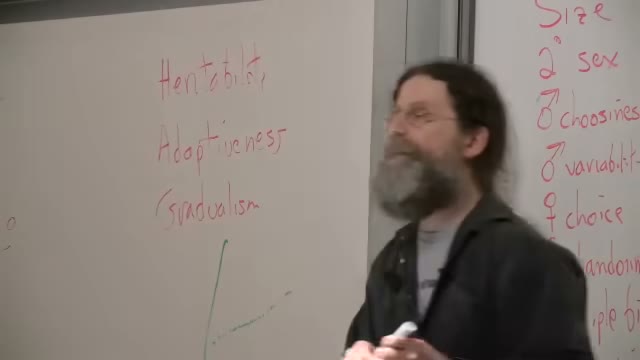
On the first, sociobiology argues by inference: the model explains the behavior, so assume a genetic basis until someone offers a better model. Molecular biologists answer, “show me the gene” (1:20:09), and the next two weeks of the course take that challenge up. He also previews that “is it genetic?” is a poorly framed question; the better one is how genes influence a behavior in a given environment.
1:20:41 – 1:29:01 Adaptationism, just-so stories and spandrels
Critics call the second assumption the adaptationist fallacy (1:20:41). If every trait must be adaptive, the job becomes inventing the best story for why, and the best storyteller wins. The demands: experimental evidence, and a way the story could be shown false.
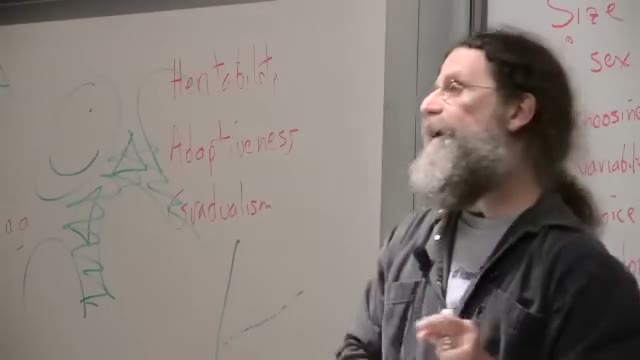
A fair qualifier comes first (1:22:16): squid are poor swimmers next to fish, but excellent ones for something built from a mollusk. Adaptation has to be judged against the starting material.
Even so, many traits aren’t adaptations. Stephen Jay Gould, a Harvard paleontologist, and Richard Lewontin, a Harvard geneticist, called them spandrels (1:23:18). In architecture, a spandrel is the triangular space left between two adjacent arches. Builders decorated them lavishly, but they exist because arches require them, not because anyone designed them for a purpose. A biological spandrel is a by-product of selection on something else.
His example is the human chin (1:25:56). Humans are the only primate with one, and adaptive stories have been offered for it. Sapolsky’s view is that a shortened muzzle plus the angle of the human jaw produces a chin automatically, so there is nothing to explain. Our note: whether the chin is a pure by-product is still debated, but it remains the standard textbook example.
He closes the point with a line he attributes, by his own admission uncertainly, to André Lwoff: evolution is not an inventor but a tinkerer, working with whatever parts are already there (1:28:00). Our note: the phrase is usually credited to Lwoff’s co-laureate François Jacob, in a 1977 essay.
1:29:01 – 1:32:37 Too much competition, and the gradualism problem
The spandrel critique leads to a broader one: a framework where every small edge counts must see life as nonstop competition. Soviet evolutionary biologists, Sapolsky says, put more weight on abiotic selection, surviving cold and other environmental extremes, where competition between individuals matters far less (1:29:33).
The third assumption, gradualism, is challenged by punctuated equilibrium (1:30:34): long stretches of stasis broken by bursts of rapid change. If most of the time nothing is happening, the endless fight over fractions of a percent shrinks in importance. Sapolsky says the next lectures will cover this, and that he thinks it is right in many cases because it fits the molecular biology better. Our note: the theory was proposed by Niles Eldredge and Gould in 1972.
1:32:37 – 1:36:46 The political critique
Few sciences invite political critique, but this one makes claims about whether male dominance, hierarchy, aggression and sexual coercion are natural (1:32:37). He mentions the questions of whether rape is a pathology or a strategy, and why stepchildren are more likely than biological children to be killed by a parent figure.
Critics noted that the founding sociobiologists (E. O. Wilson, Trivers, Irven DeVore and others) were white men from the American South, while Gould and Lewontin were Northeastern Marxists (1:33:40). The charge: a theory that makes inequality look natural suits those it favors. Sapolsky recounts protesters storming a talk by Wilson and pouring water on him, which he places in 1977 and links to the Boston group Science for the People. Our note: most accounts date this to the February 1978 AAAS meeting in Washington and attribute the water to members of the International Committee Against Racism.
His balancing point (1:35:44): punctuated equilibrium, with its stasis, sudden “dialectical” change and smaller role for competition, is exactly the evolution two Marxist scientists would want. Politics cuts both ways. Our note: that is the lecture’s real lesson for the rest of the course. Each school accused the other of projecting its politics, so judge both by the evidence.
Skip list
- 0:10 – 2:47 Grading split, readings and the lecture schedule.
- 2:47 – 8:29 Recap of the three building blocks, if Lecture 2 is fresh.
- 51:18 – 51:50 Break.
- 1:01:19 – 1:02:24 Marlin Perkins and Wild Kingdom aside.
- 1:12:18 – 1:12:49 Jokes about the two Wilsons being invited to the wrong parties.
- 1:36:46 – end Credits.
Glossary
- Individual selection — selection for traits that increase the number of copies of an individual’s own genes passed on.
- Kin selection — selection for helping relatives, weighted by how many genes you share with them.
- Reciprocal altruism — cooperation between non-relatives that pays off through returned favors.
- Tournament species — a mating system with intense male competition, large sex differences and very unequal male reproductive success.
- Pair-bonded species — a mating system with stable pairs, shared parenting and small differences between the sexes.
- Competitive infanticide — killing infants sired by rivals, which also brings their mothers back to fertility sooner.
- Interbirth interval — the time between one birth and the next for a female, largely set by how long she nurses.
- Pseudoestrus — showing the outward signs of estrus while pregnant, which can protect the coming infant from a new male.
- Kidnapping (in baboons) — a threatened male holding an infant, typically one fathered by his attacker, to deter attack.
- Pregnancy block — miscarriage triggered by the smell of an unfamiliar male; our note: in mice it is known as the Bruce effect.
- Sex-ratio adjustment — shifting offspring sex toward sons or daughters depending on rank or conditions (Trivers–Willard).
- Frequency-dependent selection — selection where the rarer type is favored, which keeps sex ratios oscillating around 50:50.
- Adelphic polyandry — one female breeding with several males who are brothers; also called fraternal polyandry.
- Imprinted genes — genes whose effect depends on which parent they came from, usually because one copy is silenced.
- Methylation — a chemical tag on DNA that can switch a gene off; the mechanism behind imprinting.
- Sperm competition — competition between sperm from different males inside one female.
- Exogamy (sex-biased dispersal) — one sex leaving the birth group at puberty to breed elsewhere.
- Founder effect — a trait becoming common because a small, isolated starting population happened to carry it.
- Multilevel selection — the view that selection can act on genes, individuals or groups depending on circumstances.
- Adaptationism — the assumption that every trait exists because it was selected for; critics call the resulting stories “just-so stories”.
- Spandrel — a trait that exists as a by-product of selection on other traits.
- Punctuated equilibrium — the model of evolution as long stasis interrupted by short bursts of rapid change.
- Abiotic selection — selection by the physical environment, such as climate, rather than by other organisms.
FAQ
Why do male langur monkeys kill infants, according to Sapolsky?
It is a competitive strategy, not a pathology. A male who takes over a group usually holds his position for less time than a nursing female takes to start ovulating again. Killing infants fathered by other males removes a rival's offspring and brings the mothers back into breeding condition sooner. Sapolsky notes the pattern disappears when the new male is a close relative of the old one, as kin selection predicts.
What are imprinted genes, and how does David Haig explain them?
Imprinted genes work differently depending on which parent they came from; typically the copy from one parent is silenced by methylation. Haig noticed that the active father-derived genes tend to push fetal growth, while the mother-derived ones hold it back. His explanation is a tug-of-war: in species where a father may never mate with the same female again, his genes gain from a big, demanding baby, while the mother's genes must also protect her future reproduction.
What is a spandrel in evolutionary biology?
A term Stephen Jay Gould and Richard Lewontin borrowed from architecture. A spandrel is the triangular space that unavoidably appears between two neighboring arches. In biology it means a trait that exists as a by-product of other traits that were selected, not because it was selected itself. Sapolsky's example is the human chin, which he presents as a side effect of a shortened face and jaw.
Does Sapolsky think group selection is real?
Not the old version where animals sacrifice themselves for the good of the species. But he describes two narrower forms that have come back: inbred founder populations that fix cooperation through kin selection and then spread it, and cases where a trait that loses one-on-one wins when a whole group shares it. Together these feed into multilevel selection, where selection can act on a gene, an individual or a group depending on circumstances.
What are the main criticisms of sociobiology covered in Lecture 3?
Sapolsky lists three assumptions under the framework, that behavioral traits are heritable, adaptive and change gradually, and a critique of each: show me the gene; many traits are spandrels rather than adaptations; and evolution may proceed by punctuated equilibrium instead of steady increments. He adds a political critique: that the theory presented competition and inequality as natural.
Studying another course? Paste its YouTube or Bilibili link on the home page to request a handout — or make your own with the desktop app (coming soon).