Sapolsky Human Behavioral Biology, Lecture 1: Introduction — notes and timestamps
Watch the video (57 min)
Watch the original video on YouTube
Lecture 1 of Robert Sapolsky’s Stanford course Human Behavioral Biology (Bio 150, recorded in 2010) is less about facts than about a habit of mind. Sapolsky argues that physiology and behavior shape each other in both directions, that our instinct to sort the world into categories gets in the way of seeing this, and that some of the most influential scientists of the twentieth century did serious damage by explaining everything from inside one discipline. The second half of the hour lays out how the course is built around that idea. The next lecture, Behavioral Evolution, opens the first of the course’s “buckets”. For the full course map, see the course index.
Key takeaways
- Body and brain run in a loop (6:00). What happens in the body can change behavior, and a thought can change heart rate. The course is about that two-way traffic.
- Categories make information easier to store, at a price (8:06). We cut continuous things, like color or running speed, into labeled chunks because labels are easier to remember.
- Categorical thinking fails in three ways (19:53): it hides differences inside a category, inflates differences across a boundary, and blocks the big picture.
- There are no buckets, only temporary platforms (24:37). A hormone or neuron explanation is just the most convenient summary of everything that came before it, back to evolution.
- Single-bucket thinking has done real harm (31:46). Watson, Moniz and Lorenz were not minor figures; their one-level explanations shaped education, psychiatry and Nazi policy.
- Humans pose three different challenges (33:19): sometimes we are just another mammal, sometimes we use ordinary physiology in unprecedented ways, and sometimes we do things no other animal does.
- Behavior is a cloud, not a clock (47:46). Breaking a system into parts and reassembling them works for machines, not for behavior, which is why Gleick’s Chaos is on the reading list.
Chapter notes
0:13 – 3:22 A strange case and a show of hands
Sapolsky opens with a hypothetical: a settled, married 40-year-old who, over about six months, punches a coworker over a baseball remark, has an affair with a teenage checkout clerk, then embezzles money from work and vanishes. Is he a creep, having an extreme midlife crisis, or carrying a single-gene mutation? The punchline is that this exact sequence matches a known neurological disease caused by one faulty gene. He doesn’t name it here; our note: the description fits frontotemporal dementia, which erodes impulse control and can be inherited.
He then polls the room (1:16): genetic influence on sexual orientation, prenatal effects on adult political views, biology and religiosity, belief in God, souls, evil and free will, and sex differences in aggression and intelligence. Most hands go up for “a nuanced interaction of nature and nurture”, which he jokingly calls the whole course. The list works as a preview of topics the class will return to.
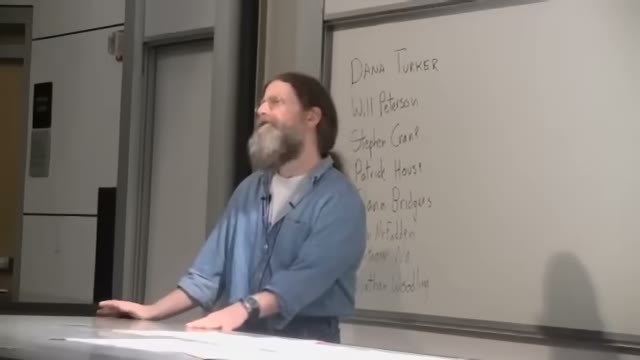
3:22 – 7:05 PMS, tumors, Twinkies and steroids: the two directions of influence
Four items go up: having your period, a brain tumor, eating a lot of junk food, and taking anabolic steroids (3:22). Students guess “hormones”. The real link is that each has been used successfully in court to explain a killing (4:24):
- Menstrual cycle: cases where juries weighed the timing of a woman’s period, supported by data linking a share of female aggression to the days around menstruation.
- Brain tumor: a tumor in the amygdala, a region involved in fear and aggression, can produce uncontrollable violence. The amygdala will come up constantly in the course.
- Junk food: Dan White’s 1978 killing of San Francisco Mayor George Moscone and Harvey Milk, and the so-called Twinkie defense (5:27). Our note: the legal argument was diminished capacity from depression, with the junk-food binge offered as a symptom; “Twinkie defense” is the press’s shorthand.
- Anabolic steroids: weightlifters on heavy doses claiming the drugs drove their violence.
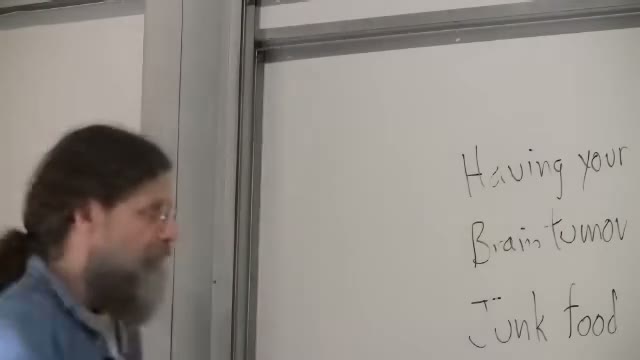
That gives point one: what goes on in your body can strongly change what goes on in your brain (6:00). Point two comes as a homework exercise: lie in bed tonight imagining your own death, and your relaxed heart will speed up (6:33). A thought, with nothing physical changing, reaches every organ.
7:05 – 12:46 Why this is hard, and why we think in categories
Explaining why wildebeest all mate in the same week is tractable. The course instead takes on human social behavior, including badly abnormal behavior, which is far messier (7:35). Faced with mess, people fall back on categories: slicing a continuum into labeled pieces (8:06).
His examples show that categories really do help:
- A sheet of paper is judged “about a foot” because we carry a mental category for “ruler length”.
- A friend’s mile time impresses us once it crosses the four-minute line, though speed is continuous.
- “Paints with eleven colors” means nothing, because we have no category there.
- Color is a continuous range of wavelengths that each language cuts at different points (10:10). People remember a shade better when it sits in the middle of one of their language’s color words than near a boundary.
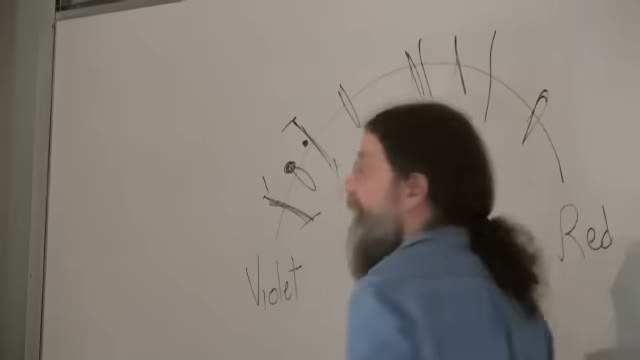
- Simple shapes we have names for (square, circle, triangle) are remembered better than an unnamed squiggle (11:43).
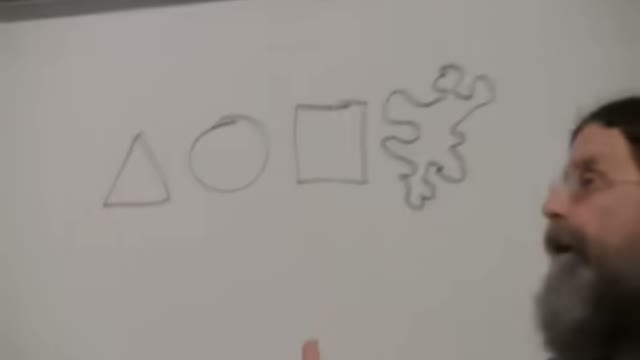
Our note: Sapolsky is not arguing against categories as such. He grants they make memory and judgment cheaper, which is exactly why they are hard to resist when the subject gets complicated.
12:46 – 19:53 The three costs of categorical thinking
Cost 1: you miss differences inside a category. Languages also cut up the range of speech sounds differently. Sapolsky’s story: a Finnish urologist, coaching him on doing testicular biopsies on baboons, told him to practice on a “bear”, meaning a pear (13:51). Finnish speakers, he says, don’t separate the b and p sounds, so two sounds in one category blur together.
Cost 2: you exaggerate differences across a boundary. A 65 and a 66 on an exam are nearly the same score, but if the pass line sits between them they feel like different worlds (14:57).
Cost 3: you lose the big picture. He reads out strings of digits for students to write down (15:31). Accuracy collapses as soon as a string stops following the three-then-four pattern of a phone number, because attention goes to the expected boundary rather than the actual sequence (16:33).
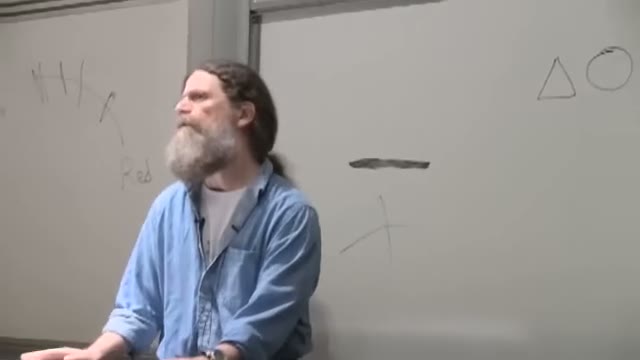
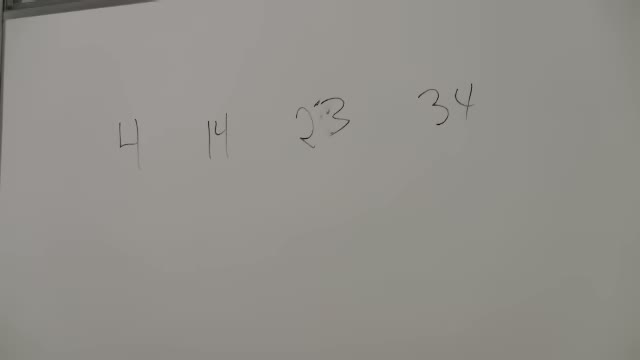
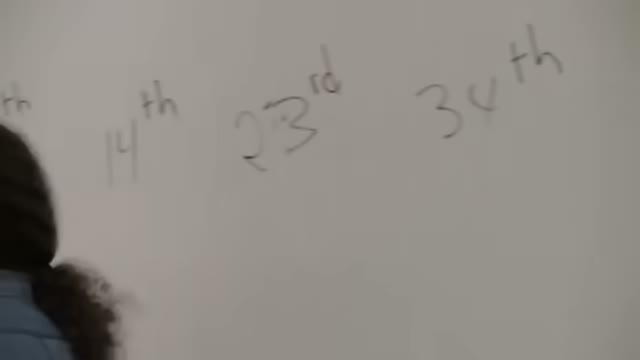
A number-series puzzle drives the point home (17:05). Students offer arithmetic answers, and one offers “seven billion”. The right answer is obvious only to New Yorkers: the numbers are stops on a Manhattan subway line (19:22). The right category makes the problem trivial; the wrong one makes it unsolvable. He recaps the three costs at 19:53.
19:53 – 25:37 Why did the chicken cross the road? Buckets versus platforms
A hen runs to a rooster after his courtship display. Why (20:24)? An endocrinologist answers with estrogen acting on the hypothalamus; an anatomist with the mechanics of a chicken’s legs and pelvis; an evolutionary biologist with the fact that hens who ignored such displays left fewer copies of their genes. Each answer lives in its own “bucket”, and living in one bucket brings back all three costs above: you start believing a behavior is explained by one gene, one neurotransmitter or one childhood trauma.
The course’s method, used for every behavior in the second half (22:27), steps backward in time:
- What does the behavior actually look like? (Harder to describe objectively than it seems.)
- What did neurons do a second before?
- What sight, sound or smell triggered those neurons?
- What did hormones over the past hours do to sensitivity to those cues?
- Then on through development, fetal life, the individual’s genes, the population’s genes, and evolutionary pressures.
The key move comes at 24:05: these levels are not rival explanations. A hormone is coded by a gene, so you are already doing genetics; a gene has been selected, so you are doing evolution; a sensory system’s sensitivity was set in development. Each level is a “temporary platform”, the most convenient place to summarize everything upstream of it (24:37).
Our note: this is the single most useful idea to carry into the rest of the course. When a later lecture says “X causes Y”, read it as “X is where we are standing to describe Y today”.
25:37 – 32:47 Three famous scientists stuck in one bucket
Is the warning against bucket thinking a straw man? Surely professionals know everything interacts. Sapolsky answers with three quotes (26:07):
- John Watson, a founder of behaviorism, boasting that with total control of a child’s environment he could produce a “doctor, lawyer, beggar or thief”. Behaviorism, later championed by B.F. Skinner, held that controlling rewards and punishments was enough. Sapolsky’s counterexample is blunt: severe protein malnutrition in fetal life alone breaks the promise. Watson was later forced out of academia by a scandal and became a successful advertising executive (27:08).
- Egas Moniz, the Portuguese neurologist who introduced what became the frontal lobotomy, describing “synaptic adjustments” that yield “cures and improvements but no failures” (27:40). He said this when accepting his Nobel Prize (1949). Students first guess electroshock; the real answer is cutting away part of the frontal lobe, done to huge numbers of people, many with nothing wrong with them. Sapolsky calls it one of psychiatry’s darkest chapters.
- Konrad Lorenz, a founder of ethology, famous for ducklings imprinting on him, writing that the state must rely on “healthy instincts” to eliminate “elements of the population loaded with dregs” (29:44). Students guess Hitler; it was Lorenz, writing as a Nazi propagandist, and he never recanted.
The point (31:46) is that these were not fringe figures but among the most influential scientists of the century, and their one-level explanations cost lives. That is why the course treats anti-bucket thinking as an ethical issue, not just a stylistic one.
32:47 – 41:03 Three intellectual challenges
Challenge 1: accept when we are just another animal (33:19). Female hamsters housed together lengthen and synchronize their ovulatory cycles via airborne chemical signals. Block the nose and it stops; add a male and the cycles break apart; and the dominant female sets the rhythm. The same holds in goats, sheep, dogs, cats and pigs. Humans show the “Wellesley effect” (35:24): college roommates’ cycles converging over a year, driven by smell, disrupted by close contact with a man, and led by the more socially dominant roommate. Our note: later research has had trouble reproducing menstrual synchrony, so it is a good illustration of the principle but a shaky fact. Sapolsky’s broader claim, that our genome is nearly the same as a chimp’s, stands.
Challenge 2: same physiology, unprecedented uses (36:57). Two chess grandmasters sit still for hours, yet their blood pressure and calorie burn rival a marathoner’s, and the winner’s physiology matches a baboon’s after a violent fight. Humans trigger the stress response with pure thought: fear of mortality, news of a child suffering across the world, a stranger’s sports car, a character in a novel. Empathy uses ordinary mammalian machinery, but we extend it to refugees we will never meet and to other species.
Challenge 3: things no other animal does (39:31). A couple has sex every night for a month and talks about it afterward. Almost no other species has regular non-reproductive sex, and none discusses it. Language, many aspects of human sexuality, and the damaging human confusion of sex with aggression fall in this category, where there is no animal model to lean on.
He restates the whole strategy at 40:01: resist categories because doing otherwise can cause “unspeakable damage”, and keep asking which of the three challenges a given behavior poses.
41:03 – 45:43 How the course is built, and who it is for
- First half: a tour of the buckets: evolution, molecular genetics, behavioral genetics, ethology, the brain, endocrinology (41:03). Sapolsky warns it will be dizzying, switching disciplines every two and a half lectures or so.
- Second half: specific behaviors (sex, aggression, parenting, schizophrenia, depression, personality disorders, language), each traced from “a second before” back to “ten million years before” (42:04).
- No prerequisites, by design. Weekly catch-up sections help students without a background in each new field.
His case for why non-scientists should take it (44:39): we already act as behavioral biologists when we sit on a jury, vote on whether a social problem is worth funding, or decide whether a depressed relative has a biochemical disorder or is self-indulgent.
45:43 – 50:52 Exams, books and readings
There is a midterm and a final and no paper. Two books are assigned: one of Sapolsky’s own (for the second half) and James Gleick’s Chaos (46:45). He says it splits the class, a quarter hate it, half are puzzled, a quarter are transformed, and that it was the most influential book on his scientific thinking since college.
The argument behind the choice (47:15): for centuries science has been reductionist, assuming you understand a complex thing by taking it apart and studying the pieces. That is how you fix a clock. Behavior is more like a cloud, and you can’t understand rainfall by disassembling a cloud. Later lectures on chaos and complexity pick this up. Readings will be mostly papers posted online, sometimes with only the abstract assigned as an example of how a given field thinks.
50:52 – 56:47 Logistics and Q&A
Handouts move online after this lecture, sections start that week, and the TAs are introduced. In Q&A Sapolsky explains the five units (with a joke about Condoleezza Rice’s time as Stanford provost), gives exam dates, and says lectures will be posted online. The one academically useful answer is about exam format (55:05): mostly multiple choice for practical reasons, with the midterm checking the basics of each discipline and the final focused entirely on thinking across them.
Skip list
- 0:00 – 0:13 Settling in.
- 13:51 – 14:57 The Finnish “bear/pear” biopsy story. Funny, but the point (sounds in one category blur together) takes one sentence.
- 15:31 – 16:33 Digits being read aloud. Only worth playing if you want to try the memory exercise yourself.
- 34:52 – 35:24 Aside about pig synchronization spray.
- 43:05 – 44:39 Show of hands on majors and catch-up section logistics.
- 48:47 – 55:05 Readers, course website, paper handouts, classroom entry, TA introductions, units and the Condoleezza Rice joke.
- 55:36 – end Questions about taping sections and exam times.
Glossary
- Behavioral biology — the study of how genes, hormones, brain activity, development and evolution shape behavior, and how behavior and thought feed back on the body.
- Categorical thinking — splitting a continuous range into labeled chunks; helpful for memory, misleading when the categories are mistaken for the reality.
- Bucket — Sapolsky’s word for a single discipline’s level of explanation (endocrinology, genetics, neuroscience and so on).
- Temporary platform — his alternative to a bucket: a level of explanation treated as a convenient summary of all the causes upstream of it, not a complete answer.
- Amygdala — a brain region involved in fear and aggression; damage or a tumor there can change behavior sharply.
- Behaviorism — the school of psychology (Watson, Skinner) holding that behavior is shaped by rewards and punishments.
- Frontal lobotomy — surgery that cuts connections in or removes part of the frontal lobe; introduced by Egas Moniz as leucotomy and later widely abused.
- Ethology — the study of animal behavior in natural settings; Konrad Lorenz was a founder.
- Imprinting — rapid, early learning in which young birds attach to the first moving figure they see.
- Pheromone — an airborne chemical signal that affects the physiology or behavior of another member of the species.
- Menstrual synchrony (Wellesley effect) — the claimed convergence of cycles among women who live together; widely taught, but its evidence is now disputed.
- Reductionism — understanding a complex system by breaking it into parts; the approach that Chaos challenges.
FAQ
What is the main point of Sapolsky's first Human Behavioral Biology lecture?
That body and behavior influence each other in both directions, and that you cannot understand behavior from inside one discipline. Genes, hormones, neurons, development and evolution are not separate explanations but different points along one chain of causes, and the course trains you to move along that chain instead of settling on a single answer.
What are the three problems with categorical thinking Sapolsky describes?
First, you underestimate how different two things are when they fall inside the same category. Second, you overestimate how different two things are when a boundary happens to fall between them, like a 65 versus a 66 on a pass/fail line. Third, when you focus on the boundaries you miss the big picture.
Which scientists does Sapolsky use as warnings in Lecture 1, and why?
John Watson, who claimed behaviorism could turn any child into anything; Egas Moniz, who won a Nobel Prize for the frontal lobotomy; and Konrad Lorenz, who wrote Nazi race propaganda. Sapolsky's point is that these were among the most influential scientists of their century, and each did real harm by explaining all of behavior from inside a single discipline.
What is the Wellesley effect mentioned in the lecture?
Sapolsky's name for menstrual synchrony among women living together, first reported in a study of Wellesley College roommates around 1970. He uses it to show that humans sometimes work exactly like other mammals, where the same effect runs on smell. Our note: later studies have had trouble replicating menstrual synchrony, so treat it as a teaching example rather than settled fact.
Why does Sapolsky assign James Gleick's book Chaos?
Because it challenges reductionism, the habit of understanding a complex system by breaking it into parts. Sapolsky argues that works for clocks but not for behavior, which is more like a cloud. Lectures later in the course on chaos and complexity build on the book.
Studying another course? Paste its YouTube or Bilibili link on the home page to request a handout — or make your own with the desktop app (coming soon).