Sapolsky Human Behavioral Biology, Lecture 2: Behavioral Evolution — notes and timestamps
Watch the video (97 min)
Watch the original video on YouTube
Lecture 2 of Robert Sapolsky’s Stanford course Human Behavioral Biology (Bio 150, 2010) opens the first of the course’s disciplinary “buckets”: evolution. The lecture has a clear arc. It throws out the popular idea that animals act for the good of their species, replaces it with three mechanisms (individual selection, kin selection and reciprocal altruism), spends a long middle section on game theory and the prisoner’s dilemma, then shows how far the logic can go: from two skulls of a newly found primate, you can predict much of its social life. It ends by asking where humans fit, and the answer is “awkwardly in the middle”. It follows Lecture 1, which set up the course’s warning against single-discipline thinking, and continues directly in Lecture 3. For the full course map, see the course index.
Key takeaways
- Behavior obeys the same optimization logic as anatomy (6:19). A giraffe’s heart is exactly as big as the equations predict because a giraffe with a smaller one could not exist. Sapolsky’s claim is that social behavior can be predicted the same way.
- Animals do not behave for the good of the species (16:20). The “self-sacrificing” old wildebeest is pushed into the crocodile river by the others. What gets selected is behavior that leaves more copies of an individual’s genes.
- Kin selection runs on arithmetic (24:45). Haldane’s quip, that he would lay down his life for two brothers or eight cousins, is the whole idea: help to relatives is worth it in proportion to shared genes, and animals track who is related to whom.
- Cooperation between non-relatives works only with rules (36:21). Reciprocal altruism needs give and take, the temptation to cheat, and vigilance against cheaters, all at once.
- Tit for tat wins tournaments but breaks under noise (51:00). A single misread signal locks two players into an endless seesaw of retaliation, which is why forgiving and trust-building variants beat it once errors are possible.
- Real animals play these games, imperfectly (1:01:33). Vampire bats, sticklebacks and hamlet fish follow tit-for-tat rules; lions and naked mole-rats show what the simple models miss, mainly that animals play several games at once.
- Two skulls can predict a social system (1:18:53). Big size differences between the sexes go with male aggression, unequal mating success and short male lives (tournament species); equal sizes go with paternal care, twins and monogamy (pair-bonding species). Humans fall in between.
Chapter notes
0:04 – 3:45 Course housekeeping and questionnaire results
Sapolsky clears up a cross-listing question (Bio 150, Bio 250 and Hum Bio 160 are the same course with the same requirements), then reads out funny answers from the first-day questionnaire about why people enrolled (“My first grade teacher is making me”). A few results point ahead: a finding that “has come up over and over”, that far more women pick peace and more men pick justice; the biology of religiosity as the topic students most want and most don’t want to hear about; and, for 22 years running, more interest in depression than in sex. None of this is needed for the content of the lecture.
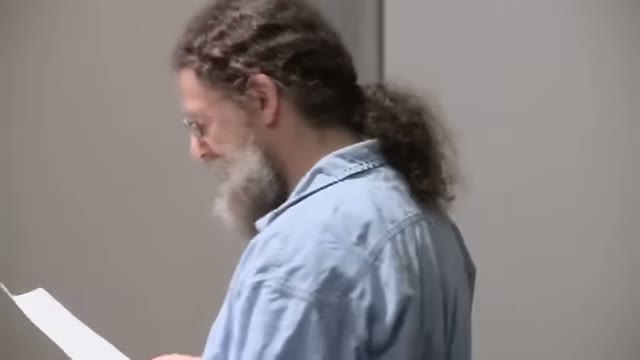
3:45 – 8:58 Two skulls and the logic of optimization
The lecture’s hook is a pair of real skulls on the bench: two adult skulls of a newly discovered species, one from an animal seen nursing an infant and one from an animal with a penis (4:15). A trained osteologist could read body size, disease, malnutrition, number of births and whether the animal walked upright. Sapolsky promises more: with the right tools you could say which sex is more likely to cheat, how aggressive the males are, whether females have twins, whether females pick males for parenting skills or because they are “big, hunky guys”, and whether the sexes live equally long. The tools come from the rest of the lecture, and he cashes in the promise at the end.
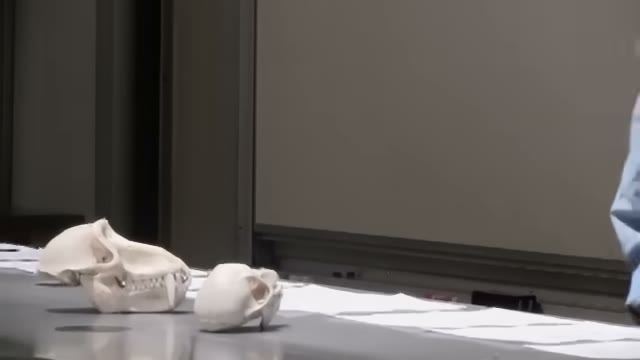
The method behind it starts with a complaint about the old Time-Life nature books. They present a giraffe whose heart is exactly the size the biomechanics people predicted, or a desert rodent whose kidney tubules are exactly as long as the math said, and then marvel at nature. Sapolsky’s answer is that this is not wonderful at all (6:19): a giraffe with a smaller heart simply could not exist, so the match is inevitable. Organisms are the solutions to optimization problems.
The same reasoning applies to behavior. Every kid with a younger sibling learns the never-lose strategy at tic-tac-toe, an example of what game theorists call a Nash equilibrium (7:54) (he admits he mentions Nash mainly because “it makes me feel quantitative”). Evolution can be treated as searching for comparable optimal strategies in social life. That program became sociobiology in the mid-1970s and, by the late 1980s, evolutionary psychology (8:24): the view that you cannot understand behavior or inner states without the evolutionary pressures that sculpted them.
8:58 – 14:13 Darwin’s recipe, applied to behavior
A quick refresher. Darwin did not discover evolution; people already knew species changed. What he (and Alfred Russel Wallace, who Sapolsky says “has gotten screwed historically”) supplied was a mechanism, natural selection (8:58). The recipe has a few ingredients:
- Some traits are heritable.
- Those traits vary between individuals.
- Some versions work better than others. The key correction (10:33): “better” means leaving more copies of your genes in the next generation, not surviving longer. Reproduction of the fittest, not survival of the fittest.
- Add occasional new variation (mutation) and enough time, and populations change, eventually into new species.
To apply this to behavior, you assume the same steps hold for kinds of behavior. Sapolsky flags that the first step, that behavior has a heritable, genetic component, is the “big incendiary issue”, and it will run through nearly every later lecture (12:39). He also separates two questions people blur: how genetic a behavior is, and how genetically determined it is.
He licenses a shortcut too (13:10). It is convenient to ask “what would this female chimp want to do to maximize copies of her genes?”, but no brine shrimp or cherry tree is planning anything. The phrasing is shorthand for “what has selection shaped this organism to do?”, and once you get past the apes, he says, nobody is literally wanting anything.
Our note: keep that disclaimer in mind for the rest of the lecture, which is full of animals that “say” and “want” things. Every one of those is the shorthand.
14:13 – 18:56 The wildebeest myth and group selection
The first thing to unlearn comes from National Geographic specials. Two million wildebeest reach a river full of crocodiles. They mill at the bank until an elderly wildebeest pushes to the front, announces that he sacrifices himself for the herd, and plunges in; the crocodiles get busy and everyone else crosses safely (15:49). The documentary’s explanation is that animals behave for the good of the species, which Sapolsky calls “the worst urban myth of evolution”.
That idea is group selection, and he pins it on the hyphenated British zoologist Wynne-Edwards, who pushed it hardest in the early 1960s (16:50) and is now “reviled throughout every textbook”. Watch the crossing long enough, instead of for the camera crew’s three minutes, and the old animal isn’t fighting his way forward: he is being pushed from behind (17:52). The weakest member is sacrificed by everyone else, which is what you would expect if each animal is looking after its own genes.
By the 1970s the replacement view had taken over: animals, humans included, behave in ways that maximize copies of their own genes. Sapolsky gives three ways that can happen, the three building blocks of the lecture. Our note: he allows that a behavior can sometimes look like it is for the good of the species; the claim is that, looked at closely, it always resolves into one of the three blocks.
18:56 – 23:10 Building block 1: individual selection
The simplest route to more gene copies is reproducing yourself. After first getting it backwards to laughter, Sapolsky gives the classic line: “a chicken is an egg’s way of making another egg” (19:27). On this view the whole animated social life of the chicken is an epiphenomenon of genes getting copied. He relates this to selfish-gene thinking, while noting it is “not quite equivalent to The Selfish Gene”.
Individual selection works through two channels:
- Natural selection shapes traits that help you survive and reproduce: speed, the right muscle metabolism, senses that warn of predators, or a male moose’s sharp antlers for fighting off predators and rivals.
- Sexual selection, Darwin’s later insight (20:31), shapes traits that do nothing for survival but appeal to the other sex. If female moose happened to like green paisley patterns on antlers, the pattern would spread. Any preference, however arbitrary, makes the preferred trait more common.
The two can pull in opposite directions (22:07). In some fish, females prefer brightly colored males, while the same bright color makes those males easier for predators to catch. The trait ends up wherever the two pressures balance.
23:10 – 31:05 Building block 2: kin selection
The second route is helping relatives, who carry copies of your genes. Sapolsky gives the standard figures (23:42): identical twins share 100% of their genes, full siblings 50%, half-siblings 25% (the week’s catch-up section works through the math). The extreme case makes it vivid: if you have an identical twin, giving up your own reproduction so your twin can reproduce costs your genes nothing.
The geneticist J.B.S. Haldane, explaining this in a bar, reportedly said he would “gladly lay down my life for two brothers or eight cousins” (25:16). Eight cousins at one-eighth each add up to one of you. The result is kin selection, also called inclusive fitness (25:47): selection favors cooperation with relatives, scaled by how closely related they are. Animals turn out to be “obsessed with kinship”, so good at tracking it that, Sapolsky jokes, they would put social anthropologists to shame.
His evidence comes from Robert Seyfarth and Dorothy Cheney of the University of Pennsylvania, working with wild vervet monkeys (26:51). They recorded each monkey’s calls and then played an infant’s alarm call from a speaker hidden in a bush. The mother looked toward the bush, as expected. Everyone else looked at the mother: they knew whose child it was. The same researchers found that if female A did something rotten to female B, B’s offspring was more likely than chance to do something rotten to A’s offspring later that day (28:28). Revenge was “displaced by one degree”, which only works if the monkeys keep track of kinship.
Both selection channels show up here too (29:31): natural selection in risking your life to save eight cousins, sexual selection in spending energy convincing everyone that your sibling is “incredibly hot”.
31:05 – 34:15 Rock-paper-scissors: evolutionary stalemates
Animals often hold back from aggression they are capable of. One way that happens is a rock-paper-scissors arrangement (31:05): A can hurt B at a cost, B can hurt C, C can hurt A. If A wipes out B, nothing holds C in check any more, and C comes for A. With the right mix of types, nobody attacks.
Sapolsky’s example is a study by Brendan Bohannan, then an assistant professor in Stanford’s biology department (31:37), using three strains of bacteria:
| Strain | Strength | Weakness |
|---|---|---|
| Toxin producer | Poisons the sensitive strain | Spends energy making the toxin and protecting itself |
| Sensitive strain | A membrane transporter that takes up extra food | The same transporter takes up the toxin |
| Resistant strain | Neither makes the toxin nor has the transporter | Has neither advantage |
The three settle into a balance. The point he stresses (33:10) is that this stalemate evolved “not in chimps, not in cetaceans, but in bacteria”, so none of it requires intelligence. It is also not real cooperation, just a truce enforced by mutual vulnerability. Our note: the published version of this experiment used strains of E. coli and a bacterial toxin called colicin.
34:15 – 41:03 Building block 3: reciprocal altruism
Animals also cooperate actively with non-relatives. Why not stab them in the back at every chance? Because “many hands make the task light” (34:45): cooperative hunters chase prey while a partner cuts the corner. Sapolsky cites Harvard’s Mark Hauser, who set up food tasks for rhesus monkeys that either one could solve or needed two working together (35:16), and found clear reciprocity: monkeys that had shared with a partner were shared with more and got more help back. Our note: Harvard found Hauser responsible for scientific misconduct in 2010, a few months after this lecture, and some of his papers were retracted; treat his specific results with caution.
This is the third building block, reciprocal altruism (36:21): help among non-relatives, as long as it is mutual and nobody puts in more than they get out. On paper it should be limited to particular animals (36:53): social, smart enough to recognize individuals and remember “the guy who owes me a favor from last Thursday”, and long-lived enough to meet the same partner again. Yet it shows up in bacteria and fungi (37:24). Some social bacteria gather into a fruiting body made of a stalk, which does the work, and a fruiting part, which reproduces. When two genetically different clonal lines combine, one tends to cheat by crowding into the reproductive part, and next time the other line refuses to form a colony with it.
Cheating is the built-in tension. Reciprocity pays only if you also take advantage when you can, and stay alert to others doing the same (38:58). Sapolsky describes a test used in evolutionary psychology (39:29): people read convoluted stories about promised rewards and punishments. In some, a character gets a reward they weren’t owed (a spontaneous kindness); in others, a character who earned a reward is punished instead (cheating). People spot the cheating far better, 75% to 25%, and he says subtle studies show chimpanzees have the same bias (40:32). Our note: this is the line of research by Leda Cosmides and John Tooby, built on variants of the Wason selection task.
41:03 – 48:24 Game theory, the prisoner’s dilemma and tit for tat
When to cooperate and when to cheat is a question game theory formalizes (41:03). It started among people studying economics, negotiation and diplomacy, and its “fruit fly” is the prisoner’s dilemma (42:06). Two escaped prisoners are recaptured and questioned separately. Each can stay silent (cooperate with the partner) or squeal (cheat). The payoffs rank like this (43:10):
- Best: you cheat while the other cooperates.
- Second: you both cooperate.
- Third: you both cheat, which in many versions counts as the start of punishment.
- Worst: you cooperate while the other cheats (“you’re the sucker”).
The tension is that cheating looks better for each player individually, yet mutual cooperation beats mutual cheating. A purely rational “Homo economicus” should be able to solve it; the interesting finding is that people don’t play that way. Sapolsky previews a later topic (44:12): in brain scanners, some players’ pleasure regions light up when they successfully stab their partner in the back, others’ when both cooperate, with a big gender difference in which is which.
Then the landmark. Robert Axelrod at the University of Michigan programmed the game on “some paleolithic computer”, asked his friends (Sapolsky’s list runs from mathematicians and theologians to, jokingly, prize fighters, serial murderers and Nobel Peace Prize winners) to submit strategies, and played each against every other in a round-robin tournament (45:15). The winner was the simplest entry: tit for tat (46:18). Cooperate in the first round, then do whatever the other player did last round. Over hundreds of thousands of repeated tournaments, it drove the other strategies extinct.
Why it works (47:20):
- Nice: it opens with cooperation.
- Retaliatory: it punishes a defection immediately.
- Forgiving: it goes back to cooperating as soon as the other player does.
- Clear: opponents can read it; nothing is probabilistic.
It can lose a given match, for instance when betrayed in a final round with no chance to respond, but “tit for tat may lose the battles, but it wins all the wars” (48:24). Our note: Sapolsky calls Axelrod an economist and dates the work to the 1970s; Axelrod is a political scientist, his tournaments were run around 1980, and the tit-for-tat entry was submitted by the mathematical psychologist Anatol Rapoport.
48:24 – 50:25 An interruption and a recap
A phone alarm reminds Sapolsky to ask a student why she is wearing a life vest; she has already left, which turns into a joke about freeing captives in Colombia. Before the five-minute break he recaps the three building blocks (49:25): individual selection, kin selection with “the mathematical fierceness of degree of relatedness” driving it, and reciprocal altruism with its rules, cheating and policing, now being formalized through game theory.
50:25 – 59:32 When tit for tat fails: noise, forgiveness and Pavlov
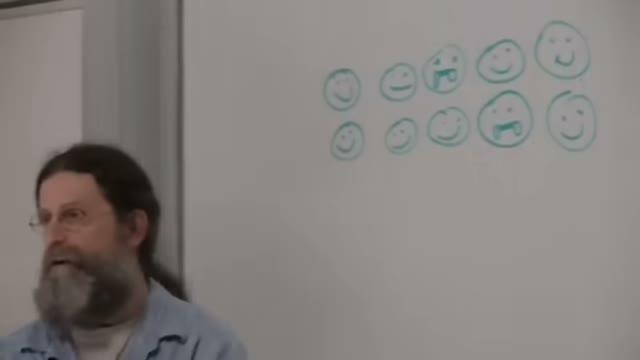
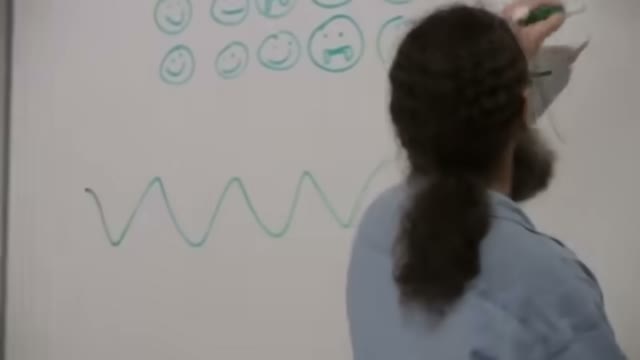
After restating Axelrod’s result, Sapolsky shows tit for tat’s weakness, which only appears once the world is imperfect (51:00). Suppose a cooperative move is garbled by noise in the system and arrives looking like a defection (51:33). The other player retaliates next round. The first player, who doesn’t know about the error, sees an unprovoked betrayal and retaliates in turn. The two then seesaw “for the rest of time” (52:35), and 50% of the cooperation is gone.
Sapolsky illustrates it with a thriller he read as a kid (53:05): a cockroach chews through a wire, the United States accidentally launches a nuclear missile that destroys Moscow, and the book ends with a tit-for-tat response to avoid all-out war, with the Soviet Union allowed to destroy New York. Our note: this matches the 1962 novel Fail-Safe, in which an accident sends American bombers to Moscow and the American president orders New York bombed himself to prevent escalation.
Once Axelrod’s simulations included signal errors, the successors arrived:
| Strategy | Rule | Strength | Weakness |
|---|---|---|---|
| Tit for tat | Copy the other player’s last move | Best in a noise-free world | Locks into endless seesawing after one error |
| Forgiving tit for tat (54:10) | Tit for tat, but after, say, five rounds of seesawing, cooperate anyway | Restores cooperation after a signal error | Can be exploited by players who never forgive (55:46) |
| Strict, then forgiving (56:48) | Start as tit for tat; switch to forgiving only after enough rounds without betrayal | Hard to exploit early, resilient to errors later | How many rounds to wait is its own optimization problem |
| Pavlov (57:53) | If your last move earned points, repeat it; if it lost points, switch | Exploits forgiving players (58:58) | The name has “nothing whatsoever to do with Pavlovian psychology”, as Sapolsky admits |
Sapolsky’s reading of the third row is the interesting one: switching to forgiveness after a stretch of good behavior is “deciding you trust somebody” (56:48). He suggests checking Pavlov’s behavior yourself with a long roll of toilet paper. Our note: Pavlov is usually called “win-stay, lose-shift”, and was popularized by Martin Nowak and Karl Sigmund in the early 1990s.
59:32 – 1:01:33 Biologists borrow the game theorists’ language
Other games followed (the ultimatum game, the trust game) with the same structure of choosing between cooperation and cheating. The modelers were already using biological metaphors (59:32): strategies “drive the other one into extinction”, glitches are “mutations”. Biologists just starting to think sociobiologically noticed and asked whether real organisms play by these rules (1:00:02).
A side story shows how far game theory reached. Daniel Ellsberg, who became famous around 1970 for leaking thousands of pages of secret Pentagon files on Vietnam to the New York Times, began as a Pentagon game theorist (1:00:32). Sapolsky cites a paper of his on “The Optimal Benefits of Perceived Madness” (1:01:02): if your opponent thinks you might do anything, including setting off mutually assured destruction, they will cooperate to stop you. Our note: Ellsberg’s 1959 lecture on this idea was titled “The Political Uses of Madness”.
1:01:33 – 1:08:58 Tit for tat in the wild
Armed with the prisoner’s dilemma, zoologists went looking (1:01:33).
- Vampire bats (1:02:04). In Sapolsky’s account, mothers return from feeding with blood stored in a throat sack and disgorge it for the babies in a shared nest, everybody’s babies, not necessarily kin. The experiment (1:03:07): net a female on her way out, pump her throat sack full of air so she looks full, and put her back. She feeds no one, the others conclude she is hoarding, and next time they don’t feed her kids. That is tit for tat, triggered by a signal error that “some grad student” introduced. Our note: the classic field work on blood sharing is Gerald Wilkinson’s, which found adults regurgitating blood to roost-mates that had missed a meal.
- Sticklebacks (1:04:12). A mirror at the side of a tank makes a fish believe a rival is attacking. A second, perpendicular mirror creates an apparent partner that advances alongside it (“what a team we are”). Angle that mirror so the “partner” hangs back (1:05:17), and next time the fish doesn’t attack: it is punishing its own reflection for defecting. Our note: this is Manfred Milinski’s 1987 experiment.
- Black hamlet fish (1:06:21). Pairs of these fish take turns being female, which costs more (eggs) than being male (sperm). If one partner plays male too much of the time, the other stops cooperating. Our note: Sapolsky describes them as changing sex; hamlets are in fact simultaneous hermaphrodites, carrying both sexes at once and taking turns releasing eggs, which biologists call egg trading.
The researchers were “blown out of the water”, but Sapolsky’s answer is the same as for the giraffe (1:07:54): no, nature isn’t amazing. It is the same “wind tunnel of selective optimization”, now shaping when to cheat and when to cooperate instead of heart size.
1:08:58 – 1:14:40 Where the models break
Then the exceptions arrived.
- Lions (1:08:58). Craig Packer of the University of Minnesota used the vervet trick on lion prides in East Africa, including prides that were not close kin: a hidden speaker plays the sound of menacing strange lions, and the pride has to approach the bush carefully. Some prides had one “scaredy cat” lion that habitually hung back, and nobody punished it (1:09:59). Maybe lions are not paying attention, but bacteria manage reciprocity, so Sapolsky prefers another explanation: the laggard pays back in a different realm, perhaps by eating less at kills. Real animals play several games at once, and the rules of one “dribble into” another (1:11:01).
- Naked mole-rats (1:11:34). The mammals closest to social insects, living in big cooperative underground colonies in Africa that turned out not to be all relatives. Each colony has one or two big animals that do no work and scarf up food, and nobody punishes them (1:12:35): “There goes Robert Axelrod down the drain.” Long observation showed their other role (1:13:08): when the rainy season comes, these big animals go up, turn around and plug the tunnel entrances with their bodies, rear ends facing out toward whatever predators are around. Different roles, not freeloading.
Sapolsky adds that play changes when you know how many rounds remain, or when an opponent shows up with a reputation from games with others (1:14:09). Those complications return in the lectures on aggression and cooperation.
1:14:40 – 1:18:53 Mutating strategies, and the three blocks recapped
A University of Michigan computer scientist Sapolsky calls “James Holland” (he hedges that the first name may be different; it is John Holland), often credited with the first computer science PhD, added random mutation to evolving game strategies (1:14:40). That let modelers ask how often a mutant strategy is adaptive, spreads, or drives others extinct, which suggested the biological vocabulary might be more than metaphor.
Reciprocal altruism also has both selection channels (1:15:45): cooperative hunting (wild dogs, jackals) is the natural-selection version, and two unrelated friends spending “an insane amount of energy” helping each other look good before the prom is the sexual-selection version.
The recap (1:16:46): not survival of the fittest, not the good of the species or group, but three ways to maximize copies of your genes. Individual selection (“an egg’s way of making another egg”); kin selection, with the hard problem of recognizing relatives, a later lecture, including how humans recognize kin in an unusual way that leaves them open to manipulation and helps explain why people in culture after culture treat “thems” badly; and reciprocal altruism, “you scratch my back and I’ll scratch your back”, which works in the wild but runs into a messier world of multiple roles and “naked mole rats stuck in plumbing”.
1:18:53 – 1:25:41 Back to the skulls: what size difference predicts
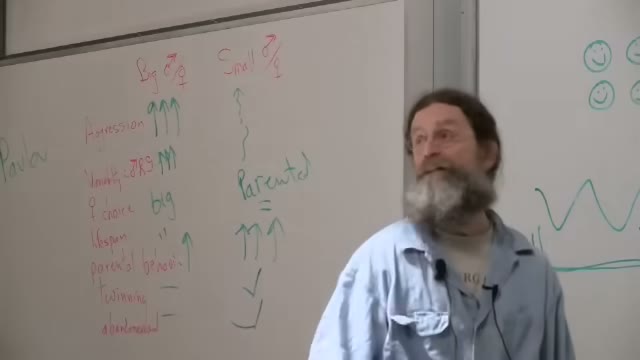
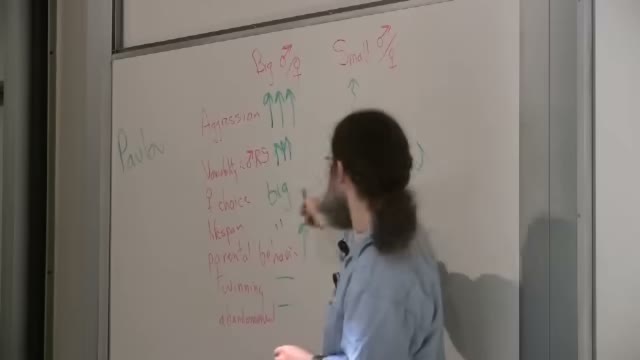
The skulls return (1:18:53). Species one: males much larger than females. Species two, “in the next county”: males and females the same size. Sapolsky builds the predictions with the class, one line on the board at a time.
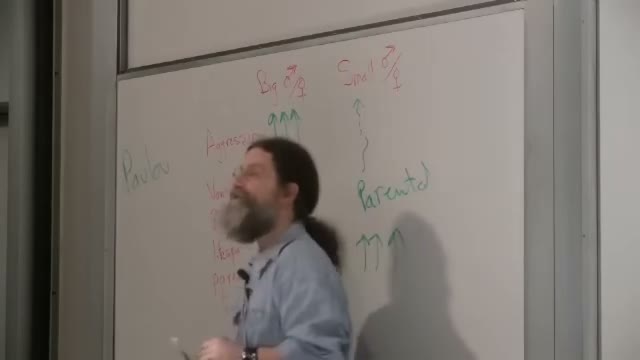
- Male aggression (1:19:24): higher in species one, where male bodies are built for it, perhaps because females have selected for that.
- Variability in male reproductive success (1:20:29): huge in species one, where 5% of the males might do 95% of the reproducing; low in species two, where every male has a kid or two. If males fight, something must be at stake.
- What females want (1:21:00): in species one, all a female gets from a male is sperm, so it “might as well be some good sperm”, which means big, healthy, impressive males. In species two males are “soccer dads” who share child-rearing (1:22:05), so females want a competent father: a male as much like a female as possible, who hasn’t wasted energy on muscle and canines that could have gone into reading Goodnight Moon. In birds, courtship feeding (a male bringing worms) is the proof of foraging competence (1:25:10).
The term for the size difference is sexual dimorphism (1:24:08): high in species one, low in species two.
1:25:41 – 1:33:05 Tournament species and pair-bonding species
- Lifespan (1:25:41): in high-dimorphism species, males die younger, from the calorie cost of extra muscle, vulnerability in famines, the effects of high testosterone on the circulatory system, and more injuries. In low-dimorphism species, there is basically no difference.
- Twins (1:26:13): a single mother, say a rhesus monkey, cannot feed two at once, so twins are rare in such species and one almost always dies. Where males share care, some primate females always have twins and both survive.
- Mothers bailing out (1:27:16): only worth it where the father will take over, so it appears in the low-dimorphism species. Sapolsky calls it “female cuckoldry, this great Victorian term”. In those species, he says, males after birth spend more calories caring for the young than females do.
He gives the two profiles names (1:28:22):
| Tournament species | Pair-bonding species | |
|---|---|---|
| Body size by sex | Males much bigger, often showier | About equal; hard to tell the sexes apart |
| Male aggression | High | Low |
| Male reproductive success | Very unequal | Similar across males |
| Female choice | Good genes (health, display) | Good fathering |
| Lifespan | Males die younger | Similar |
| Paternal care | Little or none | As much as females, or more |
| Twins | Rare, usually one dies | Routine in some primates |
| Examples | Peacocks, chickens, savanna baboons, mandrills | South American marmosets and tamarins |
The peacock’s tail is the cleanest case (1:28:55): useless for parenting, but a sign that the male is healthy enough to waste energy on “big stupid pointless feathers”, which is all a female in a tournament species can get from him. In marmosets and tamarins (1:30:30), you can’t tell male from female by looking, and a male doesn’t want to get 47 females pregnant, because he would have to help raise all the kids.
So the promise from the start of the lecture is kept: one fact about skull sizes, run through these principles, predicts much of a species’ social system. Sapolsky says the dichotomy holds across birds, fish and primates, with caveats, such as voles famous on Hallmark cards for monogamy turning out less monogamous than you’d think (1:32:34).
1:33:05 – 1:36:45 Where do humans fit?
Humans sit in the middle on every measure: size dimorphism, variability in male reproductive success (“I’m not going near that one”), lifespan difference and parental behavior (1:33:05). We are neither a classic tournament species nor a classic pair-bonding one, which, Sapolsky jokes, explains about 90% of literature. The next lecture looks at the genetics behind the two patterns.
Anthropology agrees (1:34:08). Most people today live in cultures that demand monogamy, and many in those cultures are not monogamous in practice. Traditionally, “before the missionaries got them”, most cultures allowed polygamy, yet most people in them were pair-bonded and monogamous. He distinguishes two kinds of polygamy (1:34:38):
- Economic: the wealthiest man in the village has the most wives, an enormous skew in reproductive success driven by money.
- Demographic: in a culture with a warrior class (he doesn’t name one), men spend about ten years as warriors, finish around 25, then marry girls of about 13. So many of those men die from the violence, and from the extra years of age difference, that there is a shortage of males.
He closes by previewing Friday (1:36:14): more behaviors the three blocks explain, including some, like killing members of your own species, that “good of the species” thinking circa 1960 can’t explain at all, and then how this applies to humans.
Our note: the lecture’s structure is worth copying as a study method. Each new behavior gets the same question: is this individual selection, kin selection or reciprocity, and through natural or sexual selection? That six-way grid covers almost everything Sapolsky discusses here.
Skip list
- 0:04 – 3:45 Cross-listing question and questionnaire answers.
- 48:24 – 49:25 The life-vest aside.
- 50:25 – 51:00 Post-break restatement of Axelrod’s tournament.
- 53:05 – 54:10 The thriller plot; the point (one error can escalate) is in the notes above.
- 1:00:32 – 1:01:02 Ellsberg’s biography before the game theory point.
- 1:22:36 – 1:23:06 Students calling out answers (“good personality”, “able to express emotions”); the conclusion follows right after.
Glossary
- Group selection — the discredited idea that animals act for the good of their group or species; associated with V.C. Wynne-Edwards.
- Individual selection — selection for behavior that maximizes copies of an individual’s own genes, mainly through its own reproduction.
- Natural selection — selection for traits that help an organism survive and reproduce.
- Sexual selection — selection for traits that attract mates, even if they do nothing for survival or even hurt it.
- Kin selection (inclusive fitness) — selection for helping relatives, weighted by the share of genes held in common.
- Coefficient of relatedness — the proportion of genes two relatives share by descent: 100% for identical twins, 50% for full siblings, 25% for half-siblings, 12.5% for first cousins.
- Reciprocal altruism — cooperation between non-relatives that depends on give and take, recognition of individuals and detection of cheaters.
- Prisoner’s dilemma — a two-player game where cheating pays best individually but mutual cooperation beats mutual cheating.
- Nash equilibrium — a set of strategies where no player gains by changing strategy alone.
- Tit for tat — cooperate first, then copy the other player’s previous move.
- Forgiving tit for tat — tit for tat that cooperates anyway after a run of mutual retaliation, to escape error-driven seesawing.
- Pavlov (win-stay, lose-shift) — repeat a move that paid off; switch after one that didn’t.
- Sexual dimorphism — differences between the sexes in body size or appearance.
- Tournament species — species with high sexual dimorphism, intense male competition and little paternal care.
- Pair-bonding species — species with low sexual dimorphism, shared parenting and mostly monogamous pairs.
FAQ
What are the three building blocks of behavioral evolution in Sapolsky's Lecture 2?
Individual selection (behavior that gets more copies of your own genes into the next generation, through survival or through sexual selection), kin selection (helping relatives in proportion to how many genes you share with them), and reciprocal altruism (cooperating with non-relatives under strict rules of give and take, while watching for cheaters). All three replace the older idea that animals act for the good of the species.
Why does Sapolsky reject the idea that animals behave for the good of the species?
Because selection works on how many copies of an individual's genes reach the next generation, not on what helps the group. His example is the old wildebeest that seems to sacrifice itself to crocodiles so the herd can cross a river: watched closely, it is being shoved in from behind. The 'good of the species' view is called group selection and is associated with the zoologist V.C. Wynne-Edwards.
Why did tit for tat win Robert Axelrod's prisoner's dilemma tournament?
Tit for tat cooperates on the first move and then copies whatever the other player did last. Sapolsky lists four reasons it beat every other entry: it is nice (starts by cooperating), retaliatory (punishes a defection), forgiving (returns to cooperation as soon as the other player does) and clear (its rule is easy to read). In his phrase, it may lose the battles, but it wins all the wars.
What goes wrong with tit for tat when there are errors?
If one cooperative move is misread as a defection, two tit-for-tat players fall into a seesaw of alternating punishment that wipes out half of their cooperation. Forgiving tit for tat, which cooperates anyway after several rounds of seesawing, breaks the cycle but can be exploited by players who never forgive. Sapolsky also describes starting strict and switching to forgiveness once trust is established, and the 'Pavlov' rule of repeating whatever just paid off.
Are humans a tournament species or a pair-bonded species?
Neither cleanly. On body-size difference between the sexes, variability in male reproductive success, lifespan difference and paternal care, humans sit somewhere in the middle. Sapolsky points to anthropology as confirmation: most traditional cultures allowed polygamy, yet most people in those cultures lived in monogamous pairs.
Studying another course? Paste its YouTube or Bilibili link on the home page to request a handout — or make your own with the desktop app (coming soon).