Sapolsky Human Behavioral Biology, Lecture 5: Molecular Genetics II — notes and timestamps
Watch the video (74 min)
Watch the original video on YouTube
Lecture 5 of Robert Sapolsky’s Stanford course finishes the molecular genetics unit begun in Lecture 4, “Molecular Genetics I”. That lecture introduced introns and exons, promoters, transcription factors and epigenetics. This one uses them to answer a challenge raised against punctuated equilibrium: where are the molecular mechanisms for sudden, large evolutionary change? Sapolsky goes through five of them (splicing enzymes, promoters, transcription factors, transposable elements and gene duplication), explains why they mostly produce stasis, and ends by arguing that gradual and punctuated evolution can both be true. For the full course map, see the course index.
Key takeaways
- Micro vs. macro is the organizing contrast (19:02). Microevolution tunes how an existing protein works; macroevolution changes which proteins are made, when, and in which networks, the lecture’s “if-then clauses”.
- A single mutation in a regulator can rewire a whole network (9:39). Changes in splicing enzymes, promoters and transcription factors each have amplified effects, and human–chimp differences are concentrated in transcription factor genes.
- Jumping genes are real and often switched on by stress (27:26). Barbara McClintock’s transposable elements let plants, immune systems, parasites and even neuron-making cells reshuffle DNA.
- Moving a promoter or an exon creates a brand-new if-then rule (42:07), as in the thought experiment where a progesterone-binding domain makes the body suppress immunity during pregnancy.
- Gene duplication gives evolution a spare copy to experiment with (49:24), which Sapolsky uses to answer the “irreducible complexity” argument.
- Macro-mutations are usually harmful, so they produce stasis, except in bottlenecks (54:02). That combination is the molecular basis for punctuated equilibrium.
- Evolution can be watched in real time (1:01:19): Chicago rats, Darwin’s finches, diabetes in Westernizing populations, tame foxes and antibiotic resistance.
Chapter notes
0:14 – 6:28 Recap: two ideas under attack
After announcements (including a student with a central-dogma tattoo), Sapolsky summarizes Lecture 4. Two assumptions from the sociobiology lectures took damage. The first is gradualism: point mutations, insertions and deletions only nudge how a protein performs, but punctuated equilibrium says most of evolutionary time is static, broken by rapid change (2:19). Its critics’ strongest demand was to show molecular mechanisms for such jumps. The second is DNA as the command center: most DNA is regulatory, transcription factors carry information from the outside world to the genes, and epigenetic marks change which genes are reachable. His summary line: fertilization is about genetics, development is about epigenetics.
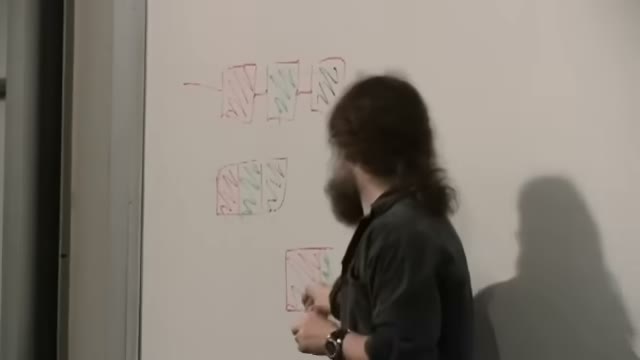
Our note: the whole lecture is built on one concept from Lecture 4, the gene’s “if-then clause”. The promoter is the “if” (a condition in the cell or environment); the gene is the “then”. Every mechanism below is a different way of rewriting the clause instead of the protein.
6:28 – 9:06 Mutant splicing enzymes invent new proteins
A gene with three exons is transcribed into RNA, and a splicing enzyme cuts out the introns. If the splicing enzyme itself mutates and cuts in different places, the cell makes proteins it has never made before (7:00). That is not a protein working slightly better; it is a new protein attached to an existing “if”. Splicing enzymes are coded by genes with their own promoters and exons, so the regulation is recursive. A student asks how often such changes are useful; Sapolsky defers the answer to later in the hour: rarely, and that matters.
9:06 – 14:50 Promoter mutations: new networks, voles and vasopressin
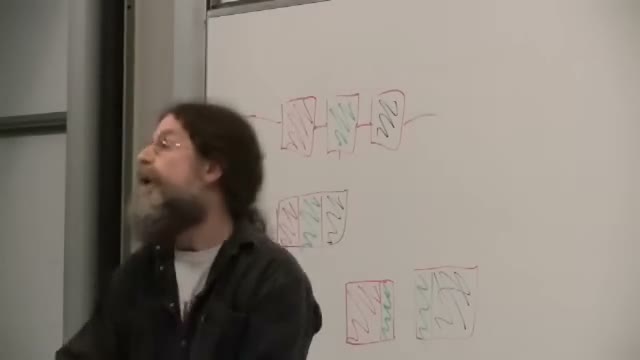
The same promoter sequence typically sits upstream of many genes, so it controls a network. Mutate it in only some locations and you build a new network out of part of the old one; change it everywhere and a different transcription factor may bind, creating a whole new “if” for the network (9:39).
Examples, each a change in a promoter rather than a gene:
- Voles. Monogamous and polygamous vole species differ in the promoter upstream of the vasopressin receptor gene. Using gene-transfer techniques to swap in the other version changes where the receptor is expressed in the brain and can make a polygamous male behave monogamously (12:15).
- Dynorphin. The number of copies of a promoter upstream of the gene for this opioid-like pain peptide predicts how readily rats become addicted to drugs (13:17).
- Humans. Variants of the vasopressin receptor promoter in men predict, statistically, the stability of their relationships and divorce risk. Sapolsky ties this back to the free-will theme of Lecture 1 and promises more in the sex lectures.
14:50 – 19:33 Transcription factors and the human–chimp gap
A mutation in a transcription factor gene changes every network that factor controls. Humans and chimps share roughly 98% of their DNA, and a disproportionate share of the genetic differences fall in transcription factor genes (15:21). This fits a prediction by King and Wilson at Berkeley, who first produced the 98% figure with early molecular methods and argued that the important evolutionary changes would be regulatory, not in protein-coding sequence. Sapolsky mentions Hunter Fraser, a new Stanford faculty member working on this.
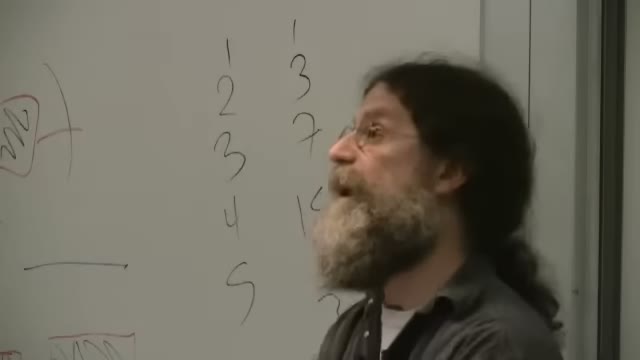
A second line of evidence: across about 100 sequenced genomes, species with more genes have a higher percentage of transcription factors (18:00). With n genes there are 2ⁿ − 1 possible combinations of them, so the regulators needed to exploit those combinations grow much faster than the genes.
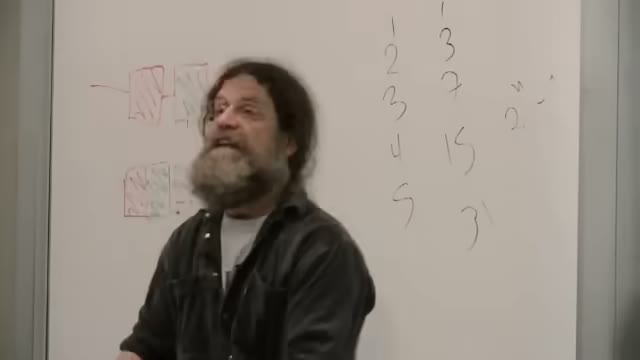
Our note: this is the arithmetic behind “macro” effects. Adding regulators multiplies possible expression patterns; tuning a structural protein only changes one output.
19:33 – 25:52 Barbara McClintock and “jumping genes”
The fourth mechanism comes with a story. Barbara McClintock, a maize geneticist, was elected to the National Academy of Sciences unusually young for a woman of her era (20:36). Working only from kernel-color inheritance, she concluded the data could only be explained if genetic elements moved around the chromosome: transposable elements. The field mocked the idea, and she kept working largely alone at Cold Spring Harbor. When molecular methods later confirmed transposons, she became famous and received the Nobel Prize, and, by Sapolsky’s account, mainly wanted to go back to her corn. He mentions meeting her once.
Our note: Sapolsky himself qualifies the legend (24:50): she was less isolated than the story says, and some neglect came from how hard her papers were to read.
25:52 – 33:11 Who shuffles their DNA, and when
- Plants. She studied the right organism. A plant can’t run from a pathogen or drought, so under stress it activates an enzyme, transposase, that copies stretches of DNA and drops them elsewhere, gambling on something useful (27:26).
- Vertebrate immune systems. The body makes antibodies against molecules that never existed before. One trick is shuffling antibody-related gene segments to generate huge variety, then keeping the ones that work (28:58).
- Parasites. Trypanosomes, which cause trypanosomiasis, shuffle the genes for their surface proteins every few weeks, staying a step ahead of the antibodies. The result is a co-evolutionary arms race.
- Neural progenitors. In primates, one transposable element becomes especially mobile in the cells that make new neurons, just as they start dividing (31:06). Sapolsky’s point: the cells most responsible for who you are get the most genetic reshuffling, which weakens strict genetic determinism.
He answers the earlier question in passing: most random reshuffles are harmful, for reasons he explains at 52:30.
33:11 – 39:33 Transposed promoters: two thought experiments
Sapolsky stresses these are deliberately crude cartoons, not real pathways. If a promoter moves, the “if” gets attached to a new “then”.
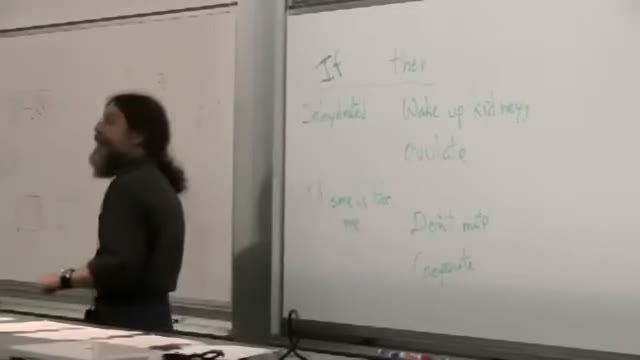
- “If dehydrated, then ovulate.” A dehydration-sensing promoter lands upstream of ovulation genes (34:43). Students propose answers, and the useful one is seasonal breeding: depending on gestation length, a species can time births to the wet season by using dryness, or wetness, as the signal.
- “If it smells like me, then cooperate.” Many species use a smells-like-kin signal to avoid mating with relatives. Move that promoter in front of cooperation genes and you have the start of kin selection; with several copies you could even grade cooperation by degree of relatedness (37:58).
Our note: the second example links this lecture to the sociobiology lectures. Kin selection was argued from behavior there; here Sapolsky sketches how a single genomic event could start it.
39:33 – 46:45 Transposed exons: swapping a hormone-binding domain
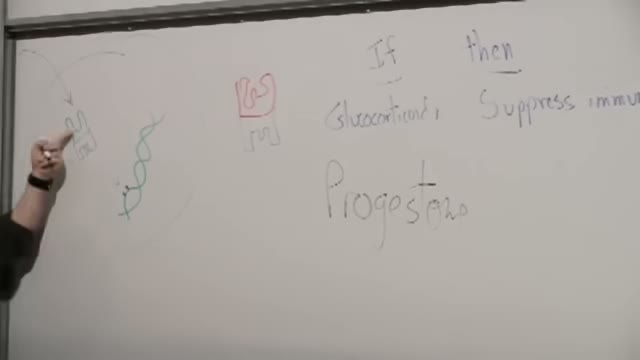
Transposition can also move parts of genes. Steroid hormones (estrogen, progesterone, testosterone, glucocorticoids) enter a cell and bind a receptor. One part of the receptor, the hormone-binding domain, recognizes the hormone; another part, the DNA-binding domain, recognizes a specific promoter. The two parts sit in different exons (41:35).
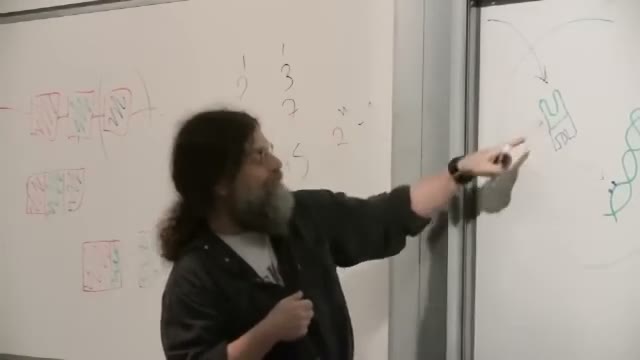
Swap the glucocorticoid receptor’s hormone-binding domain for the progesterone receptor’s, and “if stress hormones, suppress immunity” becomes “if progesterone, suppress immunity”. Students identify the payoff: immune suppression during pregnancy, so the mother’s body does not attack the fetus (43:39). The cost shows up after birth: if immunity rebounds past its old level, autoimmune disease can begin or flare in the postpartum period, which is why some women with severe lupus are advised against pregnancy (45:43).
46:45 – 52:30 Gene duplication and copy number variants
After a short break, the fifth mechanism: genes, or whole chromosome stretches, can be duplicated, a field now called copy number variation. Sapolsky notes links to schizophrenia, a possible backup role for a second copy in some Alzheimer’s cases, and dosage effects: on average Japanese populations carry more copies of a gene for a carbohydrate-digesting enzyme than Western Europeans (48:19).
The bigger point is freedom to experiment. With one copy doing the original job, the other can drift and evolves faster. Joe Thornton (University of Oregon) traced several steroid receptor genes back to duplicates of a single ancestral gene (49:54). This answers the creationist “what good is half an eye?” argument: a spare copy can wander through useless intermediate forms until it fits a hormone that appeared long before. Sapolsky adds that Russ Fernald’s work shows “half an eye” exists in many useful forms anyway.
52:30 – 58:11 Why macro changes mostly mean stasis
Now the answer to the early question. A single base-pair change in an exon used in many combinations, or in a transcription factor, alters many proteins at once. The chance that all those changes are acceptable is tiny, so most macro-mutations are harmful, and stabilizing selection removes them (54:02). That produces the long flat stretches of stasis.
Change happens in an evolutionary bottleneck, when selection is so harsh that one rescuing trait outweighs every side effect. Examples: cheetahs, so inbred after a bottleneck a few thousand years ago that skin can be grafted between any two without rejection (55:34), and probable bottlenecks in hominin history. Conclusion: Gould and colleagues are right that the molecular structure of genes favors long stasis with bursts of change, with the caveat that “rapid” for a paleontologist can mean thousands of generations to a biologist.
Our note: the same property, that one change touches many things, explains both halves of the pattern. It makes most macro-mutations lethal, which gives stasis, and it makes the rare winner a large jump, which gives punctuation.
58:11 – 1:01:19 Reconciling the two views: different systems, mixed fossils
Sapolsky’s first resolution: micro and macro may govern different systems. Human–chimp immune differences (humans resist tuberculosis better, chimps resist malaria better) are mostly micro changes. The macro differences are in development, where small changes amplify into a different-looking species (59:45). The detailed fossil lineages show both patterns, mostly punctuated. The difficulty is that gradual change is, by nature, hard to see.
1:01:19 – 1:05:59 Evolution observed in real time
- Chicago rats. Stored carcasses from the 1880s, compared with today’s rats, show substantial genome change within a century (1:01:19).
- Darwin’s finches. Decades of Galápagos fieldwork show gene frequencies for bill size shifting with environmental change.
- Type 2 diabetes. When populations switch rapidly from traditional to Western diets, adult-onset diabetes soars: among the Pima of Arizona (but much less among Pima in Mexico), Pacific Islanders in places like Nauru and Samoa, and Yemenite Jews who moved to Israel (1:03:23). The people with the most efficient, calorie-storing metabolisms die before reproducing, and in some Pacific populations diabetes rates are starting to fall, selection within about a century.
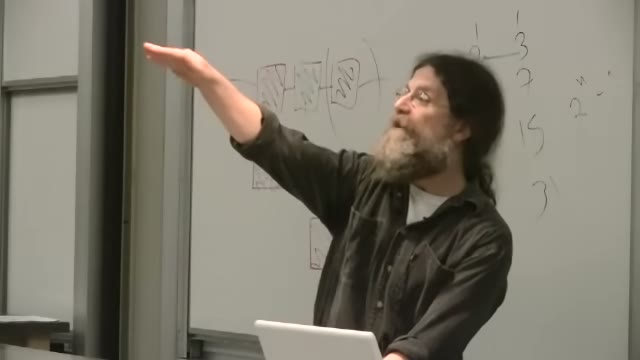
1:05:59 – 1:10:11 The Siberian silver fox experiment
A Soviet geneticist bred captive silver foxes, valued for fur, selecting each generation only the calmest 5–10% near humans (1:07:04). In about 35 generations the foxes were as tame as dogs, and their bodies changed too: rounder floppy ears, shorter muzzles, tail wagging. Sapolsky’s explanation, which he’ll return to in the ethology lectures: selecting for tameness selects for juvenile, more dependent traits, so the adults resemble fox pups. The twist is that the coats became piebald, which made the furs commercially worthless.
1:10:11 – end Antibiotic resistance, “have it all”, and what comes next
Last example: antibiotic resistance in bacteria, rapid evolution with serious consequences for human life expectancy. Many of these changes (metabolic, bacterial) would leave no trace in fossils, so paleontology can’t detect them. Final resolution (1:11:43): traits evolve in packages, and if many traits each jump at different times, the population-level average looks smooth. Punctuated events summed together look gradual.
He previews the next unit, behavior genetics: adoption studies, identical versus fraternal twins, and twins raised apart. Each approach, he says, treats as a starting point what the previous one treated as a finished explanation.
Skip list
- 0:14 – 1:16 Housekeeping: office hours, the earlier confusion over selection types, and the tattoo.
- 8:04 – 8:36 The student question and Sapolsky’s joke about the answer coming an hour later; the answer is at 52:30.
- 24:18 – 25:52 The rest of the McClintock story: fame, the Nobel, meeting her in person. Enjoyable, but no new science.
- 46:45 – 47:17 The break.
- 1:08:06 – 1:09:39 Sapolsky’s delighted reaction to the fox photos and the fur-coat joke; the result is summarized above.
- 1:13:49 – end Closing and credits.
Glossary
- Microevolution — small changes in how well an existing protein does its job, usually from point mutations; the basis of gradualist evolution.
- Macroevolution — in this lecture, changes in which proteins are made, when, and in what combinations, capable of large sudden effects.
- If-then clause — Sapolsky’s shorthand for gene regulation: a promoter responding to a condition (if) switches on a gene or network (then).
- Splicing enzyme — the enzyme that cuts introns out of RNA and joins exons; changing where it cuts produces different proteins.
- Transcription factor — a protein that binds a promoter and switches genes on or off, often a whole network at once.
- Transposable element (transposon) — a DNA stretch that can be copied or moved to a new place in the genome; McClintock’s “jumping genes”.
- Transposase — the enzyme that carries out transposition, often switched on under stress.
- Copy number variant — a difference between individuals in how many copies of a gene or DNA segment they carry.
- Evolutionary bottleneck — a crisis that only a small fraction of a population survives, letting rare traits spread quickly.
- Stabilizing selection — selection that removes deviations from the existing form, keeping a lineage unchanged.
- Punctuated equilibrium — Gould and Eldredge’s model of long stasis interrupted by brief periods of rapid change.
FAQ
What is the difference between microevolution and macroevolution in Sapolsky's Lecture 5?
In his framing, microevolution changes how well an existing protein works: a point mutation makes it bind a little better or fold a little differently. Macroevolution changes which proteins are made, when, and in what combinations, through mutations in splicing enzymes, promoters, transcription factors, transposable elements and gene copy number. One small DNA change of the second kind can rewire a whole network.
Why does Sapolsky say macro-mutations support punctuated equilibrium?
Because a change that alters many proteins or a whole network is almost always harmful somewhere, stabilizing selection weeds such changes out, which produces long periods of stasis. But during a severe selective bottleneck, a rare macro-change that happens to save its carriers can spread fast despite its side effects. Long stasis plus occasional rapid change is exactly the punctuated pattern.
Who was Barbara McClintock and why does she come up in this lecture?
McClintock was a maize geneticist who inferred from kernel-color inheritance that genetic elements can move around the genome. The idea was dismissed for decades, then confirmed once molecular tools caught up, and she received the Nobel Prize. Sapolsky uses her transposable elements as one of the main mechanisms for large, sudden genetic change.
What is the Siberian silver fox experiment Sapolsky describes?
A Soviet geneticist (Dmitri Belyaev, though Sapolsky does not name him) bred captive silver foxes only for calmness around humans. In roughly 35 generations the foxes became as tame as dogs, and they also changed in looks: floppier ears, shorter muzzles, tail wagging and piebald coats. Sapolsky uses it as an example of fast, observable evolution, and notes the breeding was selecting for juvenile traits.
How does Sapolsky reconcile gradualism and punctuated equilibrium?
He argues both happen. Some systems, like the immune system, differ between humans and chimps mostly by small micro changes, while developmental programs differ through macro changes. And if many separate traits each change in a punctuated way at different times, the population as a whole can look like it is changing gradually.
Studying another course? Paste its YouTube or Bilibili link on the home page to request a handout — or make your own with the desktop app (coming soon).