Sapolsky Human Behavioral Biology, Lecture 4: Molecular Genetics I — notes and timestamps
Watch the video (94 min)
Watch the original video on YouTube
Lecture 4 of Robert Sapolsky’s Stanford course Human Behavioral Biology (Bio 150, recorded in 2010) is the first of the course’s planned jumps from one discipline to the next. After two lectures on behavioral evolution, ending with Lecture 3, Sapolsky drops to the molecular level and asks what evolution looks like in DNA. The first half builds the classical picture: genes code for proteins, a single-letter mutation changes how well one protein works, and that supports slow, gradual evolution. The second half takes the picture apart, first with Gould and Eldredge’s punctuated equilibrium, then with discoveries that show DNA is regulated far more than it regulates: genes in pieces, non-coding switches, transcription factors and epigenetics. The lecture ends on a question that Lecture 5 answers: what happens when mutations hit the regulators instead of the proteins? For the full course map, see the course index.
Key takeaways
- Classical mutations change how well one protein does its job (23:20). Point mutations, insertions and deletions alter a protein’s shape, and with it how well its key fits its lock.
- One letter can still change a life (28:02). PKU, androgen insensitivity and a puberty-onset sex change in two isolated populations each trace back to a single small mutation.
- The pattern of mutations leaves a footprint of selection (45:08). Far more amino-acid-changing differences than chance predicts means positive selection; almost none means the protein is too important to touch.
- Punctuated equilibrium challenged gradualism, and its critics demanded a mechanism (1:01:25). In the 1980s, Sapolsky says, Gould’s camp had no molecular answer.
- Genes are modular, so one gene can make many proteins (1:08:30). Splicing enzymes mix and match exons differently by tissue, time and circumstance.
- Most DNA is switches, and the switches answer to the environment (1:13:12). Promoters and transcription factors turn genes into if-then clauses: if this condition, then make these proteins.
- Epigenetics can make early experience last a lifetime (1:29:34). Mothering style can permanently change which genes are reachable.
Chapter notes
0:15 – 4:57 The first jump between disciplines
Sapolsky explains the plan for the first half of the course: just as you get comfortable inside one discipline’s explanation, he switches to another and shows where the first one runs out. This is the first switch, from evolution of behavior to evolution at the molecular level.
He recaps three tenets of the sociobiology view criticized at the end of the previous lecture. Heritability: the assumption that behaviors have a genetic component, basis or cause, three phrases he says are very different. Adaptation: the idea that everything is optimized, against the counter-view of spandrels, traits carried along as baggage. And gradualism, the emphasis on small incremental change (1:51), which this lecture will challenge. A fourth thread runs through all three: politics, as in Lecture 1’s stories about who got lobotomized or labelled uneducable.
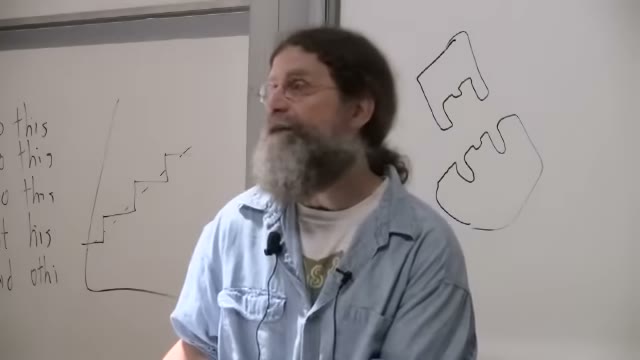
Then the methodological complaint (3:54). The sociobiologist builds a model out of kin selection and reciprocal altruism, shows it fits the behavior, and says that until you produce a better model, the fit counts as evidence for a genetic basis. Molecular biologists, Sapolsky says, regard this with contempt: show us the actual genes.
Our note: remember this “show me the mechanism” demand. At 1:01:58 the gradualists turn the same weapon on Gould.
4:57 – 12:50 Genes, proteins and why shape is everything
Here genes are molecules, strings of DNA, not the abstract units counted in kin selection. Their link to behavior runs through proteins, which hold cells together, act as messengers such as hormones and neurotransmitters, and work as enzymes.
The chain Sapolsky sets up (7:38): know the DNA sequence and you know the RNA, the amino acid sequence, the protein’s shape and therefore its function. About 20 amino acids are each coded by a three-letter stretch of DNA. Shape matters because proteins work by fitting other molecules, the lock-and-key cliché he makes the class say aloud (8:42). Shape in turn comes from chemistry: each amino acid is attracted to or repelled by water to a different degree, so a given sequence folds into a given form (9:44). Prion diseases are the exception he flags and sets aside.
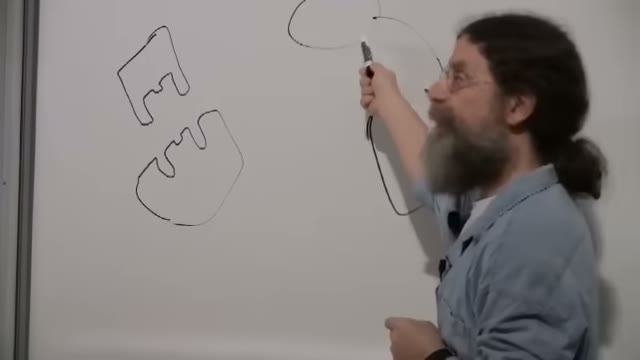
Two more roles complete the picture. Enzymes, nearly all proteins, speed up reactions enormously by joining two molecules or breaking one apart (11:18). And some proteins change shape as part of their job, such as ion channels that open and close (12:20).
12:50 – 16:28 The central dogma and its first crack
Francis Crick formalized the central dogma: information flows from DNA to RNA to protein (12:50). Sapolsky stresses the hierarchy built into it. DNA is the starting point and the boss, deciding when information flows. His preview of where the lecture is heading: DNA “knows squat”.
The first blow came in the 1970s from viruses made of RNA (15:25). A class of enzymes turns their RNA back into DNA, which is inserted into the host’s genome: these are retroviruses. The discovery was resisted, then won a Nobel Prize, but it was absorbed as a footnote. DNA stayed, in Sapolsky’s words, the Bible and the lawgiver.
16:28 – 23:20 Three classic ways to miscopy DNA
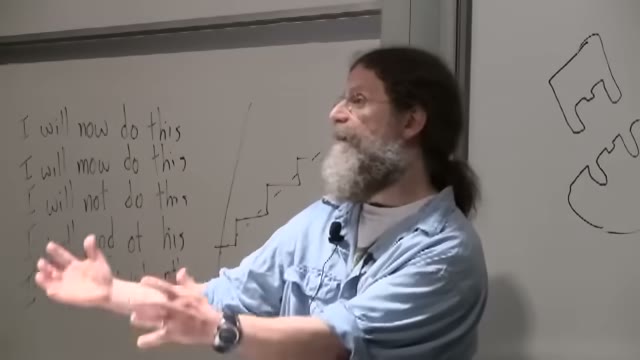
A micro mutation, for this lecture, is one letter of DNA going wrong (16:59), whether from a copying error, radiation or a chemical. There are three kinds.
- Point mutation. One letter swaps for another. With four letters there are 64 possible triplets for about 20 amino acids plus start and stop signals, so the code is redundant (18:43). The result can be neutral (same amino acid), mild (a similar amino acid, so the protein mostly works), or severe (a very different amino acid and a new shape). He shows a sentence whose meaning flips with one changed letter (21:15), and jokes that he once did that in a grant renewal.
- Deletion. A letter drops out, every triplet downstream shifts, and the rest of the message becomes gibberish (22:18). This is a frameshift.
- Insertion. An extra letter shifts the frame the other way, with similar damage.
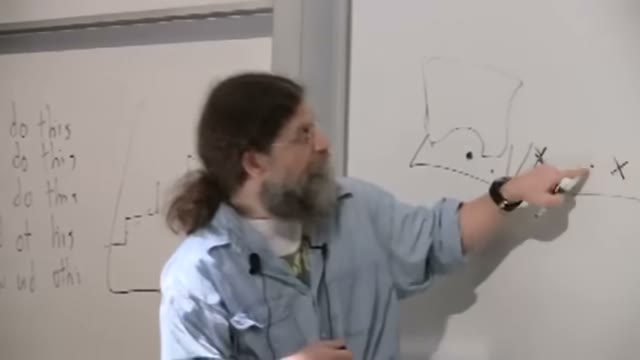
Our note: Sapolsky says redundant triplets usually differ in the middle letter. In the standard genetic code it is mostly the third letter that can change without changing the amino acid. His point, that many single-letter changes are silent, stands.
23:20 – 30:03 One protein at a time: PKU and androgen insensitivity
The concept to hold onto (23:20): micro mutations change a protein’s efficacy. A key with a slightly different shape fits less well, leaves the lock sooner and sends a weaker signal; a frameshifted key doesn’t fit at all. This is microevolution: change in how one protein works.
The effect can be huge when the protein is knocked out entirely.
- PKU (phenylketonuria) (24:55). An enzyme normally converts phenylalanine into something safer. A single ordinary mutation disables it, phenylalanine builds up, and untreated the nervous system is destroyed soon after birth. Reproductive success drops close to zero.
- Testicular feminization (26:29). Sapolsky tells it as a parent’s story: a daughter who still hasn’t reached puberty at 14 turns out to be genetically male, with undescended testes producing plenty of testosterone, yet a female body. A student supplies the modern name, androgen insensitivity (28:32). The mutation changes the shape of the androgen (testosterone) receptor, so target cells ignore the hormone however much there is. He notes a disturbing history of what doctors did to people with the condition.
30:03 – 34:45 A slow enzyme and a sex change at puberty
A subtler case: a protein that works less well rather than not at all. It appears in isolated, inbred mountain populations in the Dominican Republic and New Guinea (30:03). In Sapolsky’s account, an enzyme in the testosterone-making pathway is slow, so a genetically male fetus never gets past the threshold for testosterone’s effects and is born looking female. At puberty the surge is weaker than normal but strong enough to cross the threshold, and the child partially changes from female to male (33:12).
Along the way he contrasts it with androgen insensitivity, where current advice, he says, is to tell parents they have a healthy daughter who cannot reproduce (32:08). He also notes how both communities have absorbed the condition as an ordinary part of growing up (34:14).
Our note: the condition is usually identified as 5-alpha-reductase deficiency. That enzyme does not make testosterone; it converts testosterone into dihydrotestosterone (DHT), the more potent androgen that shapes the external genitals before birth. The lecture’s point, that one slightly slower enzyme can produce a dramatic outcome, holds either way.
34:45 – 38:18 Ordinary variation: the benzodiazepine receptor
The last example is not a disease but everyday individual difference (34:45). The brain has a chemical signaling system that lowers anxiety; drugs such as Valium and Librium are synthetic benzodiazepines that act on it. The gene for the benzodiazepine receptor comes in versions that differ at single positions (35:46). These aren’t mutations, just normal variation, and they slightly change how long the messenger stays bound. That is one of many contributors to how anxious a person tends to be.
It also explained an old puzzle. Rat lines bred for decades to be high- or low-anxiety turned out, in many cases, to differ in the shape of this receptor (37:18).
Our note: the benzodiazepine binding site sits on the GABA-A receptor, the brain’s main inhibitory receptor.
38:18 – 40:23 Why micro mutations mean gradualism
Now Sapolsky translates mutation into evolution (38:49). Suppose one base-pair change makes a receptor work slightly differently and its carrier 1.5% more fertile than competitors. Wait enough generations and everyone carries it (39:21). All of Darwin’s ingredients are there: variation from mutation, a difference in fitness, and selection shifting the population. Because each step is small, change is slow and steady. This is gradualism, and it fits neatly with the previous week’s logic of adaptation and competition, where every small edge counts.
40:23 – 47:12 FOXP2 and the footprints of selection
Single-letter changes also let you trace history. FOXP2 was first found in a family with a language disorder, and researchers still argue whether the problem is motor control of speech or grasping language as symbols (40:56). Versions of the gene appear across animals, always tied to communication: birdsong, the ultrasonic chatter of rats. Between most species the versions differ by a letter or so, but the human lineage shows a cluster of changes, which Sapolsky places in roughly the last quarter million years (41:59). Mice given the human version produce more complex ultrasonic calls (43:04).
Then the important tool (44:06). Because the code is redundant, a random mutation often leaves the amino acid unchanged; Sapolsky’s rough estimate is about two-thirds of the time. Compare that baseline with the differences actually found in a gene:
| Pattern of differences | What it suggests |
|---|---|
| Matches the random ratio | No strong selection either way |
| Nearly all change an amino acid (45:39) | Positive selection: the changes were advantageous |
| Nearly all are silent (46:11) | Stabilizing (negative) selection: the protein’s function must not change |
By Sapolsky’s account, the human FOXP2 changes bear the mark of strong positive selection (46:42), and each step fits the gradualist model.
Our note: the method is real and widely used, but the two-thirds figure is a simplification; in practice only around a quarter of random coding changes are silent. On FOXP2 itself, the human protein differs from the chimpanzee’s by two amino acids, and a 2018 reanalysis questioned earlier evidence of a recent selective sweep. Treat the lecture’s FOXP2 story as a 2010 snapshot.
47:12 – 50:52 Fifty percent with a sibling, ninety-eight with a chimp
Two familiar sound bites seem to clash: you share 50% of your DNA with a full sibling but 98% with a chimpanzee (47:12). Sapolsky’s resolution (48:15) is that the 98% concerns kinds of genes. Humans and chimps both have genes for a pelvis of a particular shape and for similar immune systems, and both lack genes for antlers, trunks and wings. The 50% from the kin selection lectures concerns versions (49:51): not whether you and your sibling both have a gene for opposable thumbs, but whether you have the same variant of it.
Our note: a more precise way to say it is that the chimp figure comes from comparing aligned DNA sequences, and any two humans already share more than 99.9% of theirs. Relatedness figures such as 50% look only at the spots where people vary, and ask how often you inherited the same copy from the same parent. The numbers measure different things, which is Sapolsky’s point.
50:52 – 52:32 The politics of gradualism
Before and after the break (50:52), Sapolsky draws out what is built into the gradualist model. If a 1% fitness advantage eventually spreads, then every small competitive edge matters, everywhere, all the time. Gradualism and a worldview centred on competition fit together, which is why the next model was a political as well as a scientific fight.
52:32 – 57:47 Gould and Eldredge: punctuated equilibrium
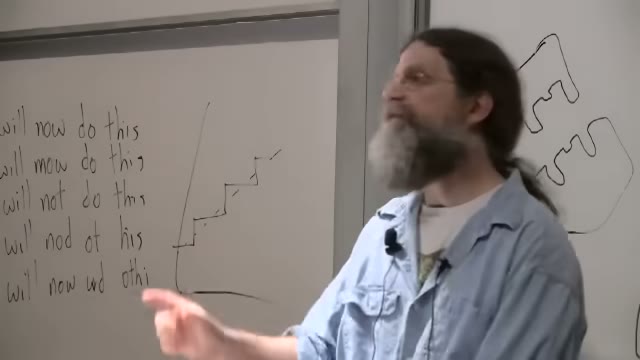
The challenge came from Stephen Jay Gould and Niles Eldredge, the latter, Sapolsky says, an excellent scientist overshadowed by Gould’s fame (52:32). Their model: most of the time nothing happens. Mutations occur but don’t matter, and a 1% edge makes no difference. Then come short, explosive bursts of change and a new period of stasis, so evolution moves in steps rather than a smooth slope (53:36). Sapolsky notes Gould was a Marxist and jokes about the fit with revolution and dialectical materialism (54:08).
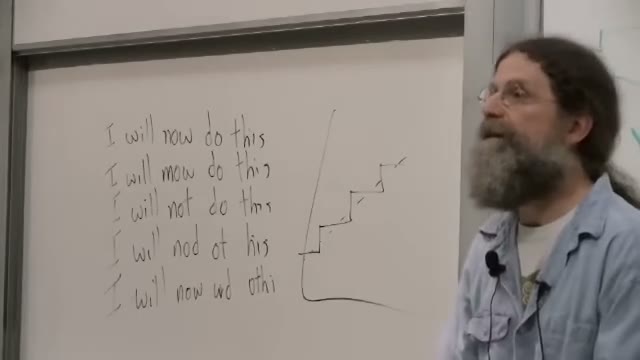
The idea came from Gould’s day job. He was a paleontologist who traced fossil lineages, Caribbean snail shells among them (55:11). As records filled in with more intermediate fossils, many lineages looked less like a ramp and more like a staircase (55:43).
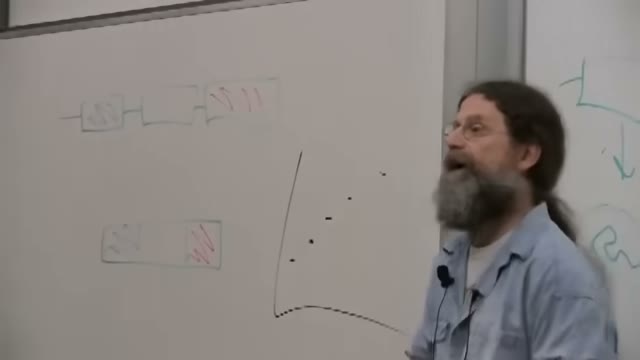
The implication cut deep (57:16). If small advantages don’t drive evolution most of the time, then the sociobiological picture of constant competition, hierarchy and domination loses its engine, and Gould’s side added that this picture conveniently suited the people who promoted it.
Our note: Sapolsky places the model in the 1980s. Eldredge and Gould’s founding paper appeared in 1972; the controversy ran through the 1970s and 1980s.
57:47 – 1:03:38 Three attacks, and the one that stuck
The evolutionary biologists hated it, and Sapolsky grants that their attacks were valid (57:47).
- Timescale (58:49). To a paleontologist, change over 100,000 years is fast. To a biologist counting generations, calling that a sudden jump is absurd.
- Fossils show only shape (59:51). Brains, organs, skin pigment and behavior leave no trace, so “stasis” may only mean bones and shells stayed the same. Sapolsky concedes, though, that the most complete fossil lineages still mostly look punctuated (1:00:53).
- Show me a molecular mechanism (1:01:25). This was the strongest. The same people who had just used molecular genetics against sociobiological storytelling now used it against Gould: classical mutations produce gradual change, so which mutations make jumps (1:01:58)?
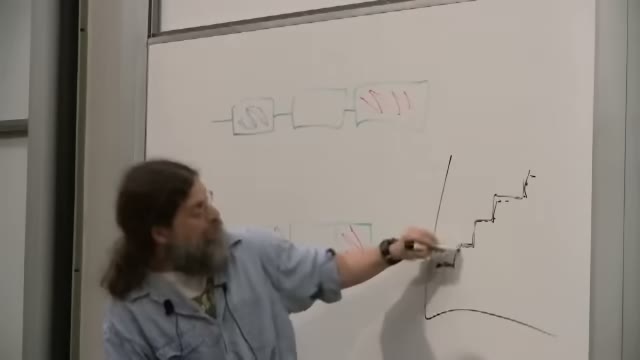
The camps traded insults: gradualists called punctuated equilibrium evolution by jerks, and the reply was evolution by creeps. In the 1980s, Sapolsky says, the Gould side had no answer to the mechanism question. But the most striking findings in molecular genetics since then have supported punctuated models (1:03:05), and the rest of the lecture sets them up.
1:03:38 – 1:06:48 Genes in pieces: exons, introns and splicing
The classical picture (1:03:38): DNA is a row of genes, each a continuous box coding one protein, ending with a stop signal right before the next. Then it turned out a gene’s code is broken into pieces, exons, separated by stretches that code nothing, introns (1:04:44).
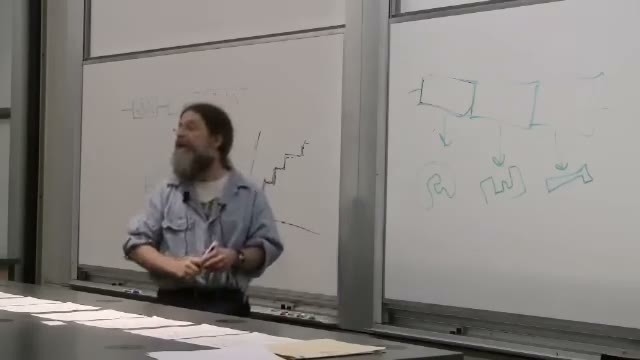
That raised an obvious problem: an RNA copy would include the introns and code for nonsense. The predicted solution soon turned up: splicing enzymes, which cut the intron sections out of the RNA and join the exons back together (1:06:18).
1:06:48 – 1:11:08 One gene, many proteins
David Baltimore, the Nobel laureate from the retrovirus work, was among the first to see that this modular construction stores extra information (1:06:48). A gene with three exons, A, B and C, can be spliced into seven different proteins: A, B, C, AB, AC, BC or ABC (1:08:30).
That breaks the old rule of one gene, one protein (1:09:02), which the old guard did not enjoy. The mechanics are simple: splicing enzymes that behave differently in different tissues give tissue-specific versions of the same gene (1:09:35), and some splice at alternative points within an exon, giving A and A′ (1:10:07). The same DNA can produce different proteins at different ages, under different conditions and in different people.
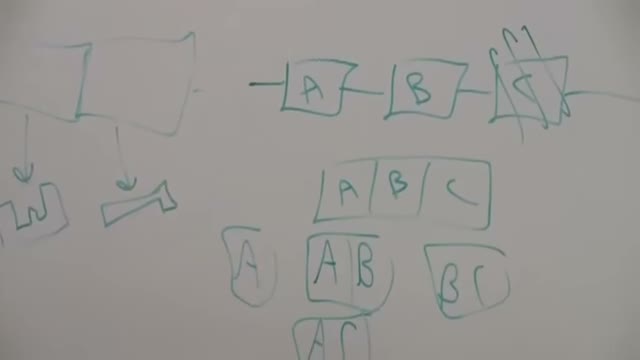
Our note: seven is 2³ − 1, every non-empty combination of three pieces. Lecture 5 applies the same arithmetic to gene networks, and also asks what happens when a splicing enzyme itself mutates.
1:11:08 – 1:14:46 Mostly non-coding: the instruction booklet
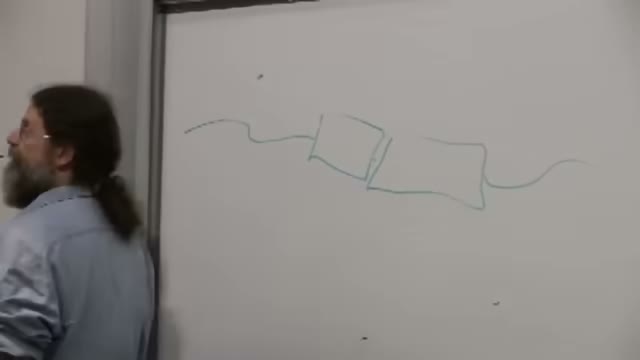
The next assumption to fall was that genes sit back to back. In fact there are long stretches between genes that code for no protein, at first called junk DNA (1:12:10). Sapolsky gives the figure as 95% of DNA (1:12:40), far too much to be packing material.
The insight was that much of it is the instruction booklet: switches, often just upstream of a gene, that decide when it is turned on (1:13:12). The implication, in Sapolsky’s blunt version, is that Crick was wrong (1:13:44). DNA is not the starting point; it is a readout controlled by other factors.
Our note: for the human genome, protein-coding sequence is now usually estimated at 1–2%, so the non-coding share is even higher than 95%. How much of it actually regulates anything is still debated, and Sapolsky himself admits at 1:25:55 that only a tiny fraction has an identified role.
1:14:46 – 1:19:01 Promoters, transcription factors and gene networks
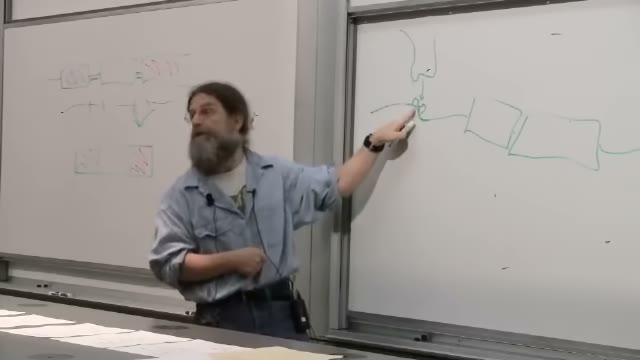
Just upstream of a gene sit stretches of DNA that code for switches rather than protein: promoters and repressors (1:14:46). Each has a small physical shape. A molecule, usually a protein, that fits it binds there, and that triggers the enzymes that transcribe the gene (1:15:17). The molecules that flip these switches are transcription factors (1:15:49).
Two complications turn switches into networks (1:16:52):
- The same promoter sits upstream of many genes scattered across the genome, so one transcription factor switches on a whole related set of proteins. That is the general rule, not the exception.
- One gene can have several different promoters, so different signals can turn it on, and it can belong to several networks at once (1:17:57).
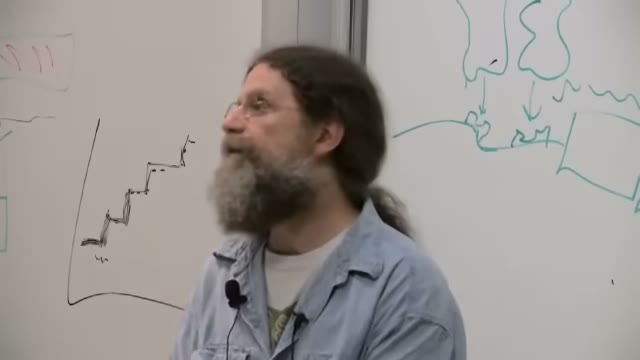
The control has moved off the DNA. What matters is whatever controls the transcription factors.
1:19:01 – 1:26:26 The environment at three distances
That brings in the word environment (1:19:01). Sapolsky gives three scales, each ending at a transcription factor:
- Inside the cell (1:19:32). The cell senses it is low on energy, a transcription factor activates, and genes for taking in and conserving energy switch on.
- Elsewhere in the body (1:20:36). A hormone, a messenger carried in the blood, binds its receptor and sets off a chain of steps that reaches the genes. Testosterone from the testes binds androgen receptors in muscle and turns on genes for structural proteins, so the muscle grows (1:22:09).
- The outside world (1:22:39). A mother rat smells her pups’ pheromones, and the signal travels inward until it changes gene expression, for example making the hormone oxytocin (1:23:45).
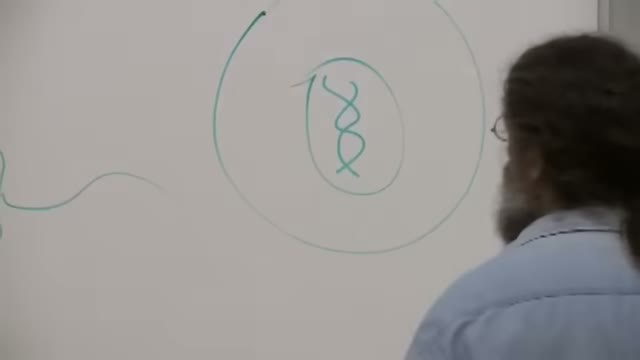
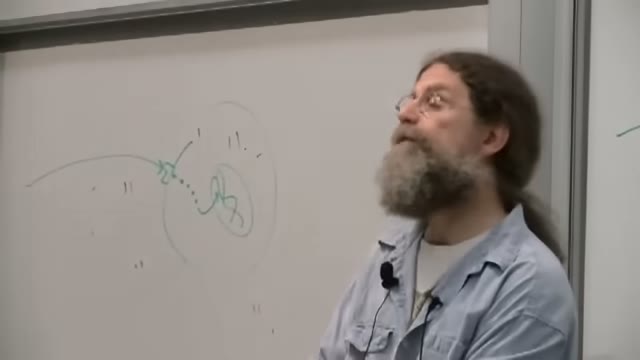
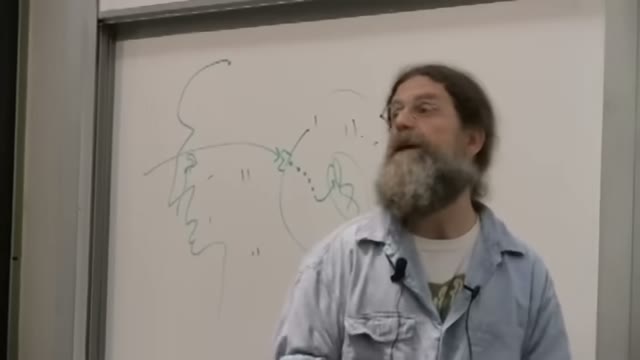
The upshot (1:24:49): the interesting thing about a gene is less what its protein is like than when, where and in what context it is made. Regulation turns genes into if-then clauses. If glucose is low in the cell, then make glucose-uptake proteins; if you smell your baby, then activate this pathway. Sapolsky argues context is far more interesting than a protein being slightly more one shape or another (1:25:22).
Our note: testosterone is a steroid rather than a protein hormone. It enters the cell, and its receptor itself acts as the transcription factor, with one part binding the hormone and another binding DNA. Lecture 5 builds a thought experiment on exactly that receptor structure. The general sequence Sapolsky draws (messenger, receptor, transcription factor, genes) holds either way.
1:26:26 – 1:31:42 Chromatin, silencing and epigenetics
One more layer of control (1:26:57). DNA is wrapped in stabilizing proteins, chromatin, and a transcription factor can only reach its promoter where the chromatin opens up (1:27:27). So a cell can be full of a transcription factor and still not transcribe a gene, because the gene is wrapped shut.
Some of these changes can become effectively permanent: the gene is silenced (1:28:30). Sapolsky names methylation, which acts on the DNA itself, as one known mechanism (1:29:01). The striking cases happen early in life. In rats, how much a mother licks and cares for her pups produces lasting changes in genes related to stress hormones (1:29:34). He adds that many such changes turn out to be partly reversible.
This is epigenetics: not the DNA sequence but regulation of access to it (1:30:06). Steve Suomi at the National Institutes of Health found that changing the mothering a baby monkey receives changes the accessibility of about 4,000 genes in one part of its brain (1:30:37). Sapolsky’s summary phrase: “Fertilization is all about genetics. Development is all about epigenetics” (1:31:10).
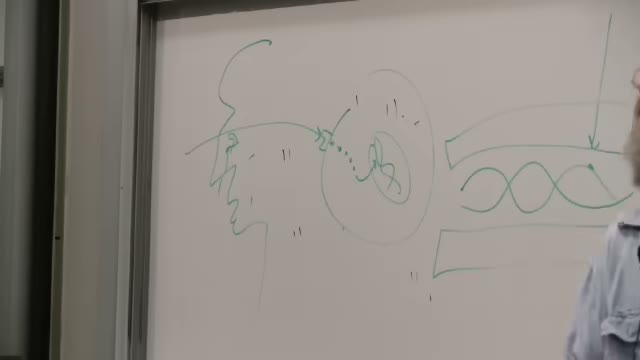
Our note: the rat licking studies he describes are usually associated with Michael Meaney’s lab at McGill. Epigenetics returns in Lecture 6 with prenatal effects such as the Dutch Hunger Winter.
1:31:42 – end Levels of regulation, and the cliffhanger
Sapolsky stacks the levels up (1:31:42): splicing enzymes mixing exons into different proteins; transcription factors carrying information from the cell, the body and the world; and epigenetic changes that can last a lifetime. The gene’s own sequence decides the shape of its protein. Everything else decides where, when, under what conditions, and whether it is ever expressed again after a childhood event.
He leaves the class with three questions for next time (1:32:43): what if a mutation hits a splicing enzyme, a transcription factor, or a promoter instead of a protein-coding sequence? That is where change stops being gradual.
Our note: the whole lecture can be read as two pictures of the gene side by side.
| Classical picture (first half) | Regulatory picture (second half) | |
|---|---|---|
| A gene is | one continuous stretch, one protein | modular exons, many possible proteins |
| Most DNA | codes for protein | regulates when genes are used |
| Who decides | DNA | transcription factors, chromatin, the environment |
| A mutation changes | how well one protein works | potentially when and where whole networks switch on |
| Evolution looks | gradual | capable of jumps (Lecture 5) |
Skip list
- 4:57 – 12:50 Protein basics: amino acids, folding, lock and key, enzymes. Skip if you’ve taken intro biology.
- 16:28 – 22:50 Codon arithmetic and the three mutation types, also review material; the idea that matters is restated at 23:20.
- 51:28 – 52:00 The break.
- 1:02:31 – 1:03:05 The “jerks” and “creeps” name-calling between camps.
- 1:33:14 – end Closing and credits.
Glossary
- Central dogma — Crick’s statement that genetic information flows from DNA to RNA to protein, with DNA as the starting point.
- Retrovirus — an RNA virus whose genetic material is turned back into DNA and inserted into the host genome; an early exception to the central dogma.
- Point mutation — a single DNA letter replaced by another; it may change nothing, change one amino acid slightly, or change it drastically.
- Frameshift — the shift in reading caused by inserting or deleting a letter, which garbles every triplet downstream.
- Microevolution — in this lecture, change in how well an existing protein does its job, driven by small mutations.
- Positive selection — selection favoring changes; seen as more amino-acid-changing mutations than chance predicts.
- Stabilizing (negative) selection — selection against change; seen as almost only silent mutations in a gene.
- Gradualism — the view that evolution proceeds by many small, steady changes.
- Punctuated equilibrium — Gould and Eldredge’s model of long stasis interrupted by brief bursts of rapid change.
- Exon / intron — the coding pieces of a gene and the non-coding stretches between them.
- Splicing enzyme — an enzyme that cuts introns out of RNA and joins exons; different splicing yields different proteins from one gene.
- Promoter — a regulatory DNA sequence, usually upstream of a gene, that switches transcription on when the right molecule binds.
- Transcription factor — a protein that binds a promoter and turns genes on or off, often a whole network at once.
- Chromatin — the protein packaging around DNA; it must open for transcription factors to reach a gene.
- Epigenetics — regulation of access to genes, such as chromatin changes or methylation, that can make early experience last a lifetime.
- Androgen insensitivity (testicular feminization) — a condition in which a mutated testosterone receptor leaves genetically male people with a female body.
FAQ
Why does Sapolsky say small mutations lead to gradual evolution?
A point mutation, insertion or deletion changes the shape of a single protein, so it changes how well that protein does its job. If the new version gives even a 1% edge in reproduction, it spreads slowly over many generations. Variation, a small fitness difference and selection add up to small, steady steps, which is the gradualist picture behind the sociobiology lectures.
What is punctuated equilibrium and how was it criticized in Lecture 4?
Stephen Jay Gould and Niles Eldredge proposed that species stay the same for long periods and then change quickly, based on detailed fossil lineages. Critics made three objections: paleontologists' idea of fast can be 100,000 years, fossils record only body shape, and, most damaging, nobody could point to a molecular mechanism that would produce sudden change.
How can we share 98% of our DNA with chimpanzees but only 50% with a sibling?
The two numbers measure different things. Sapolsky's explanation is that the 98% compares kinds of genes (both species have genes for a similar pelvis and immune system, and neither has genes for antlers), while the 50% asks whether you and a sibling carry the same version of each gene. Our note: put another way, all humans already share well over 99% of their sequence, and relatedness figures count only the spots where people differ.
What does Sapolsky mean when he says DNA is not in charge?
In his telling, about 95% of DNA does not code for proteins and instead acts as switches. Promoters upstream of genes are turned on by transcription factors, which respond to conditions in the cell, hormones from elsewhere in the body, or signals from the outside world. So the gene is a readout of those conditions, not the decision-maker that Crick's central dogma implied.
What is epigenetics in Sapolsky's Lecture 4?
Changes in how accessible a gene is, rather than changes to its sequence. The chromatin around a gene can be opened, closed, or silenced long-term, for example through methylation. Sapolsky's examples are rat mothering style permanently changing stress-related genes, and Steve Suomi's monkey work linking early mothering to the accessibility of about 4,000 genes in one brain region.
Studying another course? Paste its YouTube or Bilibili link on the home page to request a handout — or make your own with the desktop app (coming soon).