Harvard Positive Psychology Lecture 5, Self-Fulfilling Beliefs and the Power of the Situation — notes and timestamps
Watch the video (79 min)
Watch the original video on YouTube
The full transcript isn't available yet.
This is Lecture 5 of Tal Ben-Shahar’s Harvard course Positive Psychology (PSY 1504). The video is a re-upload by a YouTube channel called “anonymous anonymous”. It is not an official Harvard channel, and Harvard has not posted the course itself. The course is best known from its 2006 run, but this recording appears to date from around 2008: the guest speakers mention a Penn master’s class that started in fall 2007 and a newly founded International Positive Psychology Association. The uploader titled it “The power of environment”. That covers only the last quarter of the lecture. In fact the lecture does three things:
- It finishes the course’s fifth premise: happiness is the ultimate goal for most people, and it ought to be.
- It opens a new unit, “beliefs as self-fulfilling prophecies”.
- It ends with the power of the situation: how roles, settings and small cues shape what we do.
These notes follow the lecture’s order, check the famous stories against what is known about them, and point out which parts you can skip. The previous lecture is Lecture 4, and the course index lists every lecture covered so far. The first 21 minutes are announcements and a guest talk, so the lecture proper starts at 21:25.
Key takeaways
- Feeling good needs little defence, but it also pays off: Barbara Fredrickson’s broaden-and-build theory says positive emotions widen thinking and build resources over time (26:18).
- Negative emotions narrow the mind and can feed a downward spiral. A small positive emotion, such as a deep breath, a funny film or a friend, can turn it into an upward one (28:30).
- Pursuing happiness is self-interested but not immoral. Ben-Shahar calls happiness a positive-sum game: helping yourself and helping others reinforce each other (35:50).
- People copy what you do, not what you say. He shows this with a hand trick on the whole hall, and links it to Gandhi’s “be the change” (45:39).
- Beliefs can be self-fulfilling. Roger Bannister’s sub-four-minute mile and Robert Rosenthal’s Pygmalion study are his two main examples (49:52, 59:52).
- Situations are powerful in both directions. Psychology has studied the harmful side (Asch, Milgram, Zimbardo). Ellen Langer’s studies and priming research suggest settings can also be designed to bring out the best in people (1:07:37).
Chapter notes
0:00 – 3:27 Class announcements
The recording opens with two short notices. A former Teach for America corps member makes a 90-second appeal to apply before the next day’s deadline. Teach for America is a US program that places new graduates as teachers in low-income schools. A teaching fellow then announces an extra section that evening for students who missed theirs. Neither has anything to do with the course content.

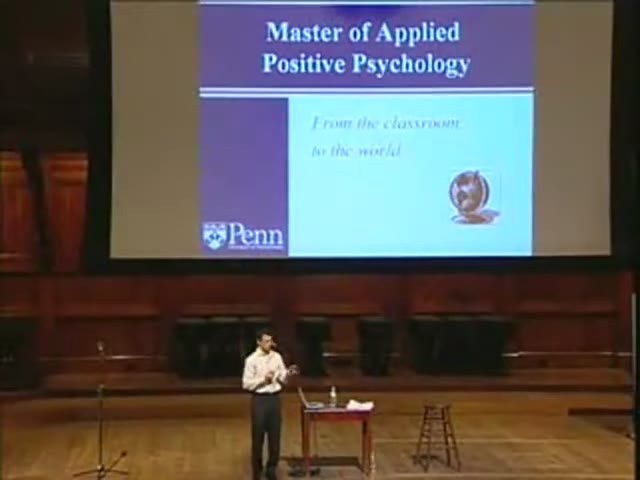
3:27 – 21:25 Guest talk: Penn’s Master of Applied Positive Psychology
Ben-Shahar hands over to two guests from the University of Pennsylvania’s Positive Psychology Center: James, its director of education, and Debbie Swick, the associate director. For about 17 minutes they describe the Master of Applied Positive Psychology (MAPP). They say it was the first master’s degree in the field. It is a one-year, full-time program taught in monthly on-campus weekends plus distance learning, so most students keep working.
There are a few useful facts for context. The guests say positive psychology began in 1998, when Martin Seligman made it his initiative as president of the American Psychological Association. They list course instructors, including Seligman, Angela Duckworth and Christopher Peterson. They also announce the then-new International Positive Psychology Association, with Ben-Shahar on its board. The rest of the talk is admissions information that is now well out of date.
21:25 – 25:45 Premise 5: happiness is the highest end, and should be
Ben-Shahar returns to finish the five “basic premises” he has been laying out since the first lectures. The fifth is philosophical. He separates two claims. The descriptive one (“is”) says that for most people, consciously or not, happiness is the ultimate goal. The normative one (“ought”) says it is right that it should be.
For the “is” side he lines up quotations. One is attributed to Aristotle, calling happiness the whole aim of human existence. One is from William James on happiness as the “secret motive” of what people do. One is from the Dalai Lama on happiness as life’s purpose. A small slip: he places James “over 200 years ago”. James was writing around 1900, so roughly a century before the lecture.
The argument is short but worth noting. Ben-Shahar puts the burden of proof on the sceptic: why not feel good if we can? The research that follows is offered as a bonus on top of that, not as the foundation.
25:45 – 35:45 What positive emotions are good for: broaden-and-build
The core research here is Barbara Fredrickson’s broaden-and-build theory. Fredrickson is a psychologist who studies positive emotions and who taught on the Penn program just advertised. The theory says positive emotions do more than feel pleasant. They widen the range of thoughts and actions that come to mind, and over time that builds lasting resources: knowledge, relationships, resilience and health. Ben-Shahar reads a long passage from her article, which is assigned reading for the week.
He explains it with two loops drawn on the blackboard. Negative emotions make us “narrow and constrict”. That is useful when a lion charges, because you want total focus. It becomes a trap when the narrowing continues after the threat has passed. His example, delivered with a knowing wink, is a breakup. You think only about the loss, the sadness narrows your thinking further, and the loop can slide toward depression. Positive emotions run the loop the other way: they broaden thinking, which brings more positive emotion.
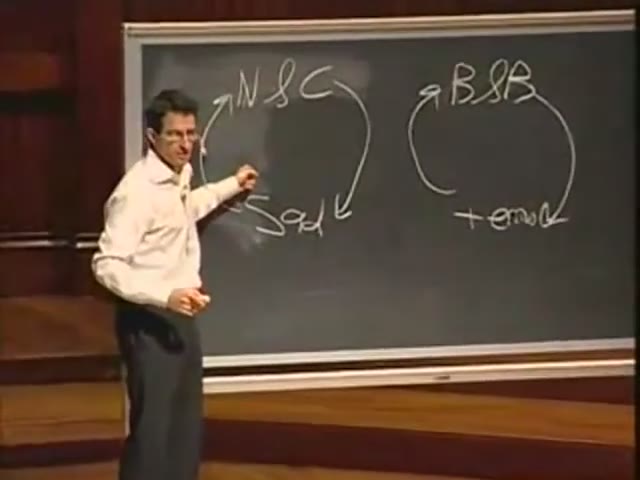
He is careful to tie this back to his earlier “permission to be human” theme. The goal is not to avoid painful emotions. It is to feel them without getting stuck in rumination for months.
He then lists the payoffs, each with a study or a claim:
- Creativity. He disputes the idea of the depressed genius. Manic-depressive artists tend to be most creative in their manic phases, not their low ones.
- Better problem-solving. Doctors given a hard diagnostic case about a liver patient did better when first put in a good mood with a small gift of candy than either a control group or a group that read about the humanistic value of medicine.
- Learning. Children asked to recall something that made them laugh or smile did better on a learning task than a control group.
- Motivation, success and health. People who move themselves out of negative states more readily tend to be more successful over time. Grounded optimists (he stresses “not Pollyannaish”) live longer on average and have stronger immune systems.
He describes the evidence on longevity and success only in general terms here. These are summaries of research lines, not single decisive studies.
35:45 – 42:20 Is pursuing happiness selfish?
Ben-Shahar’s answer is unusual for a lecture hall: yes, wanting to be happier is selfish. The mistake, he argues, is treating selfish and immoral as the same thing, and he calls that equation the number one cause of unhappiness, because it makes people feel guilty about feeling good. That ranking is his own rhetorical claim, not a research finding.
His reply is that happiness is a positive-sum game. He contrasts it with a zero-sum game (a fixed pie: more for me means less for you) and a negative-sum game (both lose). Happiness spreads: happier people are, on average, more generous, more tolerant and more helpful. He cites Alice Isen, a pioneer of experimental research on positive mood, for the finding that feeling good makes people more helpful. The link runs the other way too: helping others makes people happier.
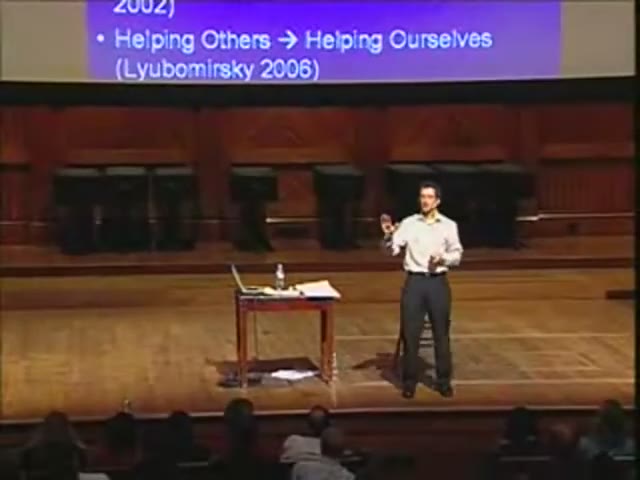
That second direction is the source of the week’s assignment. It draws on Sonja Lyubomirsky, a happiness researcher at UC Riverside and author of The How of Happiness. Her studies found that doing extra acts of kindness raised well-being. He adds, “only half in jest”, that he knows of no more selfish act than a benevolent one. He closes by playing on the two meanings of “appreciate”, to value and to grow in value. If we celebrate the part of our nature that benefits from helping, that part grows. If we feel ashamed of it, it shrinks.
42:20 – 48:55 Gandhi, a hand trick, and leading by example
To end the premise he tells the well-known Gandhi story. A mother travels a long way to ask Gandhi to tell her son to stop eating sugar. Gandhi asks her to come back in a month. When she returns, he simply tells the boy to stop. Asked why he needed a month, he says that a month ago he was still eating sugar himself. (The anecdote is widely retold but has no solid documentary source.)
Then he tests the point on the hall. He has everyone make a right angle between the thumb and middle finger, close it into a circle, and place it on their cheek, while he puts his own on his chin.

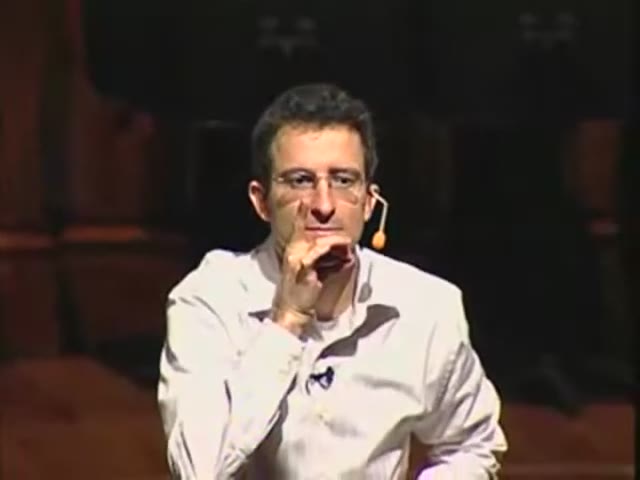
He spells out the moral for idealistic students. If you want to spread happiness, the most effective method is to work on your own, because you lead by example. The same applies to managers and parents: children learn honesty from how honest you are, not from what you say about it. He attaches the slogan “be the change you want to see in the world”, which he credits to Gandhi’s autobiography. That exact sentence does not appear in Gandhi’s writings; it is a popular paraphrase.
48:55 – 57:10 Beliefs as self-fulfilling prophecies: Roger Bannister
The new unit starts with the story that, he says, first drew him to psychology as a 14-year-old squash player. Before 1954 the four-minute mile was widely treated as a human limit. Roger Bannister, then a medical student at Oxford, said it could be done. He trained, stalled at about 4:02 like everyone else, kept insisting, and on 6 May 1954 ran 3:59.4 at Oxford. About six weeks later the Australian John Landy ran 3:57.9.
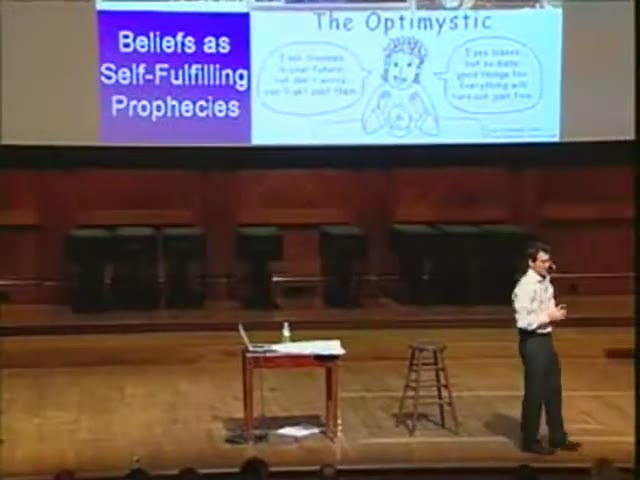
Treat the numbers with caution. Ben-Shahar says 37 runners broke four minutes in 1955 and more than 300 in 1956. Those figures are part of the legend, not the record: only a handful of men ran sub-four miles in the next few years. The claim that doctors had “proved” it impossible is also more folklore than history. The core point survives in a weaker form: once a barrier is shown to be breakable, others soon follow.
The rest of this section is a roadmap for the coming weeks:
- how beliefs shape reality, and the science behind it;
- the gap between real research and self-help claims such as Think and Grow Rich;
- how to raise belief in ourselves, through Albert Bandura’s work on self-efficacy (belief in your ability to succeed at a task) and Nathaniel Branden’s on self-esteem;
- how a dream becomes reality, with Martin Luther King Jr. and Herbert Benson as examples.
He promises to “bridge the ivory tower and Main Street”. That means showing where the power-of-the-mind message is right and where it becomes dangerous.
57:10 – 1:07:35 The Pygmalion effect
He retells the myth of Pygmalion, the sculptor whose statue of his ideal woman is brought to life by the gods. He includes a joke that the sculptor could not find a partner because this was before Radcliffe was founded in 1879. (In Ovid, the classical source, Pygmalion is from Cyprus and it is Venus who animates the statue; his version moves it to Athens.) He then follows the idea through George Bernard Shaw’s play Pygmalion and the musical My Fair Lady. He notes that the play challenged the class system by suggesting people can be transformed.
The main study is Robert Rosenthal’s classroom experiment from the 1960s. Rosenthal is a Harvard social psychologist who later moved to UC Riverside, and the study was published with Lenore Jacobson as Pygmalion in the Classroom. Pupils took what teachers were told was a new test that spotted “spurters”, children about to make an intellectual leap. In fact it was an ordinary IQ test, and the “spurters” were picked at random. By the end of the year those pupils had improved more than their classmates, including on IQ.
Ben-Shahar’s reading of the study is the most interesting part. The teachers were not fooled into an illusion, he says. They were living in one before, missing the potential in front of them, and Rosenthal simply moved their attention to it. He links this to Marva Collins, the Chicago teacher he discussed earlier in the course, and to the earlier attention examples of missing what is right in front of you.
He says IQ was supposed to be fixed from birth, and calls the result “mind-boggling”. That overstates both sides. IQ was never considered entirely fixed, and later reviews find teacher-expectation effects real but generally small, with the original IQ gains concentrated in the youngest pupils. He adds two extensions:
- Workplace replications. When managers were told that randomly chosen employees had high potential, those employees performed better, advanced more and stayed longer.
- The reverse direction. In a 1997 study he attributes to “Jamison”, one class was told in advance that its teacher was highly rated. That class rated the teacher higher, put in more effort and outperformed a parallel class taught by the same teacher.
He ends with a line attributed to Goethe: treat people as they can and should be, and they will become so.
1:07:35 – 1:11:05 The power of the situation: the negative side
This short section links back to standard social psychology. Ben-Shahar names the classic studies quickly and tells students to read up on them:
- Solomon Asch’s conformity experiments. People went along with an obviously wrong group answer.
- Stanley Milgram’s obedience studies. Ordinary people gave what they believed were painful shocks because an experimenter said “the experiment must go on”. Similar results appeared in other countries.
- Philip Zimbardo’s Stanford Prison Experiment. Students assigned to be guards became abusive so quickly that the study was stopped early. Ben-Shahar links it to the abuses at Abu Ghraib prison in Iraq.
A caution worth adding: the Stanford Prison Experiment has since been heavily criticised, partly because guards appear to have been coached, so it is weaker evidence than its fame suggests. Ben-Shahar’s real point comes at the end. If situations are this powerful, why only study their harmful side? He applies his usual “21 to 1” complaint (his figure for how much more research has gone into negative topics than positive ones) to this area too.
1:11:05 – 1:15:50 Ellen Langer: turning the clock back
The positive examples come from Ellen Langer, a Harvard psychologist known for her research on mindfulness. He mentions that she was the first woman to receive tenure in the department, and that a film about this study starring Jennifer Aniston was planned.
In 1979 she took men over 75 on a week-long retreat set up as if it were twenty years earlier: the music, magazines and newspapers all came from that time, and they were to act as their younger selves. After a week, she reported, they were stronger and more flexible, their memory and test scores rose, their eyesight and hearing improved, and even their fingers lengthened. They also became more independent, by their own ratings and their families’.
The second study is about eyesight. People read a standard eye chart. Then the same people, dressed in pilot’s overalls and sitting in a flight simulator, read the same chart at the same distance. About 40 percent saw significantly better. He cites her book Mindfulness for this and recommends it.
These are striking results, and he presents them without hedging. Keep in mind that the 1979 study was very small, and its full write-up appeared mainly in Langer’s popular book Counterclockwise (2009), not in a detailed journal report. Read them as strong suggestions, not settled facts.
1:15:50 – 1:19:01 Priming and what comes next
The final study is on priming, where exposure to words or images, sometimes too brief to notice, nudges later behaviour. He describes work by John Bargh, a social psychologist then at Yale (the captions spell it “Barge”). People were exposed to words linked to old age, such as “old” and “Florida”. (He describes words flashed on a screen; in the best-known 1996 version, participants unscrambled sentences containing such words.) Afterwards they walked more slowly to the elevator than a control group and, he says, did worse on memory tests. A separate set of studies primed achievement-related words, and those people did better and persisted longer on hard tasks.
This is the shakiest evidence in the lecture. The elderly-priming walking result is one of the best-known failures of the replication crisis: a 2012 replication found no effect when timing was automated. Ben-Shahar ends by previewing the next lecture: how to build environments, consciously and unconsciously, that bring out our best selves.
Try this
These are the tasks Ben-Shahar sets or recommends in this lecture, in our own words:
- Five extra kindnesses in one day (this week’s assignment). Choose one day and do five acts of kindness beyond what you would normally do. Doing them on one day, rather than spreading them over a week, is part of the design he takes from Lyubomirsky. Afterwards, notice whether your own mood changed.
- Read the two assigned pieces. Read Fredrickson’s broaden-and-build article. Then read the chapter from Ben-Shahar’s book on why helping yourself and helping others are linked.
- Break a narrowing spiral on purpose. The next time a bad moment starts to take over your thinking, try one small positive input he mentions: a few deep breaths, something funny, or a pleasant conversation. Then see whether your thinking widens again.
- Audit one “say vs do” gap. Pick one thing you often tell others (to be patient, to rest, to be honest) and check whether your own behaviour shows it. The finger trick suggests people will copy your actions, not your advice.
- Expect more of one person. Following the Pygmalion discussion, choose a student, colleague or friend and look on purpose for potential you might have missed. Then treat them as if it is there.
Skip list
- 0:00 – 3:27, announcements. A recruiting appeal and a section notice.
- 3:27 – 21:25, Penn MAPP presentation. Out-of-date admissions information. The only course-relevant facts are the 1998 founding of the field and the list of researchers, both summarised above.
- 57:13 – 59:50, Pygmalion myth retelling. Optional storytelling before the actual study. Jump to 59:52 for Rosenthal.
- 1:07:35 – 1:11:05, Asch, Milgram, Zimbardo. Only if you already know these studies; he only names them in passing.
If you only have 30 minutes, watch 26:18 – 31:30 (broaden-and-build and the blackboard), 45:39 – 47:00 (the finger trick) and 59:52 – 1:05:00 (Rosenthal).
Key terms
- Broaden-and-build theory: Fredrickson’s account of positive emotions as widening attention and options, and building lasting resources over time.
- Narrow and constrict: Ben-Shahar’s phrase for how negative emotions focus the mind. It helps in a real threat and does harm when it continues after the threat has gone.
- Downward / upward spiral: self-reinforcing loops of emotion and thinking, drawn on the blackboard at 30:27.
- Positive-sum game: a situation in which one person’s gain adds to others’ gains, which is how he describes happiness.
- Approach vs avoidance goals: pursuing something you want rather than running from something you fear. He mentions it here and promises it for the week on goals.
- Self-fulfilling prophecy: a belief that brings about its own confirmation by changing behaviour.
- Pygmalion effect: higher expectations from teachers or managers leading to better performance, after Rosenthal and Jacobson.
- Self-efficacy: Albert Bandura’s term for belief in your ability to succeed at a specific task.
- Power of the situation: the social-psychology finding that context and roles often predict behaviour better than personality does.
- Priming: exposure to words or images that nudges later thoughts or behaviour, often without awareness.
- Permission to be human: the course’s recurring phrase for accepting painful emotions instead of suppressing them.
FAQ
What is the main topic of Harvard Positive Psychology Lecture 5?
The lecture has three parts. It finishes the course's fifth premise (happiness is not only what people seek but something worth seeking, and pursuing it is not selfish), then opens the unit on beliefs as self-fulfilling prophecies (Roger Bannister, the Pygmalion effect), and ends on the power of the situation: how roles, settings and subtle cues change behaviour, with Ellen Langer's studies and priming research.
What is Barbara Fredrickson's broaden-and-build theory?
Fredrickson, a psychologist then at the University of Michigan and now at the University of North Carolina, argues that positive emotions widen the range of thoughts and actions that come to mind, and that over time this builds lasting resources such as skills, relationships and resilience. Ben-Shahar uses it to answer the question of what feeling good is good for.
Is pursuing your own happiness selfish, according to Ben-Shahar?
He says yes, it is self-interested, but that selfish does not mean immoral. Happiness is a positive-sum game: happier people tend to be more generous and more helpful, and helping others in turn makes people happier, so the two reinforce each other.
What is the Pygmalion effect?
It is the finding that other people's expectations can change how someone performs. In Robert Rosenthal's classroom study, teachers were told that some randomly chosen pupils were about to bloom, and those pupils gained more over the year. Later reviews agree the effect is real but usually smaller than the famous first study suggested.
What was Ellen Langer's 1979 study with older men?
Langer, a Harvard psychologist, took men in their seventies to a week-long retreat set up as if it were twenty years earlier and asked them to live as if it were that time. She reported improvements in strength, flexibility, memory, eyesight and hearing. The study was small and was described in full mainly in her 2009 book Counterclockwise, so treat the specific numbers with caution.
What homework does Ben-Shahar give in Lecture 5?
The task for the week is to do five extra acts of kindness in a single day, on top of whatever you usually do, based on Sonja Lyubomirsky's research. The readings are Fredrickson's broaden-and-build article and a short chapter from Ben-Shahar's own book on why helping others and helping yourself go together.
Studying another course? Paste its YouTube or Bilibili link on the home page to request a handout — or make your own with the desktop app (coming soon).