Harvard Positive Psychology Lecture 2, Why Study Positive Psychology? — notes and timestamps
Watch the video (74 min)
Watch the original video on YouTube
The full transcript isn't available yet.
This is the second lecture of Tal Ben-Shahar’s Harvard course Psychology 1504, Positive Psychology. The question is in the title: why does happiness need its own field when psychology already studies depression and anxiety? Ben-Shahar answers with a count of research articles, a set of grim campus statistics, the history of resilience research, a classroom exercise about attention, and the story of the Chicago teacher Marva Collins. His one-line thesis is that questions create reality. These notes explain the studies he cites, add context he leaves out, and flag the places where his numbers need a qualifier. It follows Lecture 1 and leads into Lecture 3; the course index lists the lectures covered so far.
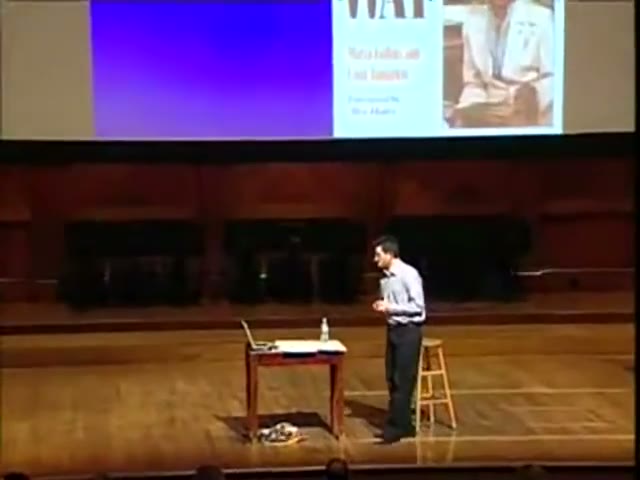
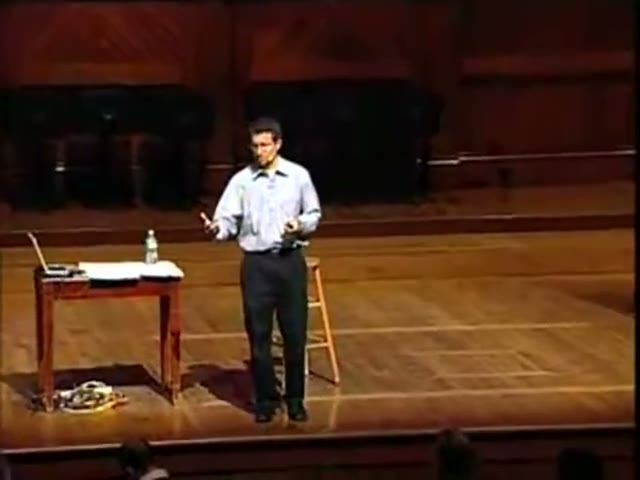
A note on the video: the copy embedded here is a re-upload of the lecture recording by a YouTube channel called “anonymous anonymous”, not an official Harvard channel. The course is best known from its 2006 run, but this recording appears to date from around early 2008. Two clues in this lecture point that way: his mentor Philip Stone died “two years ago”, and he calls a book from the turn of 2008 two weeks old. Most of the picture is the lecturer on stage; the slides are visible only now and then. This page is not affiliated with Harvard University or Tal Ben-Shahar.
Key takeaways
- Psychology has studied what goes wrong far more than what goes right: about 21 articles on anger, anxiety and depression for every one on joy, happiness or life satisfaction (12:17).
- The goal is to swing the pendulum, not to abandon the study of illness. Depression and anxiety are rising, and that research still matters (19:03).
- Three reasons for a separate field: what we focus on grows; happiness is more than the absence of unhappiness; building the positive is the best prevention (22:49).
- A new question produced resilience research. Asking why some at-risk children succeeded, instead of why most failed, found ordinary, teachable traits (26:51).
- Salutogenesis, the study of where health comes from, is the shift that made positive psychology possible (36:35).
- Questions decide what you see. In the shapes exercise almost nobody notices the children on the bus, and the same blindness hits couples, self-assessment and consulting (38:39).
- When we appreciate the good, the good appreciates: “appreciate” means both to be thankful and to grow in value (50:50).
- Move from passive victim to active agent, after allowing yourself to feel the pain; Branden’s version is that no one is coming to fix your life for you (1:06:55).
Chapter notes
0:00 – 7:33 Who the class is for, and finding your fit
The opening is housekeeping, but two points are worth keeping. First, the class is for anyone who wants to be happier, whether they are miserable or already very happy, as long as they will put in the effort of applying the ideas. The required weekly response papers are ungraded reflection pieces, and they are the one part of the pass/fail option he will not waive.
Second, he introduces fit, from Sonja Lyubomirsky, a happiness researcher at the University of California, Riverside, and her book The How of Happiness. Research shows that an intervention such as gratitude journaling, acts of kindness or exercise works for most people, not for everyone. Students should try each one and keep what suits them, which makes them, in his words, active participants rather than recipients of a doctrine.
The rest covers thesis writers skipping the midterm and a short welcome from Deb Levy, the head teaching fellow for Harvard Extension School, who says 296 Extension students are taking the course online. The fit idea matters more than it looks. Much self-help sells one technique as the answer for everyone; this course says from week one that the evidence does not support that.
7:33 – 11:52 A night ride to the hospital
The lecture proper opens with a personal story. Two years earlier, as the course began, his mentor Philip Stone, a Harvard psychology professor to whom he dedicates the class, had just died. Ben-Shahar fell badly ill, and after a blood test the doctor called at midnight and insisted he go straight to Beth Israel hospital. In the taxi along the Charles River he asked himself what he would do with one year left. Personally, he would spend it with his family. Professionally, the immediate answer was to leave behind a coherent course that introduces people to positive psychology. The illness turned out not to be serious.
11:52 – 22:49 The 21-to-1 ratio and a campus in distress
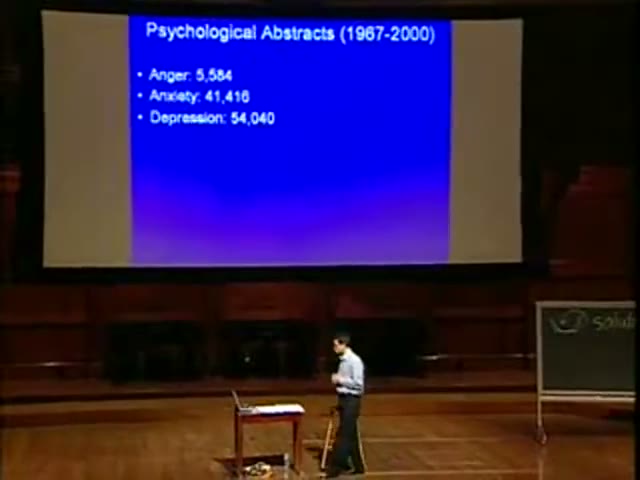
The first evidence is a count by David Myers, a social psychologist at Hope College in Michigan and the author of widely used psychology textbooks. Searching Psychological Abstracts from 1967 to 2000, he found about 5,600 articles on anger, 41,400 on anxiety and 54,000 on depression. Against that stood 415 on joy, close to 2,000 on happiness and over 2,500 on life satisfaction. The ratio is roughly 21 to 1. Ben-Shahar’s joke is that the ratio made him “very angry and anxious”.
He adds a 1954 quotation from Abraham Maslow, the humanistic psychologist known for the hierarchy of needs, who complained that psychology had confined itself to the “darker, meaner half” of human nature. Then he raises the obvious objection himself. Depression is rising worldwide, so perhaps the ratio should be even more lopsided. He cites a claim that depression is ten times as common as in 1960, and that the average age of depression is now under 15. He uses suicide rates as the most objective sign that the rise is real, not just better measurement.
Treat the last two figures with care. The tenfold rise comes from studies that compare how often different generations recall being depressed, an approach with known recall problems. Large US surveys also put the typical age of first onset of major depression well into adulthood, not under 15. The direction of his argument is fair; the precision is not.
Closer to home, he cites a 2004 Harvard Crimson survey: 80% of students reported feeling depressed in the past year, and 47% so depressed they could not function. He grants it is not an academic study, then pairs it with one that he says is. Richard Kadison, head of mental health services at Harvard and author of College of the Overwhelmed, reported in the New England Journal of Medicine on a national survey of about 13,500 students. In it, 45% had been depressed to the point of not functioning in the past year, and 94% felt overwhelmed by everything they had to do.
One caveat: national college surveys of this kind usually ask whether a student felt so depressed it was hard to function at least once in the past year. That is a real warning sign, but it is not the same as 45% having clinical depression. Ben-Shahar’s conclusion is careful even where his numbers are loose: keep researching depression, but also study the positive. He calls the trend a global epidemic and says governments and universities he visited in Europe, China and Australia share the worry.
22:49 – 25:00 Three reasons positive psychology needs its own field
He lists three reasons:
- Focus creates reality. If we study what works in ourselves, relationships and organizations, we get more of it.
- Happiness is not the negation of unhappiness. Getting rid of depression or anxiety does not leave you happy by default.
- Prevention. The most effective way to prevent hardship such as depression and anxiety is to cultivate the positive.
The rest of this lecture is about the first reason; the other two are announced here and taken up later in the course.

The quotation comes from Martin Seligman, the University of Pennsylvania psychologist who launched positive psychology as president of the American Psychological Association in 1998. The word “also” answers the most common criticism of the field, that it ignores suffering. It is the core of this lecture’s position.
25:00 – 35:28 Why some at-risk children succeed: resilience
Here is the lecture’s main case study. From the late 1940s, a great deal of government, university and philanthropic money went into studying children in high-risk neighborhoods. The question was why so many dropped out, got pregnant or ended up in crime. Smart, well-funded researchers produced reasonable answers, such as better schools and more resources, and very little changed.
In the 1980s the question changed. With Aaron Antonovsky (a medical sociologist), Ellen Langer (a Harvard psychologist known for her work on mindfulness) and Alice Isen (a psychologist who studied how positive mood affects thinking), researchers began asking why some children succeeded despite the odds. Ben-Shahar, borrowing Robert Frost, says that “made all the difference”. The concept that came out was resilience, defined on his slide as positive adaptation in the context of significant adversity or risk. The wording is close to the resilience researcher Ann Masten’s standard definition.
The surprise was that the resilient children were not super-kids. Longitudinal studies following them 5, 10 and 30 years later found ordinary children with ordinary traits. The best-known example, which he does not name, is Emmy Werner’s study of children born on Kauai in 1955. Masten later called this “ordinary magic”. The traits:
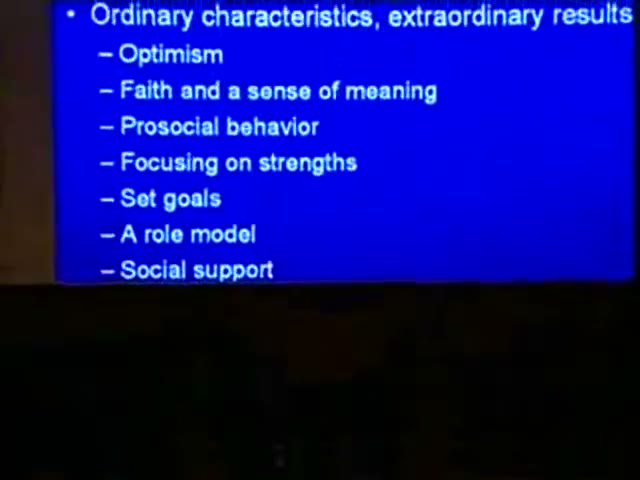
- Optimism, not the naive kind but a habit of explaining setbacks as temporary. He links this to the work of Seligman and the Penn resilience researcher Karen Reivich.
- Faith and a sense of meaning, sometimes religious, often a cause or a personal mission. He adds his recurring line that being idealistic is being realistic, because people need ideals.
- Prosocial behavior: helping others, moving “from helplessness to helpfulness”, in an upward spiral where helping others and helping yourself feed each other.
- Focusing on strengths without ignoring weaknesses. Students will identify their strengths through online tests, papers and sections.
- Goals and a future orientation. Three later lectures are on goal setting.
- A role model: a teacher, parent or friend, or even a historical or fictional figure.
- Social support, the strongest contributor of all. In his phrase, these children did not “bowl alone”, a nod to Robert Putnam’s book Bowling Alone. It takes toughness to reach out for help, and one or two close people are enough.
He then plays a short Will & Grace clip as an example of a bad choice of confidant; in this re-upload it lasts only a few seconds. The main lesson is about method more than about at-risk children. Decades of effort missed an answer that was “right in front of them” because nobody asked the positive question.
35:28 – 38:39 From pathogenesis to salutogenesis
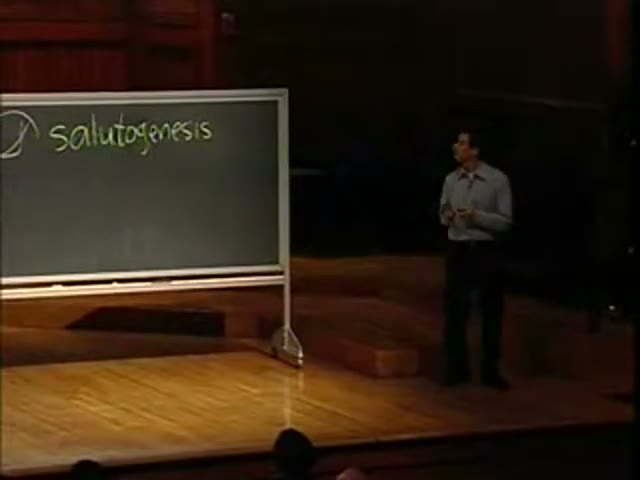
Antonovsky’s contribution gets a name. The pathogenic model asks where illness comes from; the salutogenic model asks where health comes from. Antonovsky did not dismiss the study of illness, but argued that studying people who stay healthy under stress is just as important. Ben-Shahar’s example is the student who goes through Harvard’s pressure with the usual ups and downs and still finds it a happy experience overall. How do they do it?
He reads Antonovsky’s claim that in science “the question is the breakthrough”, and the answer follows with difficulty. Antonovsky, an American-born sociologist who worked in Israel, coined the term in the late 1970s. Ben-Shahar credits this question with shaping positive psychology and positive sociology. If you take one idea from the lecture, take this one, because the next twenty minutes are applications of it.
38:39 – 45:55 The geometric-shapes exercise
The first in-class exercise: count the geometric shapes on the next slide in 30 seconds. He builds it up as a hard task he has given to mathematicians and artists. Guesses range from 6 to 200. Then come the real questions: what time was on the clock? How many children were visible on the bus? What was the dominant color of the left-most shape? Out of roughly 700 students, only a handful raise a hand for each. The answers are 10:10, five children and yellow.

His interpretation is balanced. The ability to focus is useful; without it we would be distracted by every noise. But the question he gave them created a reality with shapes and no children on the bus. The demonstration belongs to a well-known family of attention studies, the most famous being Daniel Simons and Christopher Chabris’s 1999 “invisible gorilla” experiment, in which many viewers counting basketball passes miss a person in a gorilla suit. If you watch the video, do the exercise honestly before reading on; it only works once.
45:55 – 54:02 Questions create reality: couples, the self, organizations
He carries the exercise into three settings:
- Couples. After the honeymoon phase, partners mostly ask “what’s wrong?” and “how can we improve?” Useful questions, but if they are the only ones, the good parts of the relationship stop existing for the couple, like the children on the bus.
- The self. In his cross-cultural experience, people mostly ask “what are my weaknesses?” and rarely “what are my strengths?” Someone who sees only deficiencies cannot have much self-respect, which he links to rising depression and low self-esteem.
- Organizations. Consultants usually open with “what’s wrong here?” Asking only that, he argues, weakens an organization over time.
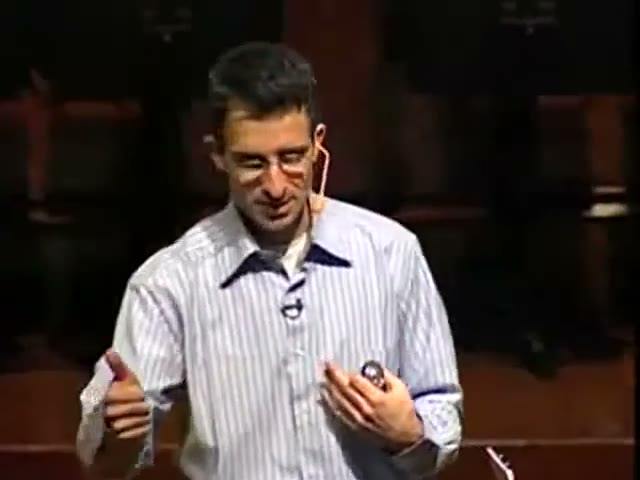
The pun that carries this section is on appreciate. It means to be thankful and also to grow in value, as money appreciates in the bank. When we appreciate the good, the good appreciates; when we take it for granted, it depreciates. That, he says, is what happens to many relationships after the honeymoon. He also rules out the narcissism reading. The aim is grounded self-confidence, and narcissism, which a later lecture covers, is its opposite.

Jacqueline Stavros and Cheri Torres write about appreciative inquiry, a method for organizational change developed by David Cooperrider in the 1980s that starts from what already works. That is the formal version of his consulting point. The section ends with what he calls a lesson from “a very important philosopher”, Homer Simpson: a short Simpsons lie-detector gag about first understanding the question. It is pure comic relief.
54:02 – 1:02:55 Marva Collins
Resilience needs role models, so he introduces his own: Marva Collins, the reason he became a teacher. In his telling, she was born in Alabama in the 1930s, and her father encouraged her to aim as high as the times allowed a Black woman: a secretary. She became one, then went to night school to qualify as a teacher and joined Chicago’s inner-city public schools. The teachers there hoped mainly to keep children in class long enough to stay off the streets. On day one she told her first to fourth graders that they would do “a lot of believing in ourselves”. Her message was high expectations, responsibility and no blaming, and children labelled “unteachable” were soon reading Euripides, Emerson and Shakespeare.
Amid rumors about her methods she left the system and opened a school in her own home with four students, two of them her own children: Westside Preparatory. He describes years of poverty, a 1979 60 Minutes segment that made her famous overnight, and offers from Presidents-elect Reagan and George H. W. Bush to be Secretary of Education. She turned both down: she loved teaching too much. He adds that “so I guess her father was right”.

Some parts of his account need balance. That every student finished college and the size of later donations are his claims, and they are hard to check. Collins (1936–2015) was also criticized in the early 1980s over claims about her results. Westside Preparatory closed in 2008. The 1981 TV film The Marva Collins Story, starring Cicely Tyson, made her a national figure. None of this undoes the teaching example, but the admiring version is the one told in class.
1:02:55 – 1:06:55 What her method teaches
His summary of her message maps straight back onto the resilience list:
- She is herself the role model, and her pupils study heroes from history, fiction and their own neighborhoods.
- High expectations: she sees the potential in each child and says so.
- Responsibility: stop blaming the government, teachers or parents.
- Tough and respectful at once. She is “no push-over” and not a feel-good-at-all-costs teacher. He calls the combination of demanding standards and respect the key to leadership, contrasting it with CEOs who mainly wanted to be liked.
- Optimism and goals for the children and their community.
- Strengths over deficiencies. Here he cites Howard Gardner, of the Harvard Graduate School of Education, whose theory of multiple intelligences replaces “is this student smart?” with “what is this student smart at?”

His image for this is a seed: potential that withers without water and light. The same applies to people and to relationships, which ties back to the double meaning of “appreciate”.
1:06:55 – 1:11:50 From passive victim to active agent
The paradigm shift in Collins’s classroom and in resilience research is from passive victim to active agent. He does not wave away external causes such as underfunded schools, but says they are not enough. His example is self-mocking: his girlfriend leaves him, a fear he says was “top on my mind” as an undergraduate.
| Passive victim | Active agent | |
|---|---|---|
| First response | Self-pity and rumination | Feels the pain, then takes responsibility |
| Next step | Blames her, his parents, her parents, the president | Acts: goes where he might meet someone |
| Feeling | Frustration and anger | Rising confidence |
| Outcome | Very few results | More hope and optimism, which become self-fulfilling |
Two qualifications stop this from becoming “just get over it”. First, the active agent still feels the painful emotion. He previews next lecture’s “permission to be human” and says action may come immediately or a day or two later. Second, the link from action to confidence comes from Daryl Bem’s self-perception theory, the finding that people infer their attitudes from watching their own behavior. Acting confidently is how confidence is built, not only how it is shown.
He applies this to students. Getting the most out of Harvard, the class and the sections is their responsibility. The first question in sections will be “what strength can I bring to make this an excellent section?”
1:11:50 – 1:14:18 “No one is coming”
The closing story comes from Nathaniel Branden, a psychotherapist whose The Six Pillars of Self-Esteem lists self-responsibility as one of the pillars. Branden told a workshop that no one is coming: no knight in shining armor will take you to happily ever after. A participant objected that Branden himself had come. Branden’s reply, roughly: yes, he came, but only to tell them that no one is coming.

It is a neat ending because it puts the teacher in the same position as Marva Collins: present, demanding, supportive and clear that the student does the work.
Try this
The lecture gives two formal tasks, the response papers and the section question, and several practices. In practical form:
- Run a fit test. For each technique you meet in this course, such as gratitude, exercise or journaling, try it for a week and note whether it suits you before deciding to keep it.
- Audit your resilience list. Go through optimism, meaning, helping others, strengths, goals, a role model and social support. Mark the ones you have now and pick one weak item to build, such as one person you would actually call for help.
- Name a role model. Write down one person, real or fictional, you would like to resemble, and one specific thing they do that you could copy.
- Ask the positive question. For one relationship, yourself and one group you belong to, write “what’s wrong?” and “what’s working?” side by side. Notice which list was harder to fill.
- Bring a strength to your group. Before your next class, team meeting or study group, answer: what strength can I bring to make it excellent?
- Plan your active-agent moment. The next time something goes wrong, give yourself time to feel it, then decide when, within a day or two, you will take one concrete step.
Skip list
- 2:10 – 7:33 Course logistics: response-paper deadlines, thesis writers and the midterm, the website, and the Extension School welcome. The fit idea just before this is worth hearing.
- 34:55 – 35:28 The Will & Grace clip, which is cut to a few seconds in this re-upload.
- 40:10 – 41:30 Students shouting out shape counts; the result is summarized above.
- 53:11 – 54:02 The Simpsons lie-detector gag.
Key terms
- Positive psychology — the scientific study of what helps people flourish; Seligman’s aim is to build the best in life as well as repair the worst.
- 21-to-1 ratio — David Myers’s count of negative versus positive topics in Psychological Abstracts, 1967–2000.
- Fit — Lyubomirsky’s idea that a happiness intervention works best when it matches the person using it.
- Resilience — positive adaptation in the face of significant adversity or risk.
- Salutogenesis / pathogenesis — Antonovsky’s contrast between studying the origins of health and the origins of disease.
- Questions create reality — Ben-Shahar’s thesis that the questions we ask decide what we notice and therefore what we pursue.
- Appreciate — both to be grateful for something and to increase in value.
- Appreciative inquiry — a method of organizational change that starts from strengths and what already works.
- Multiple intelligences — Howard Gardner’s theory that people are smart in different ways.
- Passive victim / active agent — two ends of a continuum in how people respond to setbacks.
- Self-perception theory — Daryl Bem’s finding that people infer their attitudes from their own behavior.
- Self-responsibility — one of Nathaniel Branden’s six pillars of self-esteem.
FAQ
Why does Tal Ben-Shahar say we need positive psychology as its own field?
He gives three reasons. First, what we focus on grows, so studying what works produces more of it. Second, happiness is not just the absence of depression or anxiety; removing the negative does not automatically produce the positive. Third, cultivating strengths is one of the best ways to prevent depression and anxiety in the first place. Most of the lecture develops the first reason.
What is the 21-to-1 ratio in positive psychology?
It comes from a count by the social psychologist David Myers of articles in Psychological Abstracts between 1967 and 2000. Studies of anger, anxiety and depression outnumbered studies of joy, happiness and life satisfaction by about 21 to 1. Ben-Shahar does not ask for the ratio to flip, only for the pendulum to swing so the positive gets more attention too.
What did the research on at-risk children find?
For decades, researchers asked why so many children in high-risk neighborhoods failed, with little practical result. When some started asking why a minority succeeded anyway, they found resilience. The resilient children were ordinary rather than exceptional, and the traits they shared, such as optimism, meaning, helping others, focusing on strengths, goals, a role model and social support, could be taught.
What is salutogenesis?
It is the medical sociologist Aaron Antonovsky's term for studying the origins of health rather than the origins of disease (pathogenesis). Instead of only asking why people get ill, it asks how some people stay well under the same stress. Ben-Shahar presents it as the question that made positive psychology possible.
What is the point of the geometric shapes exercise?
Students count shapes on a busy slide for 30 seconds, then are asked about the time on a clock, the children on a bus and the color of a shape, which almost nobody noticed. The question they were given decided what they saw. Ben-Shahar uses it to argue that people and couples who only ask what is wrong stop seeing what is right.
Who is Marva Collins and why does Ben-Shahar talk about her?
Marva Collins was a Chicago teacher who left the public school system and founded her own school, Westside Preparatory, for children others had written off. Ben-Shahar calls her his role model and the reason he became a teacher. He uses her story to show high expectations, a focus on strengths and personal responsibility working together.
Is this the official Harvard recording?
It is a recording of Ben-Shahar's Harvard lecture, but the YouTube copy embedded here is a re-upload by an unofficial channel, not a Harvard upload.
Studying another course? Paste its YouTube or Bilibili link on the home page to request a handout — or make your own with the desktop app (coming soon).