Harvard Positive Psychology Lecture 4, The Power of One and the Permission to Be Human — notes and timestamps
Watch the video (76 min)
Watch the original video on YouTube
The full transcript isn't available yet.
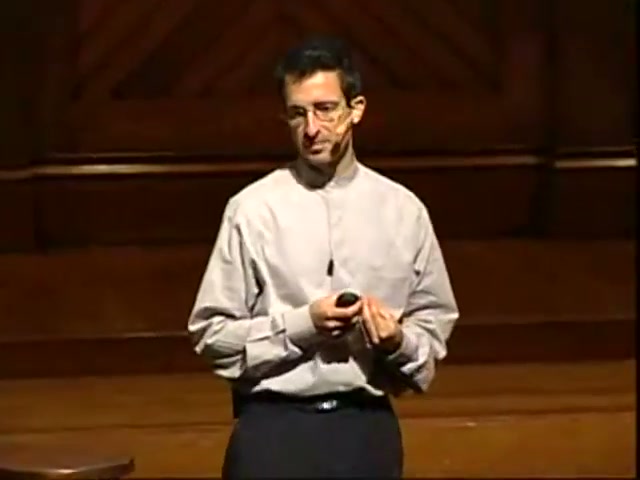
This is Lecture 4 of Tal Ben-Shahar’s Positive Psychology course (Harvard PSY 1504). The course is best known from its 2006 run; this recording appears to date from around 2008. The video is a re-upload by a YouTube channel called “anonymous anonymous”, not an official Harvard channel. The uploader called it “A positive environment changes people”, but the lecture itself is about the course’s last few basic premises: one person can make a difference, outside events have only a short-lived effect on happiness, and human nature should be understood and channelled rather than fought. The second half turns that last premise into what Ben-Shahar treats as one of the course’s main ideas, the permission to be human, and ends with a ten-minute guided meditation.
You do not need any psychology background. The lecture picks up from the twin studies and the Cambridge-Somerville study in Lecture 3, and the next lecture, Lecture 5, continues the course. The course index lists every lecture covered so far. Ben-Shahar mixes research with jokes and strong one-liners, so these notes say which claims come from studies and which are his own rhetoric, and where a study says something more modest than the version told in class.
Key takeaways
- People underestimate what one person can change because they underestimate exponential growth. A smile or a favour passed on to three people, who each pass it on to three more, reaches huge numbers within a few steps (5:38, 15:15).
- External events give a spike, then we drift back. Tenure, lottery wins, moving to California or getting into Harvard lift happiness briefly before people return to their usual level (21:50).
- The exceptions are extremes: real poverty and political oppression do lower well-being. Above basic needs, extra income makes little difference (26:00, 31:39).
- The fix is not lower expectations but right ones. Expecting an achievement to make you happy is the wrong expectation; expecting change to come from your own perception and interpretation is the right one (33:12).
- Accept human nature, then channel it. Using Thomas Sowell’s constrained-vision idea, Ben-Shahar says the course takes our instincts and emotions as fixed and asks how to work with them (35:58).
- Suppressing painful emotions makes them stronger, as in the “don’t think of a pink elephant” test. Accepting them lets them pass (51:02).
- Accept feelings, not everything. Emotions should be accepted; behaviour and thoughts can and should still be changed. He calls this active acceptance, not resignation (57:49).
Chapter notes
0:00 – 2:00 A Valentine’s Day opener
The lecture fell on Valentine’s Day, and it opens with a student a cappella group, introduced as the Harvard Callbacks, singing a love song “from the teaching staff” to the class. Ben-Shahar jokes that he had a different song in mind. There is no course content here.

2:00 – 5:38 Recap: change is hard, but it happens
Ben-Shahar recaps Lecture 3. Twin researchers David Lykken and Auke Tellegen had suggested that changing your happiness level may be as hard as changing your height. Ben-Shahar called this the “error of the average”: averages hide the people who do change, and once some people change, the question becomes how they did it, not whether change is possible. He also recalls the Cambridge-Somerville Youth Study, a large, well-funded intervention for at-risk boys that left its participants slightly worse off than the control group. On the other side are cases that worked, such as Marva Collins, the Chicago teacher whose classroom results he discussed earlier, and the resilience programs of Martin Seligman (the founder of positive psychology as a field) and Karen Reivich.
His conclusion is that good intentions are not enough. A “practical idealist” has to find out what actually works and spread it. This links back to Abraham Maslow, the humanistic psychologist who called for a kind of Manhattan Project for psychology: study the few programs that succeed, then copy them. A student’s phrase for this, “democratizing excellence”, is one Ben-Shahar adopts (5:06).
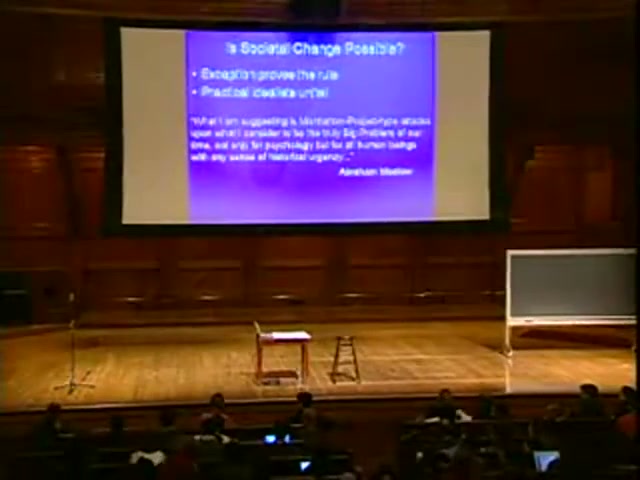
The recap is worth hearing if you skipped Lecture 3, because the whole first half of this lecture answers the question it leaves open: if large programs often fail, what can one person do?
5:38 – 10:40 The power of one
Ben-Shahar says one of the biggest barriers to change is that people underestimate their own influence. He points to social psychology research on how a minority, sometimes a single person, can shift a group’s views (he names Serge Moscovici, who is known for this work on minority influence). He backs it up with two quotations: Ralph Waldo Emerson’s line that all history records the power of minorities, “and of minorities of one”, and the remark usually credited to anthropologist Margaret Mead that a small group of committed citizens is the only thing that has ever changed the world.
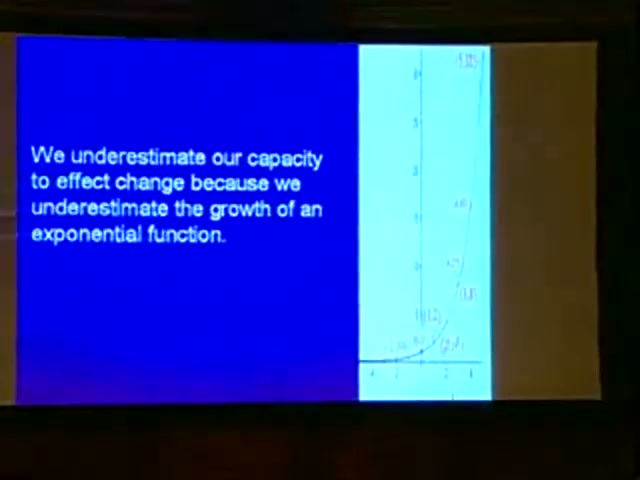
The mechanism he proposes is exponential spread through social networks. His example is smiling, which he says is contagious. If you make three people smile and each of them makes three more smile, then within about twenty steps the number covers the whole world. The same applies to compliments or making people feel good. The arithmetic holds in theory (three to the power of twenty is about 3.5 billion), but real networks overlap, so treat it as an illustration, not a forecast.

10:40 – 15:45 Three puzzles about exponential growth
To show how badly intuition handles doubling, Ben-Shahar offers the class a deal. He will pay a volunteer $1,000 a day for 30 days, and in return the volunteer pays him one cent on day one, two cents on day two, and so on, doubling every day. A few students accept. On day 30 alone they would owe him $5,368,709.12, and roughly twice that over the month (12:10). He lets them off the hook.
Two more examples follow. One is the old legend of the inventor of chess, who asks a king for one grain of rice on the first square and double on each square after; the last square alone needs 2 to the power of 63 grains. The other is a question: how many times would you have to fold a sheet of paper for it to reach the moon? His answer is 41. With ordinary 0.1 mm paper the usual figure is 42, but the point stands: a few dozen doublings take you from a sheet of paper to the moon. He finishes with a joke about why anyone made a fuss over the moon landing.
The three puzzles are entertaining, but the claim they support is psychological rather than mathematical: we do not try to influence people because we assume our effect stays small. Ben-Shahar’s version is that we influence others all the time anyway, so the real choice is about which direction we push in.
15:45 – 19:40 The final project and Pay It Forward
This is where the course design comes in. The final project is a presentation that each student gives to other people, so that what they learn spreads outward. Ben-Shahar says the idea came from the 2000 film Pay It Forward, in which a boy’s class assignment is to do big favours for three people, who each do the same for three more. He plays the trailer.

19:40 – 21:50 Premise 3: internal versus external, and can happiness be measured?
The next premise is that happiness depends far more on internal factors than on external circumstances. Before getting to the evidence, Ben-Shahar answers an obvious objection: most happiness research (“subjective well-being” to psychologists) relies on questionnaires, so is it measuring anything real? He says that newer physiological measures, such as brain scans (fMRI), EEG and other body measures, correlate highly with what people report about themselves, which supports the older self-report work.
He mentions two names he will come back to. Richard Davidson, a neuroscientist at the University of Wisconsin, found measurable brain changes after an eight-week meditation program. Joshua Greene uses brain imaging to study moral judgment.
21:50 – 26:00 Tenure, lottery wins and accidents
The core evidence comes from Daniel Gilbert, the Harvard psychologist who studies “affective forecasting”, meaning how well we predict our future feelings. In Ben-Shahar’s telling, Gilbert asked junior professors before their tenure decision how they would feel. Those who expected tenure predicted lasting joy; those who feared rejection predicted long misery. Months after the decision, both groups had gone back to roughly where they started.
He then cites Philip Brickman of Northwestern University on lottery winners and people paralysed in accidents: in his summary, both groups returned to their earlier level of happiness within months.
Both studies are real, but the class version is tidier than the papers. Gilbert’s tenure study compared forecasts from current junior faculty with reports from former junior faculty who had or had not received tenure; it did not follow the same people over time. Brickman’s 1978 study was a single comparison, and the accident victims were in fact somewhat less happy than the controls. The finding that holds up is narrower but still striking: we greatly overestimate how long good and bad events will affect us. Ben-Shahar says himself that these results are averages.
26:00 – 32:40 Money, Harvard letters, California, and the exceptions
Ben-Shahar brings in Ed Diener, the University of Illinois psychologist who has measured happiness since the 1970s, and Daniel Kahneman, the Nobel-winning psychologist. Their research, he says, shows that once basic needs such as food, shelter and basic education are met, more income adds little. Each generation is richer than the one before, yet no happier, while depression and anxiety rates have risen.
He then gives the students their own example: the Harvard acceptance letter. It brought a high that seemed permanent, lasted through freshman week and shopping period, and faded with the first paper or midterm. People who were stressed and unhappy in high school tend to feel the same a month into college. The same goes for moving somewhere sunny: Californians, he says, are no happier than people in Massachusetts. He extends the claim, admitting there is “no research” for it, to living by the river versus in the Yard. That is a joke about Harvard housing, not a finding.
The real exceptions are extreme circumstances. People in democracies are happier than people under dictatorships, women in oppressive societies are less happy than women in free ones, and extra money matters a great deal to someone who is homeless (31:39). Beyond those extremes, gains and losses in circumstances make little lasting difference.
32:40 – 35:58 Right expectations, not lower ones
This sounds discouraging: why work hard for a job or a place at Harvard if it will not make you happier? Ben-Shahar rejects one popular answer, which is to lower your expectations. In his view, lower expectations make little lasting difference. The useful distinction is between right and wrong expectations. Expecting a promotion, a partner or a new city to make you happy is the wrong expectation. The right one is that change comes from within: from what you notice, how you interpret success and failure, and what you focus on. He says the whole course is about that kind of inner change.
This is a useful correction to a common reading of adaptation research. Ben-Shahar is not telling students to stop striving; he is saying not to rely on the outcome for happiness. That leaves room for ambition and puts the work on perception and interpretation, which later lectures on cognitive reframing take up.
35:58 – 43:44 Premise 4: Thomas Sowell’s two visions of human nature
The fourth premise draws on Thomas Sowell, the economist at Stanford’s Hoover Institution whom Ben-Shahar calls one of his intellectual heroes. Sowell’s book A Conflict of Visions sorts thinkers into two camps:
| Constrained vision | Unconstrained vision | |
|---|---|---|
| Human nature | Fixed; our instincts and flaws are permanent | Can be improved, even perfected |
| What institutions should do | Channel imperfect nature toward good ends | Change and better human nature |
| Thinkers named in the lecture | Adam Smith, Alexander Hamilton, Friedrich Hayek, Edmund Burke | Thomas Jefferson, Jean-Jacques Rousseau, George Bernard Shaw, Ronald Dworkin |
| Motto on the day | Francis Bacon: nature, to be commanded, must be obeyed | Benjamin Constant: destiny calls us to self-perfection |
| Typical politics (his generalisation) | Markets, Smith’s “invisible hand” | Utopian schemes, sometimes communism |
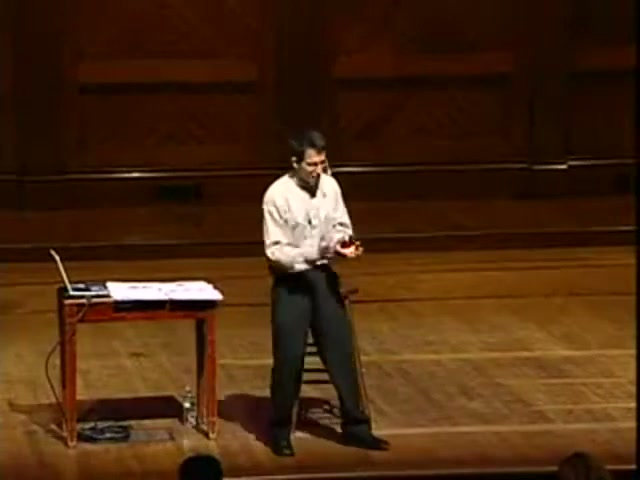
He then explains why this belongs in a psychology course. The course takes the constrained view of psychology: our instincts and emotions, shaped by evolution (or by God, he allows), will not change within our lifetimes. The job is to understand them through research and introspection, then make the best use of them (42:08). He notes that people are not always consistent: someone can hold the constrained view in politics and the unconstrained view in psychology.
The political mapping in the table is Ben-Shahar’s quick summary of Sowell, and he himself says it holds “not always”. The psychological claim is what matters for the rest of the course.
43:44 – 48:25 The permission to be human
He gives three reasons for choosing this case study: it shows Sowell’s idea working in psychology, he considers it one of the pillars of well-being, and it corrects a common misunderstanding of positive psychology. The story behind it: in the course’s first year, when it had six students, a student told him over lunch that his roommates were taking the class and that he would report back to them if he ever saw Ben-Shahar unhappy.
His answer to the class became a signature line: only two kinds of people never feel painful emotions such as envy, anger, sadness or anxiety, and they are psychopaths and the dead (45:45). It is a joke with a serious point. Babies move freely between laughing and crying. Adults, more aware of being watched and judged, stop allowing themselves the lows, and he argues that this costs them energy, creativity, happiness and eventually success.
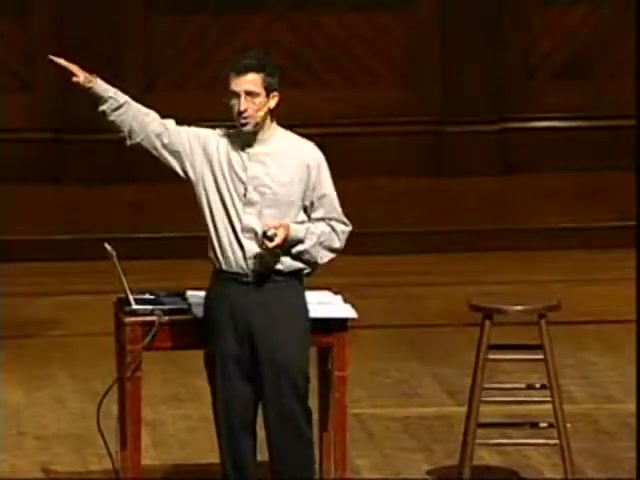


48:25 – 53:05 Envy, pink elephants and stage fright
He makes clear that he is not suggesting adults behave like the baby. What everyone needs is a safe space for unconditional acceptance: with close friends, with family, and first of all with themselves, for example in a journal.
His personal story: when his first son was born, the pediatrician’s only advice was to expect every kind of emotion, in extreme form, in the months ahead. A month later Ben-Shahar caught himself envying the baby for getting all the attention, and minutes later felt a love he had never felt before. Instead of calling himself a hypocrite, he remembered the advice and let both feelings be.
The research behind this comes from Daniel Wegner, the Harvard psychologist known for work on ironic processes: trying to suppress a thought makes it come back more strongly. Ben-Shahar runs the classic demonstration, telling the hall not to think of a pink elephant (51:02). He applies it to his own stage fright: telling himself “don’t be nervous” before lectures made it worse. After reading Viktor Frankl, the psychiatrist who developed “paradoxical intention” (deliberately allowing or even inviting the feared symptom), he started letting himself be nervous, and the nerves became manageable.
Listen for his deadpan claim that, thanks to this approach, his nerves now go away “within as little as three hours” into a lecture. It is a joke.
53:05 – 58:20 Emotions as gravity, and the “great deception”
The central analogy: imagine refusing every morning to accept the law of gravity. You would not survive long, and if you did you would be constantly frustrated. Instead we accept gravity and even build games on it, such as football and basketball. Painful emotions, he says, are as much part of human nature as gravity is of physics, so Bacon’s motto applies: nature, to be commanded, must be obeyed (55:09).
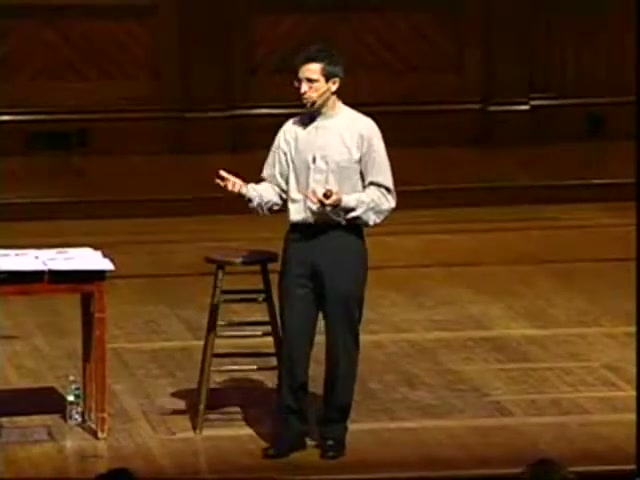
He then names a cultural habit “the great deception”: everyone answers “fine, great” when asked how they are, so each person assumes they are the only one struggling and joins in. He links this pattern to high depression rates on campuses and repeats a figure of 45% from the first lecture. That link is his interpretation, not a measured cause. He also says this does not mean pouring out your life story in the elevator of William James Hall, Harvard’s psychology building. The permission belongs in a safe space, not everywhere.
58:20 – 63:38 Active acceptance, the ABC, and “reality psychology”
Ben-Shahar separates permission to be human from resignation. “I’m depressed, that’s my nature, nothing to do” is not what he means. He calls his version active acceptance and illustrates it with the ABC of psychology on the blackboard: Affect (emotion), Behaviour (action) and Cognition (thought). Unconditional acceptance applies to affect. Envy of a best friend is human and does not make you a bad person; whether you then act generously or meanly is a moral choice. Thoughts are open to change too: ruminating on painful feelings does not help, while writing or talking about them does. Cognitive behavioural therapy and reframing come later in the course.
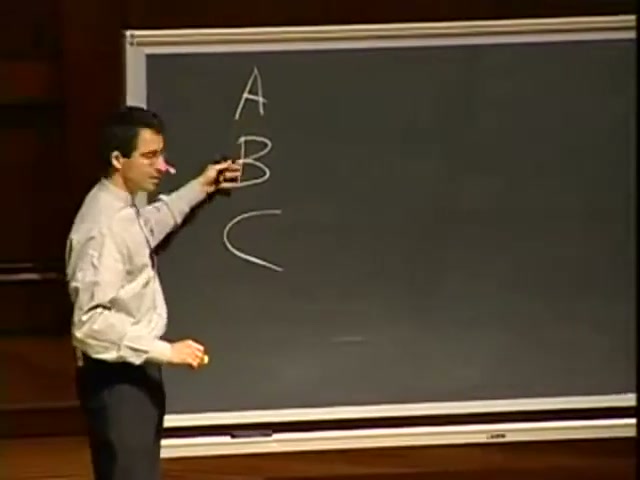
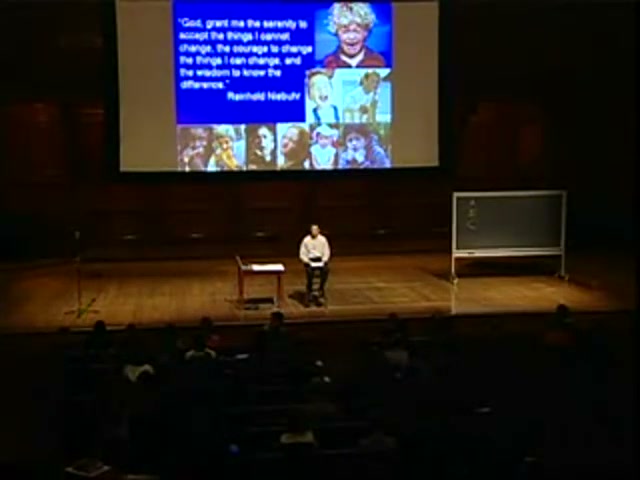
He then says the course might better be called “reality psychology” (60:56): it shifts attention toward what works without pretending painful emotions disappear. The goal is a stronger psychological immune system. Very happy people still get sad and anxious; they recover faster. He closes the section with the Serenity Prayer, which he notes is the motto of the Alcoholics Anonymous movement: serenity to accept what cannot be changed, courage to change what can, and the wisdom to know the difference. That wisdom, he says, can come partly from research and introspection.
63:38 – 76:17 A guided meditation on accepting emotions
The lecture ends with a group meditation, optional for anyone uncomfortable. Ben-Shahar sits on a stool and talks the hall through it. Sit upright, feet flat, eyes closed. Breathe deeply into the belly and out slowly. Then turn attention to whatever emotion is present, whether calm, boredom, anxiety or joy, and let it pass through without judging it. Next, picture yourself walking out of class through the Yard with all your feelings accepted. Last, imagine what life would be like if you really gave yourself the permission to be human.
He closes by asking students to remind themselves once or twice a day to give themselves the permission to be human, and to give it to others too.
Try this
These are the practices Ben-Shahar sets out or recommends in this lecture, in my own words. The first and last are his explicit requests; the others he presents as examples to follow.
- Daily permission check. Once or twice a day, notice what you are feeling and tell yourself it is allowed, especially envy, anger, sadness or nerves. Then decide separately what to do about it (1:15:38).
- Have one safe space. Pick a place where you do not have to say “fine”: a journal, a close friend, family. Use it to say how you actually are (48:25).
- Write instead of ruminate. When a painful feeling keeps circling, write it down or talk it through rather than replaying it in your head (60:24).
- Start a small chain. Make three or four people feel good each day: a sincere compliment, a favour, a smile. Do it for its own sake, not because the exponential maths guarantees results (9:20).
- Check your expectations. Name one goal you are working toward, then ask whether you are expecting it to make you happy (the wrong expectation) or whether you enjoy the effort anyway (34:13).
- Redo the meditation. Sit upright, breathe slowly into your belly for a few minutes, then notice whatever emotion comes up and let it pass without judging it. The section from 1:03:38 works as a recording you can follow.
- For enrolled students: the final project. The course’s final assignment is to teach what you have learned to other people, on the Pay It Forward model (15:45).
Skip list
- 0:00 – 2:00 The Valentine’s Day song. Charming, no content.
- 16:45 – 19:40 The Pay It Forward trailer. The idea is stated before and after it.
- 30:38 – 31:08 A Harvard T-shirt joke and an aside to students from Korea.
- 1:03:38 – 1:15:05 The guided meditation. Skip it if you are reviewing ideas; do not skip it if you want to try the practice, since it is the most practical part of the lecture.
Key terms
- Power of one: Ben-Shahar’s name for the idea that a single person can start large change, because influence spreads through networks exponentially.
- Minority influence: research showing that a consistent minority, even one person, can shift a group’s views.
- Subjective well-being: psychologists’ technical term for happiness as people report it themselves.
- Affective forecasting: predicting how future events will make us feel. People reliably overestimate how strongly and how long they will react.
- Base level (set point): the level of well-being people tend to return to after good or bad events; the return itself is usually called hedonic adaptation.
- Right versus wrong expectations: Ben-Shahar’s distinction between expecting outside achievements to make you happy (wrong) and expecting change to come from perception and interpretation (right).
- Constrained and unconstrained visions: Thomas Sowell’s two views of human nature, as fixed and to be channelled, or as open to improvement.
- Permission to be human: accepting painful emotions as a natural part of being human rather than suppressing them.
- Ironic processing: Daniel Wegner’s finding that trying to suppress a thought makes it more frequent.
- Paradoxical intention: Viktor Frankl’s technique of allowing, or even inviting, the symptom you fear.
- The great deception: everyone saying “fine” in public, so that each person feels alone in struggling.
- Active acceptance: accepting feelings while still taking responsibility for behaviour and thoughts; the opposite of resignation.
- ABC of psychology: affect (emotion), behaviour (action), cognition (thought).
- Psychological immune system: the capacity to recover from painful emotions. Happy people still get sad, but recover faster.
FAQ
What is Harvard Positive Psychology Lecture 4 about?
Despite the uploader's title, it is not mainly about environment. Ben-Shahar finishes laying out the course's basic premises: one person can start large change because influence spreads exponentially; external events such as tenure, lottery wins or a Harvard acceptance letter move happiness only briefly; and human nature is better accepted and channelled than fought. He then applies that last idea to emotions under the heading "permission to be human" and ends with a guided meditation.
What does Tal Ben-Shahar mean by "permission to be human"?
Accepting painful emotions such as envy, anger, sadness or anxiety as a normal part of human nature instead of trying to suppress them. He argues that suppression makes those feelings stronger, while acceptance lets them pass. The acceptance applies to feelings only; what you do and how you think about the feelings are still open to change.
Does winning the lottery make people happier?
The lecture cites Philip Brickman's 1978 study as showing that lottery winners end up roughly as happy as before. The original study was a one-time comparison of winners, accident victims and a control group rather than a long follow-up, and accident victims did report somewhat lower happiness, so Ben-Shahar's version is a simplification of a real and well-replicated pattern: people adapt to big changes faster than they expect.
What are the constrained and unconstrained visions?
They are Thomas Sowell's labels for two views of human nature. The constrained vision holds that our basic nature is fixed and the job of institutions is to channel it toward good ends; the unconstrained vision holds that human nature can be improved or perfected. Ben-Shahar says the course takes the constrained view when it comes to psychology.
Is positive psychology about always feeling good?
Ben-Shahar says no. He jokes that the only people with no painful emotions are psychopaths and the dead, and says the course might better be called "reality psychology". The aim is a stronger psychological immune system: still feeling bad at times, but recovering faster.
Studying another course? Paste its YouTube or Bilibili link on the home page to request a handout — or make your own with the desktop app (coming soon).