Harvard Positive Psychology Lecture 3, Is Happiness Random? — notes and timestamps
Watch the video (83 min)
Watch the original video on YouTube
The full transcript isn't available yet.
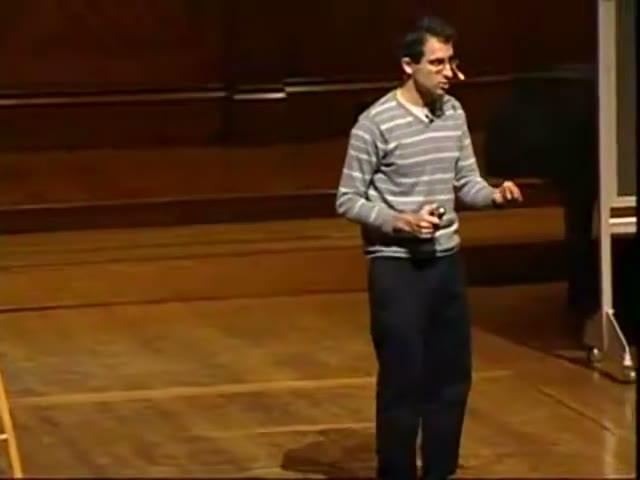
This is Lecture 3 of Tal Ben-Shahar’s Positive Psychology course (Harvard PSY 1504). The course is best known from its 2006 run, but this recording appears to date from around 2008. The video here is a re-upload of the classroom recording by a YouTube channel called “anonymous anonymous”. It is not an official Harvard channel, and this page is not affiliated with Harvard, Ben-Shahar or the uploader. The uploader’s title asks “Is happiness a random phenomenon?”, but that question only takes up the middle of the lecture. The first half finishes the case for positive psychology from Lecture 2: why removing misery does not create happiness, and why building strengths also protects against illness. The second half starts the course’s five “premises”. It covers the first two: knowledge has to be put to use (be a “practical idealist”), and people can change. The twin study, the error of the average and Maslow’s “growing-tip statistics” all serve that second premise. The course index lists every lecture; Lecture 4 continues the premises.
These notes summarize and comment on the lecture. Where Ben-Shahar cites a study, the notes say who ran it and what it found, and flag where his numbers or dates differ from the published record.
Key takeaways
- Questions shape what you see. Asking “what works, and why do some people succeed?” finds things that asking “what is wrong?” misses. Marva Collins is his model (3:11).
- Happiness is not just the absence of unhappiness. Curing indigestion does not make you enjoy a meal; the disease model’s best result is zero (6:48).
- Building strengths is also prevention. Following Seligman and Maslow, he argues that meaning, relationships and optimism act like a “psychological immune system” (15:07).
- Good intentions are not enough. Idealists who ignore research can do harm, as with indiscriminate praise or simply putting rival groups in a room together (42:27).
- Change is possible. Twin studies show genes matter a lot, but reading “you can’t change” from group averages is the “error of the average” (54:03).
- Study the best, not only the average. Maslow’s growing-tip statistics: learn from the outliers, including your own best moments (1:04:38).
- Even huge, well-funded programs can backfire. The Cambridge-Somerville Youth Study left its treated boys slightly worse off on some measures (1:15:40).
Chapter notes
0:00 – 6:48 Recap: questions create reality
After a short greeting and news about sectioning (the teaching fellow he names, Shawn Achor, later became known for his own books on happiness), Ben-Shahar picks up where Lecture 2 stopped. He had given three reasons positive psychology needs to be its own field, rather than a few extra studies inside the usual research. His starting figure is a ratio of about 21 studies on depression and anxiety for every one on happiness and well-being. He wants to shift that balance, not reverse it.

The first reason is that the questions we ask decide what we notice. He links back to the class exercise where most students counted shapes on a screen and missed the children on the bus. His main example is Marva Collins, a Chicago schoolteacher who opened her own school for children other schools had given up on. The usual question in her district was how to keep students in school and away from gangs. Hers was how to cultivate the “seed of greatness” in each student. He calls this the salutogenic question: what is the source of health and success, not only of illness? The term comes from the medical sociologist Aaron Antonovsky.

A caution from me, not from the lecture: Collins is a powerful story, but she is one teacher. Ben-Shahar uses her as an illustration of a research approach (study the people who succeed), not as evidence on her own.
6:48 – 15:07 Happiness isn’t the negation of unhappiness
The second reason: getting rid of depression or anxiety does not by itself make someone happy. His analogy is food. Indigestion stops you enjoying a gourmet meal, so you treat it first, but curing it does not serve you the meal. He draws a line with painful states below zero (anxiety, depression, anger) and positive states above it (joy, satisfaction, excitement). Traditional psychology mostly works on the part below zero. He brings in Thoreau’s line about lives of “quiet desperation” and the Pink Floyd song “Comfortably Numb” to describe people who are not ill but are not thriving either.
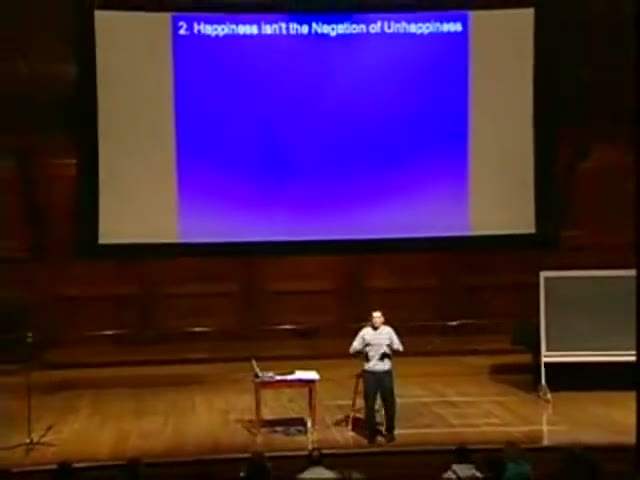
He then sets the disease model against the health model. A Gallup poll he cites found that most people, across countries, believe they should mostly work on their weaknesses. He thinks that is a mistake: people who focus more on their strengths are, he says, both happier and more successful over time. He also contrasts two people who both work 80-hour weeks. One is running away from problems at home, the other loves the work. From outside they look the same; from inside they feel very different.
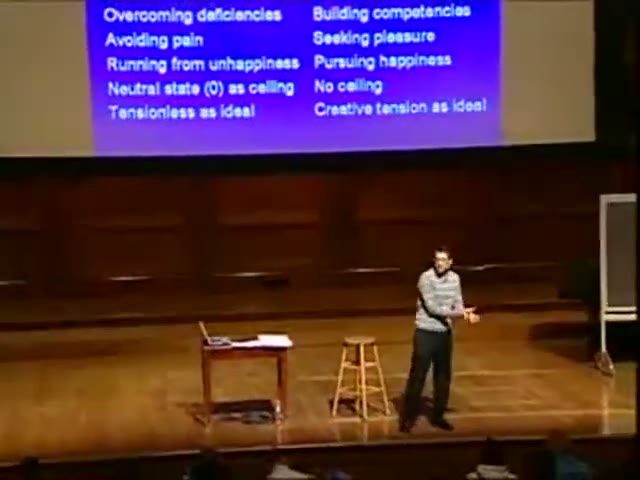
He admits the health model is a bit frightening. It has no ceiling and, at the time, far fewer research-based prescriptions than the treatment of depression. That gap is his reason for the field to exist.
15:07 – 25:43 Building strengths as prevention
The third reason is the most practical claim in the lecture: working on the positive also helps with the negative. He describes two models of illness. In the conventional one, you are ill because something is wrong, so remove it. In the positive one, you become ill partly because there is not enough health in your life: no meaning, weak relationships, nothing you are pursuing. He makes a deliberate joke of the first model (“we are sick because we are ill”) and pauses as if it were profound.

He backs this with Martin Seligman, the University of Pennsylvania psychologist who launched positive psychology as a movement when he was president of the American Psychological Association. Seligman’s argument, read out at length, is that fifty years of the disease model did little for prevention. The progress came from building competence. Strengths such as courage, optimism, hope and interpersonal skill act as buffers, and teaching optimism, Seligman reports, roughly halved later depression and anxiety in his programs. Ben-Shahar stresses that Seligman says “also”, not “instead”.
He ends with two images. One is the psychological immune system, a phrase he credits to the psychotherapist Nathaniel Branden: you still get sick, but less often, and you recover faster. The other is an engine: a bigger one gets the car up a steep hill without breaking down. That is the course’s recurring word, capacity.
25:43 – 29:49 Back at Harvard
He brings this back to campus. A 2004 Harvard Crimson article, shown in Lecture 2, called for more mental-health resources. He agrees, but argues that money should also go to helping students find their passions, sense of meaning and strengths, and resist outside pressure. These are skills that, as he puts it, almost no school anywhere teaches. He praises Harvard’s Bureau of Study Counsel, which he has used himself.

He closes the case with a summary statement of the movement (from Seligman’s writing): psychology has been “deformed” by studying only damage. Treatment should include “building what is right”. The approach must stay scientific rather than wishful thinking. The final phrase is the course’s motto: bridging the “Ivory Tower” and “Main Street”.
29:49 – 34:55 The five premises at a glance
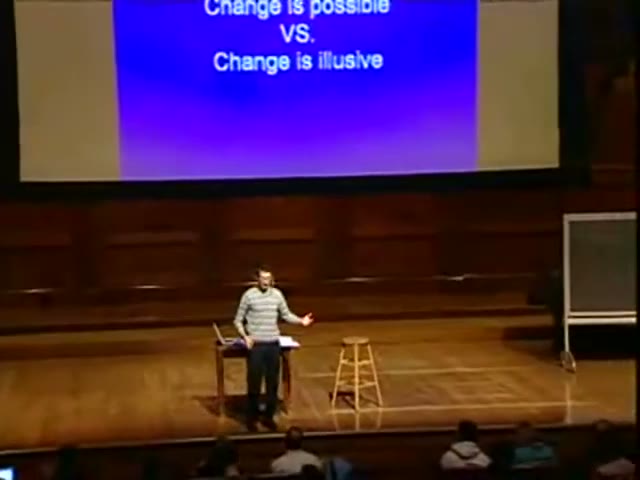
The next few lectures set out five premises. Each is presented against its opposite so the course’s position is clear from the start, and the course builds on them like a spiral:
| Premise the course argues for | Its opposite |
|---|---|
| Bridge-building between disciplines, and between academia and everyday life | Specialization |
| Change is possible | Change is illusive |
| Internal factors mainly decide happiness | External circumstances mainly decide it |
| Human nature must be obeyed (accepted and worked with) | Human nature should be perfected |
| Happiness is the ultimate end, and that is a moral claim | Happiness is a secondary pursuit |

The last two premises are the most controversial, and he says so. They are left for the next lecture. Here he covers only the first two.
34:55 – 42:27 Premise 1: be a practical idealist
Bridge-building means academia should not shield itself from the world. He quotes the philosopher Alfred North Whitehead: a university that keeps away from action chills interest and defeats progress, and “celibacy does not suit a university”. He also describes a “second psychology” that leaves the lab, tests ideas in real settings and brings the lessons back. The captions do not catch whose idea that is.

For students who will not become academics, his message is that the world needs practical idealists. He rejects the “me generation” stereotype: about 1,800 Harvard students a year volunteer with the Phillips Brooks House Association (Harvard’s student-run public service group), and graduates give a lot of time and money. He then defends Americans as the world’s most generous people, by money and by volunteering hours. These are his figures, given without a source in the lecture, and the passage is more a pep talk than an argument.
42:27 – 54:03 Good intentions are not enough
Here is the catch. Former students tell him they did everything with good intentions and still feel they fell short. His diagnosis: idealism without research can waste effort or cause harm. He gives a series of cases where the research exists but practice ignores it:
- The Pygmalion effect: teachers’ expectations become self-fulfilling prophecies (the classic study is Robert Rosenthal and Lenore Jacobson’s 1968 Pygmalion in the Classroom). He wants every trainee teacher to learn about it, and about Marva Collins, on day one.
- Self-esteem and praise: praising children indiscriminately can hurt in the long run. He points ahead to Carol Dweck, the Stanford psychologist known for her research on praising effort rather than fixed ability.
- Self-efficacy: Albert Bandura’s (Stanford) work on people’s belief that they can succeed at a task.
- Mind and body: he claims yoga in prison cut reoffending more than other programs tried, that meditation physically changes the brain, and that 30 minutes of exercise three times a week works as well as “our most powerful psychiatric drugs”. The exercise claim most likely refers to Duke University trials comparing exercise with an antidepressant for depression. “Most powerful” is his overstatement, and the yoga claim has no source in the lecture.
- Conflict resolution: Muzafer Sherif’s 1954 Robbers Cave experiment found that just putting hostile groups together (the “contact hypothesis”) often made things worse. What worked was a superordinate goal that the groups could only reach together, an idea Elliot Aronson later used in his “jigsaw classroom”.
He admits research often brings bad news: getting people to talk, or praising kids, would be easier. His analogy is an aeronautical engineer who would rather ignore gravity. Ignoring evidence because it is inconvenient gives you planes that crash. The message is to follow both heart and mind. He ends by putting responsibility on the students: “no one is coming.”
54:03 – 1:04:38 Premise 2: change is possible
Change matters because without it there is no reason for the course. In psychology, he says, it is far from a trivial claim. His foil is the Minnesota twin research: identical twins separated at birth and raised apart turned out strikingly similar in personality and in happiness. He tells the story of one pair reunited in their late thirties who had married wives with the same name, drank the same beer and gave their children the same names. This is most likely the famous “Jim twins”, though the details have grown in the retelling.
From this work David Lykken and Auke Tellegen, University of Minnesota psychologists, wrote the paper “Happiness Is a Stochastic Phenomenon”. It ends by suggesting that trying to be happier may be as futile as trying to be taller. Ben-Shahar dates it to the 1980s; it was actually published in Psychological Science in 1996. The line got wide press coverage, and he calls it harmful.
His reply has three parts:
- Counter-evidence. People change through therapy, through a single sentence or book (he credits Albert Bandura with research on chance encounters that change lives), and through experience. Besides post-traumatic stress there is post-traumatic growth (a term from the psychologists Richard Tedeschi and Lawrence Calhoun).
- The error of the average. Most twin pairs were very similar, but not all of them, and the exceptions are what show how change happens. His joke: a statistician drowns in a pool whose average depth is ten inches.
- The cost of the message. An unhappy eight-year-old who reads that her happiness is genetically fixed may become helpless as well, and so prove the claim. He offers himself as an example: “not born with happy genes”, inclined to anxiety and rumination, and happier now than fifteen years earlier.
The kicker: in TIME magazine’s 2005 issue on happiness, Lykken said he had made “a dumb statement” and that happiness levels can change.
My note: the twin research does show that genes account for a large share of the differences between people in well-being. Ben-Shahar accepts this (“genes do matter and they matter a lot”). His claim is narrower than it sounds: heritable does not mean fixed.
1:04:38 – 1:15:40 Growing-tip statistics: study the best
If the first principle of good research is “study what works”, the second is “study what works best”. Maslow called this growing-tip statistics, after the tip of a plant where growth happens. If you want to know how fast humans can run, you study Olympic champions rather than averaging a sample, and the same holds for moral or spiritual growth. Maslow’s sharpest line, which Ben-Shahar reads out, is that what psychology calls “normal” may be a “psychopathology of the average”.
He admits this feels elitist and that it still makes him uneasy. He gives two answers. It is “also”, not “instead of”, studying the average. And the average person gains most from it. His examples:
- Resilience research got nowhere while it studied the average at-risk child, and moved forward when it studied the “super kids” who did well anyway.
- Meditation: researchers studied long-practising monks rather than a random sample of sophomores. Jon Kabat-Zinn (who created mindfulness-based stress reduction), Richard Davidson (a neuroscientist who scanned monks’ brains) and Herbert Benson (a Harvard cardiologist who described the “relaxation response”) then brought what they learned to everyone else.
- Relationships: the historical average marriage subjugated women. John Stuart Mill’s unusually equal marriage informed The Subjection of Women (1869). Ben-Shahar calls it “subjugation”; the book’s title says “subjection”.
- Teaching: study Marva Collins, not the average teacher.
He then turns the idea inward: study your own best moments. Studying your average only describes your life; studying your best moments can suggest what to do next. Maslow, again, points to the “peak moments” of ordinary people.
1:15:40 – 1:22:30 The Cambridge-Somerville Youth Study
To close he asks whether social change is possible, using one of the best-known cautionary studies in the field. Starting in the late 1930s near Harvard and MIT, experts designed what he calls a “Rolls-Royce” program for at-risk boys. It included regular visits from counselors, tutoring, psychiatric care and youth clubs, for about five years. A control group was assigned at random and tracked for decades. (His aside that “there wasn’t a Rolls-Royce then” is a slip: the company dates from 1906.)

The results: no difference in juvenile or adult offenses, or in physical or mental health. The only significant differences went “in the wrong direction”: more alcoholism and lower job status in the treated group. The people who ran the program had rated it highly. The long-term follow-up was published by the criminologist Joan McCord in the late 1970s. Ben-Shahar’s group sizes (250 each) and “40 years” are rounded.
He does not conclude that social change is impossible. He points to programs that work, such as the Penn Resiliency Program by Karen Reivich and Seligman, and to Collins. He also suggests what may have made the difference: “hard love” rather than a free lunch, and not labelling children as needy. The final call quotes Maslow on “Manhattan-Project-type” attacks on the big human problems. That means bringing the best minds together, as Oppenheimer, Szilard, Fermi, Feynman and Bohr were brought together, while setting aside whether the bomb itself was right.
Try this
Ben-Shahar sets no formal assignment in this lecture, but he gives several applications. Here they are as exercises:
- Ask the salutogenic question about a problem you have. Instead of “why does this keep going wrong?”, ask “when has this gone well, and what was different then?” Write down three answers.
- Study your personal best. Pick one period when you were at your happiest or most effective. List what you were doing, with whom, and how you spent your days. Look for one element you could bring back this week.
- Check one weakness-fixing plan. For a goal you are working on, ask whether you are only “overcoming deficiencies” or also “building competencies”. Add one action that uses a strength.
- Test one good intention against evidence. Pick something you do to help others, such as praising a child, mediating a conflict or volunteering, and look up what the research says about whether it works.
- Watch the error of the average in your own thinking. When you catch yourself saying “people like me don’t change”, find one counter-example, someone who did, and ask how they did it.
Skip list
- 0:00 – 1:11 Greeting and section sign-up logistics.
- 39:46 – 42:06 The passage on Harvard volunteering and American generosity statistics. It is a morale boost, not part of the argument.
- 1:22:30 – 1:22:59 End of recording.
Key terms
- Salutogenesis — studying the sources of health rather than only the causes of disease (Aaron Antonovsky’s term).
- Disease model / health model — fixing what is wrong (best result: zero) versus building what is right (no ceiling).
- Psychological immune system — inner resources that make setbacks less frequent and recovery faster.
- Practical idealist — someone who joins good intentions to research about what actually works.
- Contact hypothesis / superordinate goal — the idea that contact alone reduces conflict, versus Sherif’s finding that groups need a shared goal they can only reach together.
- Happiness as a stochastic phenomenon — Lykken and Tellegen’s claim that well-being is largely genetic and mostly random around a set point.
- Error of the average — Ben-Shahar’s term for concluding “no one can change” from group averages that hide individual change.
- Growing-tip statistics — Maslow’s call to study the best cases in order to learn what humans can do.
- Post-traumatic growth — positive change that some people report after a crisis.
FAQ
Is happiness random, according to Tal Ben-Shahar's Lecture 3?
No. He takes on the 1996 paper by David Lykken and Auke Tellegen, "Happiness Is a Stochastic Phenomenon", which used twin data to argue that happiness is largely set by genes. His reply is that genes matter a lot but do not decide everything: averages hide the individuals who did change, and Lykken himself later told TIME that his line about happiness being as hard to change as height was a mistake.
What is the "error of the average"?
It is Ben-Shahar's name for concluding that change is impossible because a group, on average, does not change. His joke is the statistician who drowns in a pool whose average depth is ten inches. The outliers who did change are the interesting cases, because they show how change happens.
What are growing-tip statistics?
Abraham Maslow's term for studying the best cases rather than the average: Olympic runners if you want to know how fast humans can run, the most mature people if you want to know about moral growth. Ben-Shahar adds that you can do the same with your own best moments, and argues that ordinary people gain the most from this kind of research.
What was the Cambridge-Somerville Youth Study?
A large delinquency-prevention program for at-risk boys in the Cambridge and Somerville area of Massachusetts, started in the late 1930s, with a randomly assigned control group and decades of follow-up. Ben-Shahar uses it as a warning: on crime and health the treated group did no better, and on alcoholism and job status it did worse.
What are the five premises of Harvard's positive psychology course?
Ben-Shahar lists them as pairs: bridge-building versus specialization, change is possible versus change is illusive, internal factors versus external circumstances as the main source of happiness, accepting human nature versus trying to perfect it, and happiness as the ultimate end versus a secondary goal. This lecture covers the first two; the rest come in Lecture 4.
Studying another course? Paste its YouTube or Bilibili link on the home page to request a handout — or make your own with the desktop app (coming soon).