GTC 2026 physical AI: robotaxi partners, Isaac Lab, Newton and Olaf
Watch the original video · 139 min
This segment runs from 2:05:26 to about 2:14:43 of the GTC 2026 keynote. Jensen Huang moves from digital agents to physical ones: new automakers for NVIDIA’s robotaxi platform, a bigger Uber deal, the simulation stack for training robots, and a stage appearance by Disney’s Olaf robot. It is the part to watch if you follow autonomous driving, industrial automation or humanoid robotics, and it also explains why NVIDIA treats simulation compute as a substitute for real-world data.
Key takeaways
- Four new robotaxi automakers named on stage. Jensen lists BYD, Hyundai, Nissan and Geely; the official release lists BYD, Geely, Isuzu and Nissan (2:06:55).
- Uber expands to a dated rollout. NVIDIA full-stack robotaxis launch on Uber in Los Angeles and the San Francisco Bay Area in the first half of 2027, reaching 28 cities by 2028, per the release (2:07:19).
- Compute stands in for data. The robotics reel argues real-world data will never cover every edge case, so training data must come from simulation and world models (2:09:47).
- The training stack got version bumps. The release announced Isaac Lab 3.0 in early access built on Newton 1.0, Cosmos 3, GR00T N1.7 with commercial licensing, and a GR00T N2 preview.
- Olaf is a Newton demo. Disney’s Olaf learned to walk in simulation with the Newton-integrated Kamino solver and runs on a Jetson computer (2:13:33).
Chapter notes
2:05:26 – 2:06:35 From digital agents to physical agents
Jensen sets up the section with NVIDIA’s three-computer model for robotics: one for training, one for synthetic data generation and simulation, and one inside the robot. He says there are 110 robots on site at GTC and that he cannot think of a robotics company not working with NVIDIA. The 110 figure is a stage claim not found in the official releases.
The framing is useful because it shows where NVIDIA earns money in robotics. It is not mainly the onboard chip, which sells in modest volumes today. It is the data-center training and simulation compute that every robot developer needs long before a product ships.
2:06:35 – 2:07:33 Robotaxi partners and Uber
Jensen says the ChatGPT moment for self-driving has arrived and announces four new partners for NVIDIA’s robotaxi platform: BYD, Hyundai, Nissan and Geely. He adds that these companies build about 18 million cars a year combined; that number was not in the official release. He lists earlier partners Mercedes-Benz, Toyota and GM.
The official release differs from the stage list in one name. It says BYD, Geely, Isuzu and Nissan are building level 4-ready vehicles on the Hyperion platform, with Nissan’s program powered by Wayve software and Isuzu working with TIER IV on an autonomous bus. Hyundai appears on stage and on the stage backdrop but not in that release, so readers tracking contracts should rely on the release wording.
The Uber news has more concrete dates than in 2025. A fleet running NVIDIA’s full DRIVE AV software will launch on Uber across 28 cities on four continents by 2028, starting with Los Angeles and the San Francisco Bay Area in the first half of 2027. The release also names Bolt, Grab and Lyft as Hyperion users, introduces the Halos OS safety architecture, and launches the Alpamayo 1.5 reasoning driving model.
2:07:33 – 2:08:36 Factory robots and robotic cell towers
Jensen names ABB, Universal Robots and KUKA as industrial partners integrating NVIDIA physical AI models into simulation, so robots can be validated before going onto production lines. The robotics release adds FANUC and YASKAWA and says these four arm makers have an installed base of more than 2 million robots.
He also mentions Caterpillar and T-Mobile. The T-Mobile point is that cell towers become AI-RAN base stations on NVIDIA Aerial that adjust beamforming to save energy while keeping signal quality. Calling a tower a “robot” is a stretch, but it shows how broadly NVIDIA now defines physical AI: any system that senses and acts in the real world.
2:08:36 – 2:11:40 Closing the data gap: Alpamayo, Isaac Lab, Newton, Cosmos
A short video shows a Mercedes-Benz car running Alpamayo, explaining its own lane changes in natural language and accepting a voice request to drive faster. Reasoning traces matter for safety review: an engineer can see why the car acted, not only what it did.
The robotics reel then makes the section’s main argument. The real world has too many edge cases for collected data alone to cover, so developers pre-train on internet-scale video and human demonstrations, then generate post-training data with classical and neural simulation.
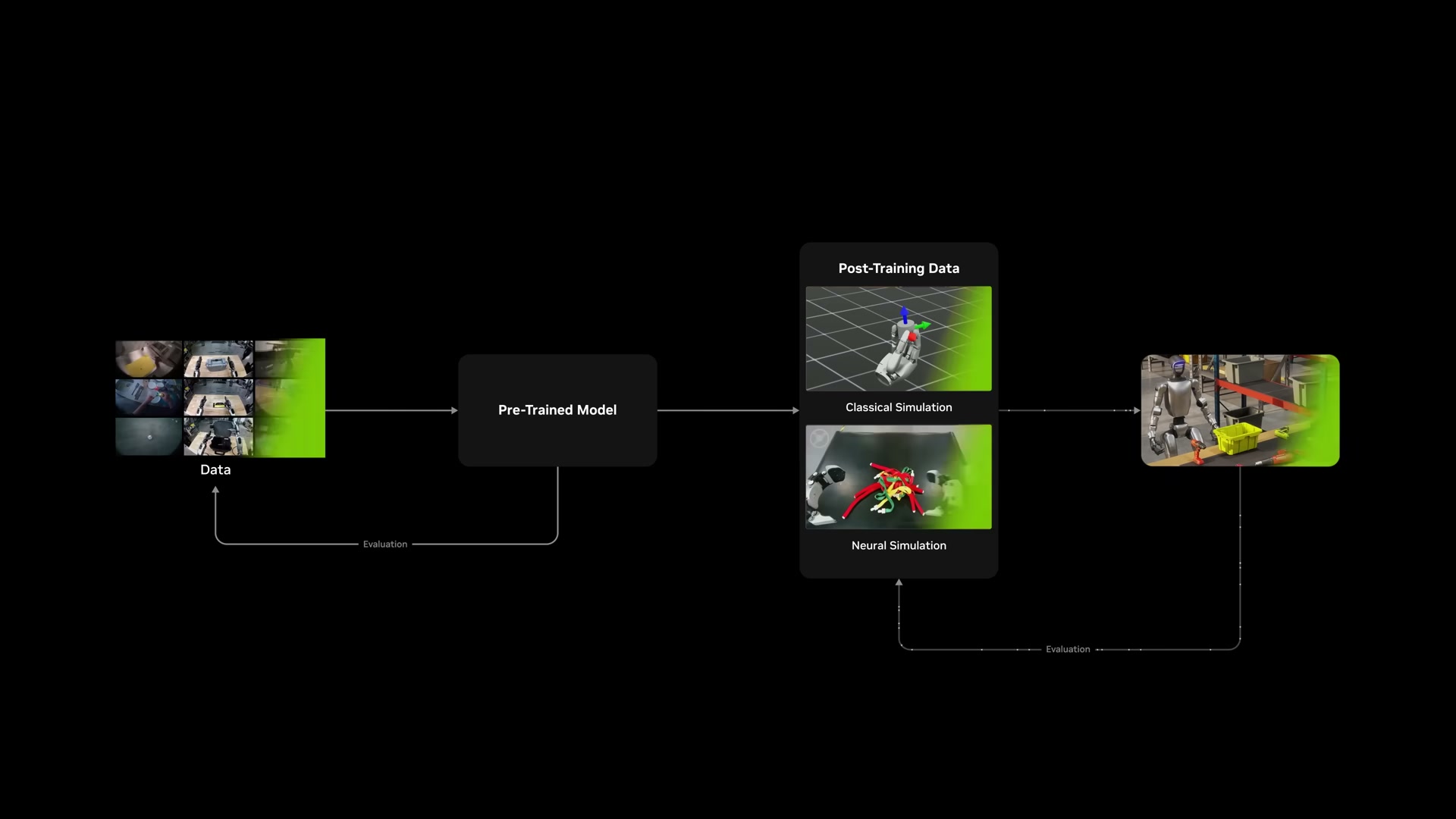
The diagram maps each NVIDIA product to a stage. Isaac Lab is the open framework for robot training, evaluation and simulation. Newton is the GPU-accelerated, differentiable physics engine for the classical-simulation box. Cosmos world models fill the neural-simulation box. GR00T is the robot foundation model that reasons and outputs actions. The pitch is that more compute can stand in for real-world data collection, which is slow, expensive and sometimes dangerous.
The reel names customers using this stack: Peritas AI for operating-room assistants, Skild AI for post-training data, Humanoid for whole-body control, Hexagon Robotics, Foxconn and Noble Machines. Disney Research uses Kamino, its simulator inside Newton, with Isaac Lab to train all its character robots.
2:12:46 – 2:14:43 Olaf on stage
Disney’s Olaf walks out and banters with Jensen. The technical content is short. Olaf runs on a Jetson computer, learned to walk in Omniverse, and relies on the Newton solver built on NVIDIA Warp with Disney and Google DeepMind. The release adds detail the stage skipped: the Kamino simulator trained Olaf to manage its own heat and reduce impact noise, and Olaf was due to debut at Disneyland Paris on March 29, 2026.
What changed since GTC 2025
GTC 2025 (March 18, 2025) launched much of this stack in first-version form. NVIDIA announced Isaac GR00T N1 as the first open humanoid foundation model, and said it was developing Newton with Google DeepMind and Disney Research, expected later in 2025. Disney’s BDX droids joined Jensen on stage. On cars, NVIDIA announced the Halos safety system and a GM partnership covering vehicles, factories and robots. No robotaxi platform was announced at GTC 2025.
Comparing the two years:
- Newton shipped. In 2025 it was announced as under development. In 2026 the release cites Newton 1.0 as the base of Isaac Lab 3.0, and Disney’s Kamino runs inside it. That is a promise kept.
- GR00T matured. N1 was a research release. N1.7 now has commercial licensing, and N2 is previewed for year-end 2026.
- Halos grew from a system into an OS. The 2025 Halos announcement was a bundle of safety tools; 2026 adds Halos OS as a three-layer safety architecture for level 4 on Hyperion.
- Robotaxi went from absent to central. The Uber partnership was first announced at GTC Washington, D.C. in October 2025, with a 100,000-vehicle target starting in 2027. GTC 2026 added the 28-city, four-continent scope and the first two launch markets.
- The stage robot changed from BDX droids to Olaf, both trained on the same Disney-NVIDIA simulation lineage.
Skip list
- 2:08:36 – 2:09:40: the Alpamayo in-car video. Worth one viewing, but the takeaway is in the notes above.
- 2:11:40 – 2:12:46: robot montage with music and no narration.
- 2:14:43 onward: the wrap-up handoff and closing song.
Glossary
- Physical AI — AI that perceives and acts in the real world, such as robots, cars and industrial machines.
- Hyperion — NVIDIA’s reference compute and sensor platform for level 4 vehicles, renamed from DRIVE Hyperion in September 2026.
- Level 4 — Driving automation where the car handles all driving within a defined area without a human fallback.
- Isaac Lab — NVIDIA’s open-source framework for training and evaluating robot policies in simulation.
- Newton — An open-source, GPU-accelerated, differentiable physics engine co-developed by NVIDIA, Google DeepMind and Disney Research.
- Vision language action model — A model that takes images and instructions and outputs robot actions; GR00T and Alpamayo are examples.
For the model families behind GR00T, Cosmos and Alpamayo, see the Nemotron and open models page. The keynote notes cover the rest of the talk.
FAQ
Which automakers joined NVIDIA's robotaxi platform at GTC 2026?
On stage Jensen Huang named BYD, Hyundai, Nissan and Geely. NVIDIA's official release the same day lists BYD, Geely, Isuzu and Nissan building level 4 vehicles on Hyperion, with Nissan's program powered by Wayve software.
When do NVIDIA-powered robotaxis launch on Uber?
The March 16, 2026 release says a fleet running NVIDIA's full DRIVE AV software will launch with Uber across 28 cities on four continents by 2028, starting with Los Angeles and the San Francisco Bay Area in the first half of 2027.
What are Isaac Lab, Newton and Cosmos used for?
Isaac Lab is NVIDIA's open robot-learning framework, Newton is an open GPU physics engine co-developed with Google DeepMind and Disney Research, and Cosmos generates synthetic training data from world models. Together they produce training data in simulation instead of collecting it all from real robots.
What powers Disney's Olaf robot?
An NVIDIA Jetson computer runs onboard, and its walking policy was trained in simulation using Kamino, a Disney-built simulator on NVIDIA Warp that is integrated into Newton, plus Isaac Lab.